2025 was a memorable year for tourism in Kenya. Industry players say visitor numbers improved, air access expanded and visa reforms opened new markets. However, the sector was also rattled by abrupt policy shifts, climate stress and capacity gaps that exposed how sensitive tourism is to timing and long-term planning.
The Kenya Wildlife Service (KWS), for example, rolled out a new park fee payment system accepting only M-Pesa and Visa card payments, scrapping bank transfer options that many tour operators relied on for group payments. It also introduced an 8.5 percent processing fee for all card payments, a rate industry players say is high compared to other government platforms.
The Kenya Tourism Federation (KTF) also faulted KWS for using an exchange rate of Sh135 per US dollar, higher than the Central Bank of Kenya’s prevailing rate of about Sh129.5.
Industry players say the challenge was not the principle of revising fees, but the execution.
KTF chairman Fred Odek described the fee changes as the biggest operational disruption of the year.
“The biggest disruption we had was the change in the park fees. It was introduced midstream, and affected the already made bookings, which operators were now forced to either get out of pocket to pay for the incremental or go back to the agent to try and collect the money that was ready for the contract already signed,” Mr Odek said.
The tourism industry relies heavily on predictability, and the impact went beyond balance sheets.
The timing of the revision was particularly damaging in a year that had already shown strong potential for growth in international travel and access.
“The other disruption was when we had riots early in the year, and that affected the movement of tourists and also the access to the market,” he added.
Crowding in smaller parks
Despite the disruptions, Mr Odek said 2025 had been stronger than previous years, citing improved arrivals.
However, the growth exposed pressure points in domestic air capacity, with airlines struggling to meet demand on the Mombasa, Kisumu and Eldoret routes.
“They don't have enough equipment to run these destinations. We also need to look into that so that the tourism growth is seamless because you can't talk about growth and you don't have the actual equipment to run those kinds of flights,” he said.
As visitor flows shifted, pressure intensified on some parks, revealing unintended consequences of pricing decisions across the tourism ecosystem.
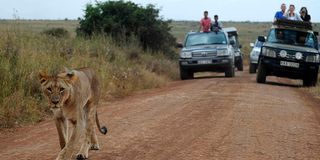
“We have an overuse in Amboseli National Park, and this has been caused by the increase in Maasai Mara park fees. Amboseli has been getting more tourists, and the problem is that it is a smaller park, and so they are unable to take that heavy movement of tourists into that area,” Mr Odek said.
While KTF has not recorded operational crises in major parks, Mr Odek said fears of drought pose another risk.
“If you look at the country, we are not getting rain, and that affects our parks, and mostly it will affect Tsavo East, Tsavo West and Amboseli. Those are normally very dry areas. We need to partner with the KWS and the donor community to figure out how to get water into those parks so that we don’t lose wildlife,” he said.
“If we don’t, it’s not just losing animals in terms of livestock, but we are going to lose a lot of wildlife here because of the drought.”
“2027, we are going into an election. We only have one stable year, which is 2026,” Mr Odek added.
Travel agents count the cost
From the perspective of travel agents, the year tested business models built on long-term certainty.
Nicanor Sabula, chief executive of the Kenya Association of Travel Agents (KATA), said it was a difficult year, particularly due to higher national park fees.
While the industry accepted the rationale for higher fees, the execution again proved problematic. In an industry driven by advance bookings, abrupt changes are destabilising.
“This industry thrives in long-term planning, because people book their holidays and travels in advance, so we usually need about three, up to sometimes six months, to be able to put together the itinerary and sell them. That has been a huge disruption to our businesses because it meant revising the itinerary,” Mr Sabula said.
He said agents were left to absorb the cost changes. In some markets, revising contracts midstream is not an option, forcing operators to take losses that affect business sustainability.
“When we compare ourselves with our competitors in the region, we are still priced slightly higher than the competition. The price-sensitive clients would opt for other options,” he said.
On connectivity, Mr Sabula described 2025 as transformative.
"We welcomed almost more than five international airlines that were flying into Nairobi. That has been fantastic. We have also seen increased frequencies for a number of international flights, so we are seeing newer flights coming into the market. That is a huge boost in terms of connecting the country to our soft market,” he said.
MICE seen as 2026 buffer
Looking ahead to an election-adjacent 2026, KATA is banking on diversification.
“We hope to sustain the growth since we have had some fantastic growth this year. I know we are always a sensitive market, particularly regarding elections, but we should be able to at least sustain 2026 and then get into the high-octane politics in 2027.”
The Meetings, Incentives, Conferences and Exhibitions (MICE) segment could help cushion the sector, Mr Sabula said.
“The beauty about the MICE market is that it is not as sensitive to the political environment as the leisure market. If we leverage our MICE industry, we should be able to go through the year more easily than the previous year.”
At the operator level, abrupt policy shifts also carried reputational risks. Minaz Manji, chief executive of Twiga Tours, said the reputational damage was more severe than the financial losses.
“We lost substantial amounts, and that sends a wrong signal to our overseas partners because for many of our incoming business, the majority of people will book at least a year or a year and a half in advance. As an example, we are actually taking bookings for 2027,” Mr Manji said.
Beyond pricing, Mr Manji pointed to mounting ecological pressure on Kenya’s flagship parks.
“Some of the parks in Kenya are now oversaturated. There's a tremendous pressure on all these parks because of over-commitment or overdevelopment of properties within those game reserves and game parks,” he said.
“As a result, we are finding that the human encroachment by way of not just the tourists, but also the outside areas where there are little settlements, unplanned settlements that are coming up, is causing difficulty or blocking the migratory routes,” he added.
“If we end up choking the Maasai Mara, for example, or even the Nairobi National Park, with development all around it, we will not be left with wildlife in its natural environment to be showcased to the rest of the world,” he said.