Nyakang’o steps up push to classify pending bills as public debt

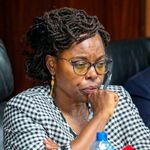
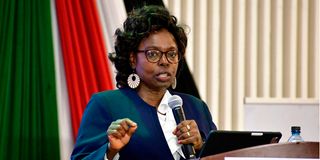
Margaret Nyakang’o

Controller of Budget Margaret Nyakang’o speaks during the 5th Legislative Forum held at the Edge Convention Center on March 18, 2025.

Photo credit: Francis Nderitu | Nation Media Group

The Controller of Budget (CoB) Margaret Nyakang’o is pushing for counties’ pending bills to be recognised as public debt, to allow for controls to be put in place to stem further growth and speed up their clearance.

She said that leaving the unpaid bills outside of legally recognised public debt has allowed counties to accumulate dues uncontrollably, threatening the prudent financial management of devolved units.
She is now calling for a legal review to include pending bills in the definition of public debt for counties, in addition to loans and securities as currently stipulated.

“Section 2 of the Public Finance Management (PFM) Act 2012 defines County Public Debt as 'all financial obligations associated with loans raised and securities issued by the county government.”

“When this section is examined alongside Sections 140 to 144 of the PFM Act 2012, it becomes clear that pending bills or payables are excluded from this definition of public debt,” Dr Nyakang’o says in her report on counties' budget implementation for the year ending June 2025.

She argues that the failure to include pending bills as  public debt has caused many counties to neglect debt management strategies on the basis that they do not have debts, despite accumulating pending bills in the billions of shillings.

She wants the law to be changed so that pending bills that remain unpaid for more than a year are considered public debt.

“The controller recommends amending the PFM Act 2012 to broaden the definition of county public debt to include pending bills (payables) beyond one financial year,” the report says.

The CoB reckons that considering pending bills as public debt would prevent counties from accumulating unpaid bills beyond 20 percent of their revenues and would oblige them to pay the debts as a first charge on their official accounts, where public funds watchdogs have control.

This is because the Public Finance Management (PFM) Act, 2012 states that “debt service payments shall be a first charge on the County Revenue Fund (CRF), and the Accounting Officer shall ensure this is done to the extent possible so that the county government does not default on debt obligations.”

The CoB approves all withdrawals by counties from CRFs after receiving requests detailing the reasons for the withdrawals. This allows her to monitor their compliance with settling pending bills.

Her calls come at a time when counties’ pending bills hit Sh176 billion in June 2025, constituting a third of the Sh533 billion revenues the devolved units had during the past fiscal year.

During the year to June, counties accumulated Sh48.88 billion in new unpaid bills while failing to honour payment plans made at the start of the year.

If the CoB’s proposal were to be adopted, pending bills valued at Sh127.9 billion would be considered part of the counties’ public debt.

As of June, 28 percent of the Sh176.8 billion in pending bills had accrued within the past year, 12 percent had been pending between one and two years, and 48 percent had been pending for over three years.

“The significant amount of bills under one year is concerning, especially since full disbursement of the Equitable Share for the financial year 2024/25 had been provided,” the CoB said.

Dr Nyakang’o faults counties for making commitments towards the end of the financial year without revenues, resulting in piling up unpaid bills.

“County treasuries are advised to settle outstanding debts using the first-in-first-out principle, in line with Regulation 55(1)(b) of the Public Finance Management (County Governments) Regulations 2015,” she says.

PAYE Tax Calculator

Note: The results are not exact but very close to the actual.