Kindiki office spends nearly half annual recurrent budget in 3 months

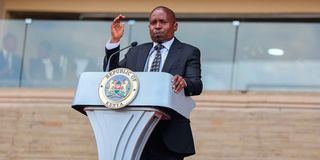
Deputy President Kithure Kindiki speaking during a past state function at Nyayo National Stadium on October 17, 2025.

Photo credit: Lucy Wanjiru | Nation Media Group

The Office of Deputy President Kithure Kindiki has exhausted nearly half of its annual recurrent budget within the first quarter of the current financial year, coinciding with heightened political activity around the nationwide empowerment programmes that he has spearheaded in recent months.

New data published by the Treasury shows that the Deputy President's office had spent Sh1.34 billion by the close of September 2025, which translates to 44.9 percent of its annual recurrent allocation of Sh2.97 billion.
This leaves Sh1.63 billion for the remaining nine months of the fiscal year, which ends in June 2026, making the office one of the top spenders among Constitutional and Executive agencies.

At the current spending rate, the office would exhaust its annual allocation by March next year unless the pace moderates or new appropriations are sought through a supplementary apportionment.

Treasury records indicate that the pace of spending in Prof Kindiki’s office is almost four times that of his impeached predecessor, Rigathi Gachagua, who by September 2024 had utilised Sh331.8 million, or 12.8 percent of his annual recurrent allocation at the time.

The office’s recurrent allocation covers wages, allowances, travel, operations, and maintenance costs, alongside coordination of government programmes under the DP’s mandate.

Prof Kindiki, who assumed office on November 1, 2024, following Mr Gachagua’s ouster earlier in October of the same year, has in recent months led a wave of county engagements under programmes branded as economic empowerment initiatives.

Official briefs show that the activities have involved economic sensitisation forums, cooperative mobilisation, and small business support drives held in Meru, Nyeri, Bungoma, Kisii, Narok, and Kwale.

A detailed expenditure breakdown is not publicly available, making it unclear how much of the Sh1.34 billion went directly into the empowerment programme activities versus administrative and personnel costs.

The high absorption rate comes amid growing scrutiny of public expenditure, with fiscal managers urging ministries and departments to align spending to quarterly limits to prevent funding shortfalls later in the year.

It also comes in a period when President William Ruto, who took power in September 2022, has been at the forefront of an austerity crusade aimed at reversing a past trend of borrowing to fund government operations.

The Treasury is expected to publish the half-year budget implementation report in early 2026, which will offer a clearer picture of the DP’s expenditure trajectory through the second quarter.

PAYE Tax Calculator

Note: The results are not exact but very close to the actual.