The value of Kenya’s food and beverage imports hit Sh81.6billion in three months to March 2026, marking a record first quarter expenditure and underscoring renewed concerns over dwindling domestic crop output.
The 40.9 percent jump in the food and beverages import bill from Sh57.9billion in the corresponding quarter of 2025 also represents the fastest growth since 2023 when the country battled a devastating drought and disruptions in the global supply chain.
Provisional data from the Kenya National Bureau of Statistics (KNBS) show the increase of Sh23.7 billion ranked food one of the biggest drivers of the country’s rising import bill and signalled growing reliance on foreign supplies to bridge domestic production shortfalls.
Kenya remains heavily dependent on imports of wheat, rice, edible oils and sugar, while yellow maize is periodically imported to bridge production deficits during drought years and stabilise food supplies.
Food imports expanded nearly three times faster than Kenya's overall import bill, which grew 14.4 percent to Sh740.8 billion in the review period from Sh647.6 billion a year earlier.
The renewed jump in food imports comes against a backdrop of worsening drought conditions across large parts of the country.
The State Department for Arid and Semi-Arid Lands (ASALs) and Regional Development earlier this year warned that drought conditions had intensified following successive seasons of below-average rainfall.
"In early 2026, drought conditions have intensified in ASALs, following successive below-average rainfall," the Department’s Principal Secretary Kello Harsama, who was last week transferred to the Petroleum department Mr Harsama said on February 27.
He said that below-average rains in late 2024 limited recovery, while the 2025 short rains performed even worse in both amount and distribution.
The poor rains constrained water availability, pasture regeneration and crop production, worsening food insecurity across drought-prone regions in northern Kenya.
According to the Kenya Food Security Steering Group, a multi-agency entity coordinating food security in Kenya under the leadership of the National Drought Management Authority (NDMA) alongside the UN World Food Programme, 3.5 million Kenyans required humanitarian food assistance as of February 2026, up from 2.2 million people in February 2025 and 1 million in July 2024.
The increase followed the failure of the October-December 2025 short rains, which reduced crop output and undermined livestock productivity.
The government says it was forced to spend more than Sh6 billion on drought response measures in 23 arid and semi-arid land counties, including food assistance, livestock feeds and water provision.
A further Sh778.5 million was disbursed through the Hunger Safety Net Programme, an unconditional Government cash transfer programme under NDMA, to support 133,101 vulnerable households in eight severely affected counties.
The Treasury has already warned that drought poses a direct threat to economic growth this year through lower agricultural output and wider spillover effects across the economy.
“A drought affecting crop production in 2026 is projected to reduce output noticeably, reflecting immediate losses in agricultural value added and spillover effects across the broader economy,” the Treasury wrote in the 2026 Budget Policy Statement.
The Treasury officials added that drought-related losses in livestock production would also weigh on growth, although the effects would be smaller because of the sector's relatively weaker linkages with the wider economy.
The latest spending marks the highest first-quarter food import bill on record, surpassing levels recorded during the food crisis triggered by drought and global market disruptions in 2022 and 2023.
The previous surge came in 2023 when Kenya was reeling from what the government described as the worst drought in four decades, alongside supply chain shocks linked to Russia's invasion of Ukraine.
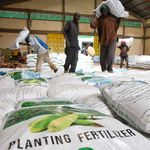
The crisis pushed up prices of staple foods and fertiliser, squeezing farmers and consumers while exposing the country's dependence on imported food commodities.
President William Ruto's administration responded by introducing fertiliser subsidies and allowing tax-free imports of selected food items to stabilise supplies and ease pressure on household budgets.
Food items imported duty-free included white maize, rice, yellow maize, soya beans, soya bean meal, protein concentrates and feed additives.
The National Treasury said the tax waiver was intended to "bridge the food stocks deficit as well as lower and stabilise food prices."
The fertiliser subsidy programme became one of Dr Ruto's flagship interventions after he assumed office in September 2022 amid soaring food prices and widespread concern over the cost of living.
At the time, fertiliser prices had climbed to about Sh6,500 for a 50-kilogramme bag, driven by supply disruptions in global markets following the war in Ukraine.
Government subsidies subsequently reduced the price to Sh3,500 before falling further to Sh2,500.