Kenya eyes a single gold export unit to curb smuggling

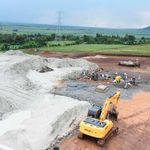
A gold extraction site in Isulu, Ikolomani sub-county, Kakamega County on December 16, 2025.

Photo credit: Boniface Mwangi | Nation Media Group

Kenya targets to centralise its gold exports under a single agency as part of reforms aimed at curbing smuggling and boosting foreign exchange earnings from the mineral.

Under the proposed changes, all gold produced in the country will be sold domestically through a tightly controlled system before export, giving the State visibility over volumes in a sector long dominated by informal trade.
Officials in the Ministry of Mining, Blue Economy and Maritime Affairs say the shift is designed not only to clamp down on illicit outflows, but also to reposition gold as a strategic financial asset capable of supporting the country’s foreign exchange position.

“We are putting the dealers together so that once they buy the gold, that gold should be sold within the country. The sole exporter of gold from this country should be one channel where we are able to account for what is getting out,” Mines Secretary Thomas Mutwiwa said in an interview with the Business Daily.

“We will be able to get foreign exchange reserves —and who knows, we can keep this gold as reserves in our central bank to help stabilise the shilling.”

The disclosure signal that refined Kenyan gold could, in the coming years, play a role in anchoring the shilling. Official records show the country’s gold reserves are limited, with the value negligible relative to the overall reserve needs.

The Economic Survey 2025, estimates monetary gold held as part of reserve assets at Sh188.9 million in 2024, up from Sh181.5 million in 2023, Sh124.9 million in 2022, Sh115.3 million in 2021, and Sh149.9 million in 2020.

The modest gold reserve position contrasts with official domestic production. Kenya produced 358.5 kilogrammes of gold valued at Sh3.02 billion in 2024, compared with 410 kilogrammes worth Sh3.18 billion in 2023 and 563.6 kilogrammes valued at Sh3.38 billion in 2022.

Under the proposed model, gold from artisanal, small-scale and large-scale miners will flow through licensed dealers and processing facilities before reaching refineries, where it will be upgraded to international standards. The refined output will then be exported through a centralised mechanism, ensuring traceability from mine to market.

The strategy centres on the proposed Kakamega gold refinery, which is nearing completion and is expected to process gold to 99.99 percent purity.

Kenya’s approach mirrors models adopted elsewhere on the continent.

In Ghana, gold exports are centralised under the Ghana Gold Board, while in South Africa, the South African Diamond and Precious Metals Regulator licenses dealers and refiners, with Rand Refinery handling the bulk of processing before export. Other countries, including Libya, Sudan, and Zimbabwe, rely heavily on central banks as sole buyers and exporters, with similar reforms underway in Ethiopia and Uganda.

Mr Mutwiwa says the facility will act as a national aggregation point, enabling the country to retain more value locally while tightening control over exports.

The government is also restructuring the broader value chain by licensing dealers, as well as leaching and elution plants that recover gold from tailings. These steps are aimed at capturing output that previously slipped through informal channels and boosting overall recovery rates.

“We will not only license the artisanal miners, but we will also license the elution plants and the leaching plants,” Mr Mutwiwa said. “We need to have more CIPs [Community Investment Plans] and CILs [Community Investment Level] so that we take care of the production from the artisanal and small-scale miners.”

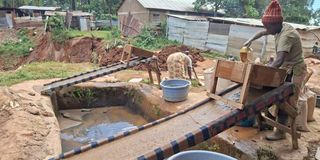
Kenya’s gold sector has historically operated on the margins of the formal economy, with thousands of artisanal miners relying on rudimentary methods and informal buyers. While this has supported livelihoods across regions in western Kenya and parts of the Rift Valley, it has also limited the State’s ability to collect revenues and monitor trade flows.

The artisanal and small-scale mining (ASM) sector — concentrated in counties such as Migori, Kakamega, Siaya, Narok, and Vihiga — employs an estimated 500,000 miners and supports about two million livelihoods indirectly.

Follow our WhatsApp channel for the latest business and markets updates.

PAYE Tax Calculator

Note: The results are not exact but very close to the actual.