KCB, tycoons to get over Sh42bn from traffic fines

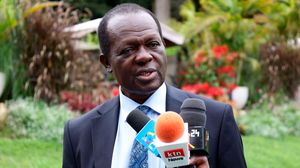
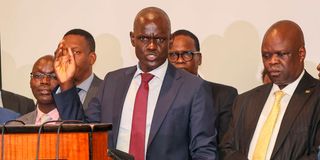
National Transport and Safety Authority Director General Nashon Kondiwa (center) addresses the media during a press briefing on newly introduced transport regulations at Sarova Stanley in Nairobi on March 10, 2026.

Photo credit: Wilfred Nyangaresi | Nation Media Group

KCB Group, a little-known investor and two well-connected individuals will earn over Sh42 billion for 21 years from the smart driving licence project, with newly launched instant traffic fines and licensing fees generating the bulk of the earnings.

A consortium of the bank and Pesa Print has lined up a capital investment of Sh42 billion for the lucrative public-private partnership (PPP) project, which they intend to recoup in a span of 21 years.
Sources familiar with the deal reckon that the backers of the project are expected to post a return of at least 120 percent over the period.

This suggests they could earn a gross return of Sh50.4 billion on the initial investment of Sh42 billion.

Pesa Print, which began the project in 2017 with the National Bank of Kenya, is partly owned by Jabir Abdul Nassir Abdalla Al-Kindy and Faryd Abdulrazak Sheikh.

Pesa Print’s founder, David Njane, has a 58.83 stake in the company, largely through his firm Kenya Twelve Ventures.

Being a PPP, whose contracting authority is the National Transport and Safety Authority (NTSA), revenues for the private investors will come from user charges, which will include Sh3,000 for issuing the smart driving licence as well as the various instant fines to be paid by offenders.

“This model [PPP] allows for the establishment of a self-funded delivery system where initial capital investments by private partners are recouped through revenue generated from fines, licensing fees, and service charges,” said the NTSA in a presentation on the project.

The instant fines will range from a high of Sh10,000 for overspeeding or driving without a valid inspection certificate to Sh5,000 for failing to stop when asked by the police and Sh500 for failing to wear a seat belt while the vehicle is in motion.

The investors have promised to make the Sh42 billion investment within the first two to three years of the implementation of the project, which is aimed at reducing accidents by curbing speeding, among other traffic violations.

The project aims to transition Kenya to second-generation driving licences embedded with biometric and digital security features over a 21-year concession period.

Kenya’s second-generation, chip-embedded driving licence was first introduced in March 2017, when the NTSA signed a Sh2.03 billion contract with a consortium led by NBK for supply of five million smart card licences.

However, the contract was transferred to KCB as part of the agreement that saw the KCB Group sell NBK to Nigeria’s Access Bank.
More than 1,000 new smart cameras are to go live on Kenyan roads to catch drivers breaking traffic rules under the project aimed at curbing speeding and enabling the execution of instant fines.

The network will comprise 700 fixed cameras to be mounted at strategic locations along major highways and high-risk corridors and 300 mobile units targeting speeding hotspots and accident-prone zones.

A Nairobi motorist on Tuesday moved to court seeking to stop the NTSA from implementing the automated traffic fines system, arguing that it punishes drivers without affording them a chance to defend themselves in court.

Kennedy Maingi Mutwiri filed a constitutional petition at the High Court’s Constitutional and Human Rights Division, challenging the Instant Traffic Fines Management System introduced by the state transport regulator. However, his request for an injunction was declined, with the mention of the case slated for April 9.

Because the government’s fiscal space has been narrowing, it has increasingly turned to private investors to undertake most of the major public projects, from roads and energy to airports.

The private investors plan to generate five million smart driving licences within the implementation period, which means that at a fee of Sh3,000, this would earn the consortium, including NTSA, around Sh15 billion.

Official data published by the Treasury shows that in the five years from July 2020 to June 2024, the government collected an average of Sh1.7 billion annually from traffic fines.

But the introduction of instant fines is expected to increase the collections multiple times.

Company registry documents reveal that Faryd and Abdul acquired a combined 41.17 percent stake in Pesa Print.

The two made their entry through Simbabanc Investments and Cropharmony Africa, companies registered in August and October 2023, respectively—just weeks after the Treasury approved the project’s feasibility study in July 2023.

The project was initially slated to run for three years, ending in March 2020. However, it is now four years behind schedule, according to Auditor-General Nancy Gathungu.

Following the Kenya Kwanza administration’s rise to power in 2022, the government began shifting its approach toward PPPs as a preferred mode of financing infrastructure and service delivery.

It was during this transition that Faryd and Jabir entered the scene, acquiring a substantial stake in Pesa Print.

Pesa Print founder Njane has previously said that the decision to bring Faryd into the project was based on the latter’s technical capability.

Mr Njane noted that Faryd owns Greenbo Africa, a company that supplies prefabricated materials for smart terminal construction and is a manufacturer of industrial-grade towers.

Mr Njane, who started Pesa Print over 10 years ago, said the firm won a competitive tender in 2015 to supply smart licences in the previous administration of Uhuru Kenyatta.

However, in 2021, the government opted to convert the contract into a PPP model to ease fiscal pressure. By then, the government owed Pesa Print close to Sh2 billion in pending bills.

Mr Njane said it took a long time for the previous administration to roll out the PPP project.

It was only after the Kenya Kwanza administration assumed office that things started moving, albeit slowly, Mr Njane added.

He insisted that the political affiliation of the other shareholders had no bearing on the operations of his company, which he praised as “a fully Kenyan company…that offered a local solution for local problems”.

“We designed the licences from scratch, using Kenyan artists,” he said.

Follow our WhatsApp channel for the latest business and markets updates.

PAYE Tax Calculator

Note: The results are not exact but very close to the actual.