Time flies with great content! Renew in to keep enjoying all our premium content.
Prime
Export taxes place Kenya’s leather industry on growth path
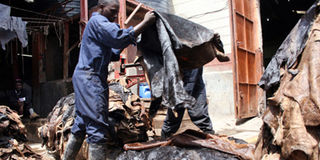
A worker arranges fish skins at KIRDI (left) and a technician at Zingo: The government estimates that value addition could raise leather earnings to Sh9 billion while the Leather Development Centre estimates that if Kenya processed all its hides and skins, income could hit Sh16 billion a year. file
Is the European Union helping or hindering economic development in Kenya? As negotiations continue between Brussels and the East African Community on a free trade agreement, a number of contentious issues remain to be resolved. One of the most important is Kenya’s use of export taxes.
The current text of the draft trade agreement would severely limit the use of such taxes. If this EU demand stands, Kenya’s development prospects are likely to be hindered, at least if the leather industry is anything to go by. Recent research shows the benefits of the government’s use of export taxes and what can be achieved by defying the EU’s ideological commitment to free trade.
Before 1990, Kenya’s tanning industry thrived; 19 tanneries with a capital investment worth Sh3.8 billion directly employed 4,000 people. This changed after the abolition of the government’s ‘export compensation’ scheme and market liberalisation, which involved cutting trade tariffs on imported leather and footwear, provoking a surge in cheap imports. Half the tanneries went out of business and thousands of jobs were lost. By 2004/05, 80 per cent of hides and skins were being exported in raw form.
The reliance on a primary, unprocessed commodity provides relatively little income in the value chain. Only eight per cent of the value of the international leather trade is accounted for by raw hides and skins, compared to 86 per cent for leather.
John Muriuku of the Leather Development Centre, part of the Kenyan Industrial Research and Development Institute, says that processing to wet blue stage adds 80 per cent to the value of raw hides and skins, moving to crust adds 200 per cent and to finished leather 400 per cent.
A major change came in 2004/05 when the government, responding to industry stakeholders, especially the tanning sub-sector, began to re-look at how to increase value addition in the leather sector. In its 2006 Budget Speech, the government raised the tax on the export of raw hides and skins to 20 per cent and the following June doubled it to 40 per cent, with the aim of encouraging the leather processing industry.
The policy has been strikingly successful, at least according to the available figures. In the year after introducing the 40 per cent duty, Kenya’s leather exports rose 54 per cent. Now, nearly 98 per cent of skins produced in the country (and 96 per cent of hides) are semi-processed to wet blue or finished leather compared to 56 per cent in 2004. Production of raw hides and skins declined by a factor of six from 2003 to 2007 while finished leather production increased more than four-fold: in 2007, Kenya produced 20,000 metric tonnes of leather compared to around 5,000 in 2003 and 10,000 in 2005.
Government figures are that earnings from the leather industry have risen from Sh3.15 billion in 2005 to Sh4.02 billion in 2008 – a rise of Sh870 million, or 21 per cent. One source of income is increased company tax payments. The government provides few figures on this, but a civil servant with expertise in the leather sector estimates that the tanneries are paying around Sh100 million in tax now, compared to around Sh10 million before the export tax was doubled.
The number of tanneries has risen from nine in 2005 to 13 in 2009, with operating capacity improving from around 30 per cent in 2003/04 to 70 per cent in 2007/08. According to interviews with officials, a further three tanneries are expected to start up soon, one later this year and two more in 2011.
The number of cottage industries employing thousands of small-scale workers has also risen, from 17 in 2005 to 24 in 2008. One estimate is that around 1,000 direct jobs and 6,000 indirect jobs have been created since the introduction of the export duty; in addition are increased incomes for perhaps 40,000 workers in peripheral industries who benefit from the boost to the leather sector. The new jobs are a variety of technical and skilled positions such as selectors of material, quality controllers, tanners and mechanics, and unskilled, sometimes casual labourers.
Many recruits are those who lost jobs in the 1990s – skilled workers in the leather industry who were forced to take other less skilled and usually less well-paid jobs.
Grace Wangunguthu and Joseph Njuguna have recently found jobs at Zingo Investments, a small Kenyan-owned leather tannery in Nairobi. The company has grown from seven permanent employees four years ago to 25, along with 40 casual workers, half of whom are women. For Grace, aged 34, this is her first job after spending the last few years looking after her two children. Responsible for grading and quality control of the company’s leather for export, she now earns Sh25,000 a month.
Joseph has worked in Kenya’s leather industry on and off for 30 years. “I lost my job in the tanneries in the 1990s,” he says. “Employment was down then and, when I eventually found a job, it was only as a casual labourer. I earned very little. Now I’m back full-time.” A skilled quality controller who selects the hides material to produce leather, Joseph began work at Zingo in 2009. He is now responsible for training five apprentices in quality control, acting as tutor, in expectation of the company’s continuing expansion.
Robert Njoka, the company’s director, says since the export tax was introduced Zingo has gone from producing 10,000 to 200,000 pieces of processed leather per month, mainly for sale to footwear manufacturers in India, China, Bangladesh and Italy. The company’s financial position is solid enough to be planning a Sh150 million expansion into shoe production, which, they estimate, could create 500 jobs.
EU restrictions
The European Union is, however, not wholly enthused with export taxes. Rather, it has been using every opportunity over the last few years to push for their abolition, even though they are used by over 70 countries and are perfectly legal under the World Trade Organisation rules. The European Commission says it seeks “non-discriminatory access to key inputs for the EU economy” and that “one particular problem” is export taxes. It argues that such taxes are generally counter-productive and that African countries should do everything possible to maximise their exports of raw materials — something which doesn’t exactly square with EU development priorities, stressing the importance of countries diversifying away from reliance on commodities.
EU policy, however, allows for some exceptions — on environmental or development grounds — to abolishing export taxes.
The Interim Economic Partnership Agreement signed with the East African Community — initialed in 2007 but on hold due to failure to resolve contentious issues — allows EAC states to introduce export taxes only with the ‘authorisation of the EPA Council’, which includes the EU. Even then, they can be levied only “on a limited number of products for a limited period of time” and are reviewed by the EPA Council after two years. Whether Kenya would be allowed to increase existing export taxes, such as on raw hides and skins, is unclear. The fact that the EU would have a veto over Kenya’s use of export taxes is especially noteworthy.
An EU delegation official in Nairobi interviewed for this research said that export taxes were “not a major issue” in the trade negotiations and the disagreement on the subject would be resolved. If true, why is the EU insisting on stringent conditions on the use of export taxes at all? It is likely the EU is using it as a bargaining chip to push through its other demands in the negotiations.
“My tannery would die if the export tax were removed,” says Robert Njoka, the director of Zingo Investments. “We couldn’t compete with others, like China. If the tax were removed, we’d lose lots of jobs. We cannot go on exporting labour by simply exporting hides.
We have to industrialise and develop.” It is not that the tanners and government officials believe that export taxes should remain forever; they think they should be removed once Kenya has become more competitive with Asia, which might take up to 10 years.
Dr Samuel Kiruthu of the Eastern and Southern Africa Leather Industries Association, which represents the industry, says: “Export taxes are a stop-gap needed to bring the industry to a certain level, to become competitive in the face of competition from other countries.”
Mr Njoka says that to further develop the leather industry, the government should provide more incentives and encourage joint ventures with foreign companies to increase technology transfer. Indeed, he says the Kenya-owned tanneries should receive special incentives, over and above those given to foreign companies, such as capital expenditure or tax breaks or reductions in land rent or ownership. EU policy is again a problem, since it is seeking to enshrine ‘national treatment’ investment rules in trade agreements, that would require governments to give the same rights to foreign investors as to local businesses.
Industry potential
The government estimates that value addition could more than double leather earnings to Sh9 billion. Mr Muriuku of the Leather Development Centre estimates that if Kenya produced leather from all its hides and skins, earnings could rise fourfold to around Sh16 billion, and directly employ around 10,000 people. Kenya could produce much more of its own footwear rather than being flooded by cheap imports undermining local production — but this depends on the industry becoming more competitive.
Many challenges remain, however. Kenya has long suffered from tax evasion after export duties have been raised. The media uncovered a scam in 2006 whereby 14 leading exporters of hides and skins had formed a well-knit cartel with government officers to deny the government revenue; from 2002-06, the cartel had avoided paying tax to the tune of Sh676 million. The cartel reportedly began the tax evasion scam after the government imposed a 20 per cent duty in the 2002/03 budget.
Exporters of raw hides and skins have lost out as a result of the increase in export taxes, though it is hard to quantify these losses. Economic theory suggests that primary producers of raw hides and skins will lose from export taxes since domestic prices fall. In Kenya, prices paid to small producers have fluctuated significantly in recent years. An officer in the Livestock Marketing Council, which advocates on behalf of pastoralists, says that immediately after the imposition of the 40 per cent levy, prices paid for raw hides and skins fell, but have since recovered. The price in late 2010 was more than double that of five years ago: in 2005, a skin sold for Sh50-100 per kg compared to Sh150-180 in late 2010.
Also critical is the need to provide better extension services for livestock producers, especially to improve the quality of hides and skins. One government study shows that the sector loses Sh4.5 billion a year from damages to hides and skins, mainly through tick bites, branding and flaying (skin removal) techniques after slaughter of the animals. The number of livestock extension officers, and their fuel allocation, is grossly inadequate. An official in the Ministry of Livestock Development says that the livestock extension service receives only Sh50 million a year — not enough to cover 210 districts adequately.
Experience around the world suggests that export taxes are not a magic bullet but can be a key part of a successful industrialisation strategy provided other right policies are in place. Positively, the government has drafted a five-year Strategic Plan for the leather sector, and has this year established a Leather Development Council, comprising the industry’s various stakeholders in a form of public-private partnership, to oversee leather sector strategy. The government has recently allocated Sh175 million to construct 5-7 medium-sized tanneries in rural areas, each costing Sh25-35 million.
The idea is that the tanneries will be managed by community groups or rural-based registered enterprises that will upgrade their operations from rawstock to leather processing. It remains to be seen whether Kenya’s leather sector will help achieve the government’s 2030 vision to industrialise the country, but evidence suggests it has made a good start.
Curtis is UK-based development analyst and director of www.curtisresearch.org. His research on Kenya’s leather industry was commissioned by a coalition of European NGOs working on trade and development issues, including Oxfam-Germany and Traidcraft. [email protected]
Unlock a world of exclusive content today!Unlock a world of exclusive content today!