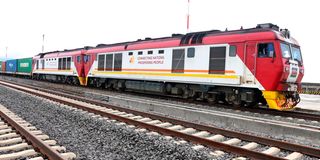
The government has lost a bid to keep secret the Chinese loan agreements, operational deals and procurement records linked to the Sh600 billion standard gauge railway (SGR) line between Mombasa and Nairobi.
This follows a Court of Appeal’s decision upholding orders requiring the Principal Secretary in the Ministry of Transport, the Principal Secretary at the National Treasury and the Attorney-General to release the documents, opening the door to fresh public scrutiny of Kenya’s debt obligations and dealings between Nairobi and Beijing.
The three-judge bench ruled that the State could no longer hide behind secrecy clauses, national security claims and diplomatic confidentiality to withhold details of the infrastructure project.
Now, the Court of Appeal has compelled the Ruto administration to make public the terms of the loan agreements with the Export-Import Bank of China and China Exim Bank and how SGR equipment was procured.
However, the decision, which would violate the agreements' confidentiality clauses if China Exim Bank does not agree to their publication, risks straining relations between Kenya and its largest trading partner.
The contracts for the railway, which was opened for operations from Mombasa to Nairobi in 2017, have long been a subject of controversy, with then President Uhuru Kenyatta citing confidentiality clauses when a court ordered their publication in early 2022.
The court said the State had failed to prove that disclosure of the agreements would threaten national security, foreign relations or Kenya’s economic interests as claimed by officials.
“The public interest in transparency, accountability and oversight of public finance outweighed any speculative harm alleged by the State,” the judges said.
The judges further ruled that non-disclosure clauses signed between Kenya and foreign entities could not override constitutional requirements on access to public information, especially where taxpayers’ money and sovereign obligations were involved.
The Court of Appeal reckons that the SGR was financed through billions of dollars in concessional and commercial loans from China Exim Bank and that repayment obligations continue to be met using public funds despite the railway’s operational losses.
Kenya borrowed Sh655 billion ($5.08 billion) from the China Export-Import Bank in the fiscal year ended June 2015 for the construction of the SGR from Mombasa to Nairobi and later to Naivasha.
The Treasury estimates that it has been spending Sh50 billion a year on servicing the SGR loans.
In the landmark judgment, the appellate court dismissed an appeal filed by the Attorney-General and upheld a 2022 High Court decision compelling the government to disclose extensive SGR records sought by governance activists Khelef Khalifa and Wanjiru Gikonyo.
The records sought include loan agreements with China Exim Bank, procurement contracts, guarantees, collateral arrangements, feasibility studies, environmental impact assessments, cargo agreements and operational contracts involving Africa Star Railway Operation Company, which ran SGR services in the first five years of operations.
The ruling could place fresh pressure on the Treasury and transport authorities to publicly disclose the financial and legal obligations Kenya assumed under the Chinese-funded railway project.
The legal dispute started after Mr Khalifa sought detailed SGR records through letters written in December 2019 and May 2021 to the Ministry of Transport, the Treasury and other State agencies.
Among the documents sought were financing contracts, Take-or-Pay agreements between Kenya Railways and the Kenya Ports Authority, agreements involving Africa Star Railway Operation Company and records on the railway’s economic, environmental and social impact.
Mr Khalifa also requested details on cargo volumes handled through the Port of Mombasa, Inland Container Depot facilities and the ownership structure of Africa Star Railway Operation Company.
The activists argued that the public remained unaware of the consequences of default under the Chinese loan agreements despite taxpayers carrying the repayment burden.
They also cited previous court findings that the SGR procurement process breached procurement laws and constitutional requirements on public participation.
The Attorney-General opposed the petition, arguing that the requested records were protected under the Official Secrets Act and exemptions under the Access to Information Act.
The State further argued that the agreements contained non-disclosure clauses and that releasing them could expose Kenya to serious legal and financial consequences.
Additionally, the State claimed disclosure could undermine foreign relations with China and harm Kenya’s ability to manage the economy.
However, the Court of Appeal rejected those arguments and faulted the government for issuing blanket secrecy claims without presenting evidence showing how disclosure would cause actual harm.
The judges said merely citing national security or confidentiality clauses was insufficient under the Constitution.
“Access is the rule; secrecy the exception that must be earned by the State,” the court ruled.
Public agencies, the judges added, cannot rely on blanket claims of national security, confidentiality or diplomatic sensitivity to shield taxpayer-funded projects from public scrutiny without presenting clear evidence of potential harm.
The judges further stated that public officials could not deny citizens access to information based on suspicions about how the information would be used.
“The information belongs to the public. The State holds it as custodian, and not as proprietor,” the court said.
The appellate judges upheld findings by High Court, which had ruled that the refusal to disclose the information breached constitutional rights on access to information, transparency and accountability.
The High Court had also ordered the government to provide the requested records at its own cost.
In its appeal, the Attorney-General argued that the activists had failed to demonstrate why they needed the information or what public benefit disclosure would serve.
But the Court of Appeal rejected that position, holding that citizens are not required to justify requests for State-held information.
The judges said Article 35 of the Constitution grants citizens an unconditional right to access public information unless the State proves lawful exemptions.
The court further warned against using secrecy laws to shield government operations from scrutiny.
“Public business is the public’s business. The people have the right to know,” the judges said.
The precedent-setting ruling is expected to have far-reaching implications for future government borrowing, public-private partnerships and bilateral infrastructure deals involving foreign financiers.
It also strengthens demands for disclosure of debt agreements, concession contracts and sovereign guarantees signed by the government in other mega infrastructure projects.