Banks face loan refunds risk from illegal charges

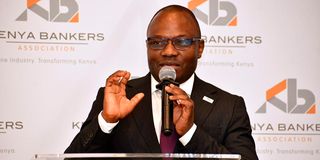
Kenya Bankers Association (KBA) Chief Executive Officer (CEO) Raimond Molenje makes his remarks during the release of the 2024 Banking Customer Satisfaction Report held at the Radisson Blu Hotel on February 12, 2025.

Photo credit: File | Nation Media Group

Banks are facing financial exposure worth billions of shillings after courts ruled that lenders cannot alter interest rates on loans without formal approval from the Treasury Cabinet Secretary.

In two separate decisions, judges have ruled that Stanbic Bank and Spire Bank breached the law after changing their lending rates without approval from the Treasury.
Stanbic was ordered to refund a customer over Sh10 million while Spire was compelled to reduce an outstanding loan balance in judgments that have sent shockwaves through the banking sector, sparking fears of an avalanche of suits.

The bankers’ lobby, the Kenya Bankers Association (KBA), has challenged in court the section of the law that requires them to seek approval from the Cabinet Secretary before changing lending rates.

KBA Chief Executive Raimond Molenje, without giving details, said the lobby is back in court to avert exposures facing banks.

This will mark the third time KBA is attempting to intervene in the matter after two previous attempts to join the suits were blocked.

Banks have been receiving approvals from the Central Bank of Kenya (CBK) before increasing lending rates on the back of a May 2006 legal notice, in which then Minister for Finance Amos Kimunya officially delegated the consent powers to the central bank governor.

The Stanbic and Spire Bank suits challenged the 19-year-old Legal Notice No. 35 of 2006, with courts siding with customers that a Cabinet Secretary “can only donate his authority but not responsibility.”

Section 44 of the Banking Act states that “no institution shall increase its rate of banking or other charges except with the prior approval of the Minister.”

The Supreme Court and the High Court separately ruled in Stanbic and Spire Bank suits, respectively, that the legal notice did not absolve the Treasury CS from legal responsibility.

Mr Kimunya had in the notice said he had delegated the powers over interest rate variation to the CBK governor “for the time being,” requiring the central bank to only update him after every three months on changes in borrowing cost and other charges.

The courts ruled that the variation of loan interest terms without the involvement of the CS was illegal and unenforceable.

This risks opening a floodgate of suits against banks over loan terms in a period when high lending rates have partly triggered defaults.

Defaults have been mounting, hitting Sh724.2 billion or 17.6 percent of the Sh4.115 trillion loan book at the end of April.

Lending surges at their fastest rate in the two years to November 2024, driving the defaults and slowing borrowing to a multi-year low.

The rates surged from an average of 12.36 percent in November 2022 to 17.22 percent in the same month last year as banks revised borrowing costs upward without the Treasury CS’s approval.

The Treasury has over the years largely taken a back seat on matters of interest rates.

Banks have routinely been seeking clearance from the CBK when altering loan terms, and the Treasury rarely intervened.

The position of courts has thrust the Treasury back into a central regulatory role it had informally relinquished.

Mr Kimunya’s legal notice had been used over the years by the CBK to receive and approve banks’ applications to vary interest rates.

However, this was first put to the test by Santowels Limited, a Stanbic customer who had taken out several loans between 1993 and 1997.

Santowels, a sanitary towels manufacturer, fell out with Stanbic for varying interest rates to levels it felt were unjustified.

Court papers show that in 2002, the company paid the amount that was outstanding and closed its accounts with Stanbic, but moved to court the following year, arguing that the bank unilaterally varied interest rates without seeking the Treasury’s approval and charged it extra Sh17.25 million interest.

The suit escalated from High Court to Court of Appeal and finally landed at the Supreme Court. The apex court agreed with the Court of Appeal that interest rates on loans and facilities advanced by banks are subject to regulation under section 44 of the Banking Act, requiring prior approval from the Cabinet Secretary.

KBA had previously sought to join Stanbic’s case as an interested party, pointing to the implications the case had on the sector. The Supreme Court declined the request, arguing that it was not a neutral player.

“The applicant cannot, within the same proceedings, transmute from asserting a vested interest to claiming neutrality as an amicus curiae,” held the Supreme Court in March this year.

KBA had told the Supreme Court that it possessed specialist expertise on banking regulation and could assist the judges in their ruling.

The Stanbic case was also cited in the July 24, 2025 High Court judgement in which Spire Bank was found to have varied the interest rate on a customer’s loan to 32.5 percent from 28.5 percent without approval from the Treasury.

Spire Bank was ordered to recalculate the loan using the correct rate and issue the customer with an updated outstanding balance.

In 2016, then President Uhuru Kenyatta introduced caps on commercial interest rates to spur access to credit. The move had the opposite effect and was repealed two years later.

PAYE Tax Calculator

Note: The results are not exact but very close to the actual.