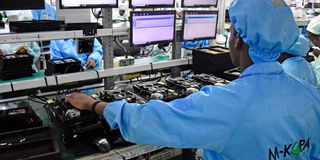
In a brightly lit, air-conditioned godown in Nairobi’s Industrial Area, rows of workers in blue coats and hair nets sit along a moving conveyor belt. Every few seconds, another smartphone inches forward to a new station, where it receives a new component.
By the end of the day, more than 7,500 of these devices will roll off the line, boxed, sealed and ready for sale across Kenya and Uganda.
This is the assembly plant of asset financing company M-Kopa, one of Kenya’s most heavily funded startups, now at the centre of a shift towards local smartphone manufacturing.
Founded in 2011 by Jesse Moore, Nick Hughes and Chad Larson, M-Kopa built its business on pay-as-you-go solar financing before expanding into smartphones and other devices.
The company has raised more than $590 million (Sh76.3 billion) in funding to date, according to Crunchbase, a business database.
Factory floor
The firm began smartphone assembly in January 2023, targeting low-income Kenyans. This came months after the Kenyan government introduced a 10 percent excise duty on imported phones, on top of an existing 25 percent import duty.
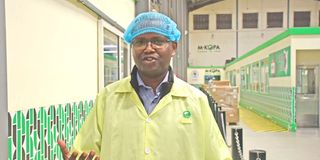
“This meant that device prices were going up by around 37 percent, and we thought, how do we start doing this?” M-Kopa Kenya general manager Martin King’ori told the Business Daily in an interview.
The company partnered with HMD Global, the Finnish maker of Nokia-branded phones, to set up the Nairobi facility. While it initially assembled both M-Kopa and Nokia devices, the factory has since shifted focus to M-Kopa-branded smartphones, with more than four models now on the market.
The operation runs on three assembly lines, each capable of producing 2,500 devices per day.
“Every line does 2,500 devices, which means per day, 7,500. Monthly, we can comfortably do 150,000,” Mr King’ori said.
M-Kopa Kenya general manager Martin King’ori speaks during an interview at the company’s smartphone assembly plant in Nairobi.
Photo credit: Billy Ogada | Nation Media Group
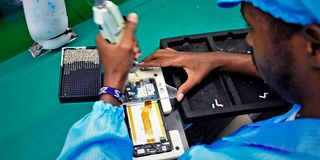
Each phone begins as a skeletal unit – just the display mounted on a plastic chassis. As it moves along the conveyor, more than 55 components, including storage chips, cameras, connectors and ports, are added in sequence by operators stationed along the line.
At one station, a robotic arm fastens 18 screws in just 11 seconds. Further down, devices undergo charging and discharging tests, connectivity checks for Wi-Fi and Bluetooth, and are assigned unique IMEI numbers.
At this stage, the phones are still running engineering firmware and have not yet been loaded with the Android operating system.
Assembly push
M-Kopa works with original design manufacturers (ODMs) in China to specify components and features, a process that takes four to six months from concept to first assembly. The company then installs Android software using licensed keys from US tech giant Google.
Mr King’ori said the plant’s output grew from an initial 100,000 units to cross the one-million mark within a year.
Technicians work on the M-Kopa factory floor in Nairobi on April 23, 2026.
Photo credit: Billy Ogada | Nation Media Group
He cited a June 2023 policy that zero-rated locally manufactured phones as a key catalyst. “Today, we have done 3.2 million devices,” he said.
In late 2024, M-Kopa began exporting about 15,000 phones monthly to Uganda, roughly 10 percent of its total production. The company is targeting 10 million locally produced smartphones by 2027.
M-Kopa sells its phones through a hire-purchase model. Customers pay a deposit and repay the balance in daily, weekly or monthly instalments. Devices are remotely locked if a customer defaults on payments.
In a separate section of the factory, another operation is underway – refurbishment. Here, traded-in phones are assessed, repaired and reintroduced into the market at a lower retail price.
The firm also takes in devices returned by buyers who could not complete their instalments.
Some are cleaned and updated with new firmware, while others are opened up and faulty components replaced. If a handset requires more than three parts, it is dismantled and salvaged for components used in assembling “second-life” devices.
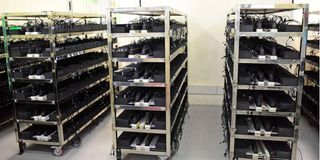
Smartphones undergo durability testing in the ageing room at the M-Kopa factory in Nairobi.
Photo credit: Billy Ogada | Nation Media Group
“Refurbishing capacity currently stands at about 500 units per day, with the ability to scale to 800 depending on demand,” said the company’s head of manufacturing, Ismael Abisai.
Mr Abisai said that, to date, more than 300,000 phones have been refurbished. The devices are sold at prices roughly 30 percent lower than new models, targeting customers transitioning from basic feature phones.
“It’s a big opportunity,” he said. “These refurbished devices help a lot of people acquire their first smartphone.”
Tax bottlenecks
M-Kopa’s investment is part of a broader shift triggered by the government’s zero-rating of locally assembled phones.
Last year, solar products financing company Sun King set up a manufacturing facility in Tatu City, Kiambu County, to assemble smartphones and solar-powered television sets. The company’s first smartphone model hit the market in February.
Similarly, East Africa Device Assembly Kenya Limited (EADAK), a joint venture between Safaricom, Jamii Telecom and Chinese firm Shenzhen TeleOne Technology, has also been producing low-cost 4G smartphones at its plant in Athi River, Machakos County. In 2024, the company announced it had made 360,000 phones in its first year of operation.
But while finished devices are zero-rated, imported components attract 16 percent value-added tax (VAT), which manufacturers must later reclaim – a process Mr King’ori said can take months and tie up working capital.
“We pay VAT on the components, but the finished good is zero-rated. So, we need to do claims to get it back,” he said. “There is a delay in terms of our working capital.”
The company is pushing for zero-rating of inputs to match outputs, as well as more predictable policy timelines to support long-term investments.
A worker holds M-Kopa smartphones on the assembly line at the company’s factory in Nairobi.
Photo credit: Billy Ogada | Nation Media Group
“We want a situation where, when the government comes up with a policy, they say within five years this policy will not change,” he said. “In a year, we have not recouped anything.”
Beyond assembly, M-Kopa, which says 10 percent of its components are sourced locally, sees potential for a broader manufacturing ecosystem, from charging cables and earphones to packaging.
“We employ 450 workers, 40 percent of whom are women, and support a distribution network of 15,000 agents. But we see potential in this nascent sector to grow not only in phone assembly but also in the knock-on value chain,” the manager said.
At the same time, Kenya’s local smartphone assembly industry faces competition from imported devices that sometimes bypass official tax channels.
Last September, for instance, the Kenya Revenue Authority (KRA) intercepted a range of undeclared goods at Eldoret International Airport, including 21,600 smartphones valued at Sh6.4 million.
“If these loopholes are tightened, you’ll see another acceleration in factories being set up in Kenya,” said Mr King’ori.
The local assembly boom comes at a time when Kenya has begun phasing out older phones by requiring USB Type-C charging ports for all devices sold in the country, in a bid to reduce electronic waste and standardise technology.
The policy, announced last month, mainly affects importers of popular low-cost feature phones, which largely use Micro USB.
“It is a growth opportunity for us, especially our refurbishing,” Mr King’ori said, “because there is a population that cannot afford an entry-level smart device.”
Back on the assembly floor, about 220 finished devices emerge from each line every hour, ready for packaging.
A worker prepares smartphone packaging boxes at the M-Kopa factory in Nairobi.
Photo credit: Billy Ogada | Nation Media Group
A new kind of manufacturing line is taking shape, one that could turn Kenya into a regional hub for affordable smartphones, if investment, policy and demand align.