Time flies with great content! Renew in to keep enjoying all our premium content.
Prime
Inside the battery-rental model powering Kenya’s electric motorbike uptake
Arc Ride batteries and service engineer Sammy Waweru explains how a battery swap station works during the launch of the Zoom motorbike and automated battery swap station at Kmall, Nairobi, on June 26, 2023.
At one corner of a busy roadside filling station in Nairobi’s Hurlingham area, a line of about 16 motorcycle taxi riders, commonly known as boda bodas, snakes towards a compact steel kiosk stacked with rectangular battery packs.
One rider rolls in, lifts out a depleted unit from beneath his bike’s seat, and in three minutes slots in a fully charged replacement before speeding off to his next customer as the afternoon rush begins.
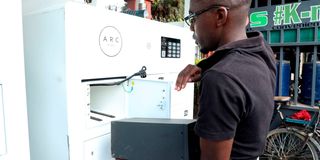
Battery-swapping stations like these are fast becoming the backbone of Kenya’s transition to electric motorcycles. They anchor a new battery-rental business model known as battery-as-a-service (BaaS), which is accelerating the uptake of electric boda bodas.
Under this model, instead of owning both the bike and its battery, riders buy or finance the motorcycle while subscribing to a network that rents out charged batteries on demand.
Cost shift
Batteries are the most expensive component of any electric vehicle (EV), often accounting for roughly 30 percent to nearly half of the total vehicle cost. Through BaaS or battery leasing, EV companies separate the battery from the vehicle cost, lowering the upfront purchase price and mitigating concerns about battery degradation.
For riders like Amos, the model has lowered the barrier to entry into electric mobility. He rides an Ampersand bike acquired through a financing plan, paying a Sh20,000 deposit and daily instalments of Sh560 over two years. The battery, however, is not his to own.
“Each swap costs me about Sh270, and I typically replace batteries twice a day. On busy days, I might swap it late in the evening to take me until mid-morning the next day, but mostly I spend roughly Sh540 daily,” the Nairobi-based operator, who has had the bike for just over a year, told the Business Daily in an interview.
After deducting financing, energy, and ride-hailing platform costs, Amos says he can make up to Sh1,000 a day, comparable to petrol-powered peers but with more predictable operating expenses.
Electric mobility firms estimate that a conventional 150cc petrol motorbike consumes between two and four litres of fuel over an 80-kilometre range, costing between Sh356 and Sh713 at current prices.
Spiro Kenya Deputy Country Head Raymond Kitunga holding a motorcycle battery at their manufacturing plant in Nairobi on August 6, 2024.
Photo credit: Bonface Bogita | Nation Media Group
By contrast, EV batteries offered by companies in Kenya have a range of about 80 kilometres. Charging a battery fully requires about three kilowatt-hours (units) of electricity, roughly Sh80 when done at home.
“With my previous petrol motorcycle, I used to spend Sh800 daily on fuel; now I swap my battery at a daily average of Sh400,” Kulema, another Nairobi-based operator, said.
“I no longer incur additional monthly servicing costs specifically tied to petrol bikes, such as engine oil, spark plugs, and oil filter.”
Time gain
Battery swapping adds a convenience premium but eliminates downtime, one of the biggest barriers to EV adoption. Riders can exchange batteries in minutes rather than waiting around two hours for a full recharge, allowing them to remain on the road during peak earning periods.
In Kenya, electric motorcycles accounted for 31,869 of the 43,324 registered EVs by the end of 2025, according to data from the Africa E-Mobility Alliance. Most are boda bodas, reflecting the sector’s central role in the country’s transition to cleaner transport.
Companies such as Spiro, Ampersand, and Arc Ride have built their business models around the BaaS approach, retaining ownership of batteries to keep upfront costs low. Spiro, for instance, sells its bikes for about Sh110,000 without a battery, well below the Sh130,000 to Sh200,000 price range of new petrol motorcycles.
The company, which operates a fleet of 20,000 bikes in Kenya, charges around Sh290 per full battery swap.
“We don't want to make the upfront cost of the bike very heavy. It is about ensuring that the ultimate cost to my end customer, the rider, remains as low as possible,” Jitender Jangra, Spiro’s EV Energy Business Head for Africa, said in an interview.
The firm says this structure reduces capital expenditure for riders while shifting the technical burden of battery management, maintenance, and replacement to the operator.
“We see our model as keeping the costs low; purchase cost, running cost, which is the daily charging costs, and maintenance,” said Mr Jangra.
But the model comes with trade-offs. Riders are effectively locked into a network of swapping stations, limiting flexibility compared to petrol bikes, which can refuel almost anywhere.
“Petrol bikes might be more expensive to run, but I still don’t have the freedom of a petrol bike in terms of leaving the city where there are swapping stations,” said Amos. “I cannot accept rides to, say, Naivasha, like a colleague with a petrol bike who does not worry about finding filling stations on the way.”
Operators have also reported losing customers when queues build up at swapping points, with waiting times stretching to an hour during peak periods.
There is also the question of geographic reach. Data from the Electric Mobility Alliance of Kenya shows that swapping infrastructure expanded from 117 stations in April 2024 to about 300 by mid-2025.
Yet around 90 percent remain concentrated in Nairobi. This leaves riders reluctant to accept trips beyond urban centres due to ‘range anxiety’ (the fear that an EV will run out of charge before reaching a destination or a charging station) and uncertainty about where to find the next swap.
Electric Mobility Association of Kenya President Hezbon Mose (right) explains how the Ampersand motorcycle works to Energy Principal Secretary Alex Wachira (2nd right), Kenya Power CEO Dr Joseph Siror (2nd left), and chair Joy Brenda Masinde at KICC Nairobi on April 23, 2024, during the 2nd Kenya Power E-Mobility conference and Expo.
Photo credit: Dennis Onsongo | Nation Media Group
Credit lock
Operators say the financing structure has further complicated the model. Most EV companies in Kenya have partnered with asset financing firms to loan bikes to operators.
For many riders, access to battery swaps is tied to daily loan repayments, and missing an instalment can lead to being blocked from swapping, rendering the bike unusable until payments are brought up to date. This effectively links energy access to credit discipline.
“If the money is due by 1 pm and I haven’t paid the Sh560, I cannot swap my battery to use the bike. It is essentially useless until I look for money,” said Amos.
“If I default on the payment for a few days, it accumulates as debt until I step up my daily instalments to clear it. If the debt grows, the financier takes away the bike.”
Model split
Besides the BaaS model, other firms, such as Roam, are pursuing a hybrid approach in which riders can own their batteries outright and charge them at home. Its bikes are priced between Sh295,000 and Sh419,000, depending on whether they have a single- or double-battery configuration.
The model is significantly more expensive, particularly under financing. Riders pay a deposit of Sh25,000 and about Sh530 daily for a single-battery bike, while the two-battery option requires a Sh30,000 deposit and roughly Sh800 in daily repayments.
Rider Ezra Kipkemboi inspects the battery system of an electric motorcycle, during the launch of Africa's first electric service station for the electric motorcycles, the Roam hub, on May 26, 2023 in Nairobi.
Photo credit: File | AFP
Over a 24-month repayment period, this pushes the total cost to upwards of Sh400,000 for the single-battery version and more than Sh600,000 for the two-battery model.
“We see owning the battery and being in control of one’s charging as important to a businessperson. It is less risky because a rider is not tied to the battery provider daily,” said a Roam spokesperson.
While charging at home is significantly cheaper, it can be less convenient for high-mileage riders. Roam has battery rental hubs where riders can temporarily swap at hourly rates of Sh20 or recharge batteries at Sh150 per full charge.
“It is more expensive than charging from home, but cheaper and more convenient than having to go home to recharge my battery during the day,” Njiru, a boda boda operator, said.
Future test
Globally, the battery-as-a-service model has gained traction in dense urban markets such as China and India, where limited access to home charging and high population density make swapping more viable.
In Kenya, experts say its long-term sustainability will depend on how the industry expands infrastructure quickly enough to match demand, balances affordability with profitability, and addresses concerns over rider autonomy.
“Right now, we are limited,” said Kulema, the boda boda operator. “It is as if the swapping infrastructure is not being expanded in proportion to how we are buying the bikes.”