Two local oil firms imported expensive petrol outside the government-to-government (G-2-G) supply contract between Kenya and three Gulf oil majors, setting consumers up for a potential steep climb in pump prices from April 15.
Industry sources revealed that One Petroleum and Oryx were, in early March, cleared by the Ministry of Energy to import 60 tonnes of petrol each, as the government scrambled to avert shortages tied to the US-Israel war with Iran.

One Petroleum quoted a premium of $290 (Sh37,691.3) per tonne, which is three times the $84 (Sh10,917.48) for a similar quantity of petrol under the G-to-G deal that Kenya signed with Saudi Aramco, Emirates National Oil Company (Enoc), and Abu Dhabi National Oil Company (Adnoc) to supply products since March 2023.
“One Petroleum invoiced oil companies last week. We got our invoice on Friday, and the price build-up shows a premium of $290 per tonne,” an industry executive told Business Daily.
The pricing of petroleum products is based on premium and Free-on-Board (FOB) prices. FOB is the price of the petroleum product at the port of departure and covers all costs up to the point the product is loaded onto the ship.
Premium is the extra cost added to the FOB price to facilitate importation of petroleum products and includes a host of charges such as ocean freight, insurance, handling fees, and loss in transit. The premiums are, however, negotiable between product suppliers and importers.
Sources told Business Daily that the price of a litre of petrol could rise by at least Sh19 on account of the high premium demanded by the importers, given that the two cargo consignments imported outside the G-2-G deal will be part of those to be used in setting the monthly pump prices from April 15.
“We are looking at an increase of at least Sh19 per litre on account of the premiums alone. Then we also add the Platts (global benchmark prices of fuel) for this month (March), which are way higher than those for last month. The effect is going to be huge unless the government goes for a significant subsidy,” the industry source said.
The State could, however, tap the subsidy programme to cushion consumers from steep prices. It occasionally taps a subsidy funded by the petroleum development levy to stabilise pump prices and cushion consumers from inflation pressure.
Oryx and One Petroleum look set for high premiums, which could force the government to apply a steep subsidy in order to mitigate against sharp price increments and avert public outrage.
Kenya’s G-to-G deal has fixed premiums of $84 (Sh10,917.48) per tonne of petrol, $78 (Sh10,137.66) for a similar quantity of diesel, and $97 (Sh12,607.09) for a tonne of dual-purpose kerosene.
The percentage of premium is a factor of the FOB prices, meaning that a higher FOB translates to a lower premium. Premiums consist of freight, insurance, and the margins for suppliers.
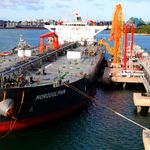
The Ministry of Energy and Petroleum floated the idea of shipping fuel outside the G-to-G deal after a vessel carrying 114.7 million litres of super from Enoc was unable to leave the Port of Jebel Ali in Dubai due to the closure of the Strait of Hormuz.
But sources say that a section of importers under the G-to-G deal did not support the idea, citing the potential impact of steep premiums as compared to the fixed ones under the government-backed deal.
“The ministry made a request for the two vessels in order to plug the gap occasioned by the ship that failed to depart its loading port in Dubai. One Petroleum has already discharged its cargo, while that for Oryx is coming this week,” another oil executive said.
Energy and Petroleum Cabinet Secretary Opiyo Wandayi had, by press time, not responded to Business Daily queries over the two vessels and how the government will treat the significantly high premiums in order to protect consumers.
Without a steep subsidy, the April 15-May 14 prices are expected to be the highest in months, reflecting the impact of the fuel supply disruptions caused by the attacks on oil facilities in the Gulf and a paralysis of the Strait of Hormuz.
Iran has, since last month, launched drone attacks on several oil refineries in the neighbouring Gulf countries and attacked at least 18 merchant ships along the Strait of Hormuz in response to the US-Israel strikes against it.
The attacks have disrupted production and choked the critical Strait of Hormuz, significantly hindering the movement of fuel from the oil-rich region.
Nearly 25 percent of the global liquified natural gas and fuel passes across the Strait of Hormuz, enabling its movement from the Persian Gulf to the Gulf of Oman, the Arabian Sea and beyond.
Iran, Iraq, Kuwait, Qatar and Bahrain notably rely on the strait to deliver the vast majority of their oil exports.
Official records show that Saudi Aramco, Enoc and Adnoc have turned to Sikka Port in India, Port of Antwerp-Bruges in Belgium, and ports along the Red Sea to source fuel destined for Kenya and ensure the safety of the vessels by relying on the Red Sea-Mediterranean route.
Some 239.1 million litres of petrol will be loaded onto two vessels at the Port of Antwerp-Bruges, with the ships set to sail via the Red Sea-Mediterranean route and arrive at the port of Mombasa between April 16 and 27.
A further 156.75 million litres of fuel (81.15 million litres of dual-purpose kerosene and 75.6 million litres of diesel) is expected to be loaded at Sikka Port this month. These vessels are expected at the port of Mombasa between April 12 and 21.