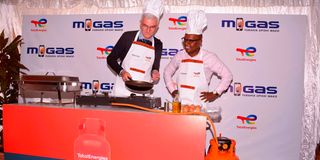
Circle Gas, the UK-based parent company of the Kenyan cooking gas distributor M-Gas, aims to raise more than $27 million (Sh3.4 billion) from carbon markets by the end of June, as it engages the Kenyan government to secure approval for the sell.
The company has 12 subsidiaries across nine markets, including Kenya and Tanzania, and has secured an offer for carbon credit purchases worth $27 million, per financial disclosures filed in the UK. Of this, $8.5 million (Sh1 billion) had been received by the end of December 2024.
Circle Gas seeks additional external funding and is negotiating to upgrade its existing carbon credits into the Paris Agreement’s ‘Letter of Authorisation’ (LoA) category to raise money from higher-value international carbon markets.
An LoA allows carbon credits generated in Kenya to be transferred abroad under Article 6 of the Paris Agreement, with the host country adjusting its national carbon accounting accordingly.
“The group has secured an offer for future carbon credit certificate purchases with a remaining value of $27 million, of this, $8.5 million has been received to date,” Circle Gas says in the disclosures seen by the Business Daily.
M-Gas has so far secured a Letter of Approval from the Kenyan government. Late last month, the company said the planned carbon project “is now progressing toward the next stage of the authorisation process.”
Circle Gas reckons carbon credit sales under the conditions of an LoA are at a significantly higher value than voluntary carbon credit sales, “with the potential to raise additional funding of at least $9 million based on the number of accredited carbon credits held by the Group at the reporting date.”
Safaricom holds an 18.96 percent stake in Circle Gas, and both the telco’s current CEO, Peter Ndegwa, and Michael Joseph, its former chief executive, sit on the UK firm’s board. The Kenyan government owns 35 percent of Safaricom.
Circle Gas’s 12 subsidiaries include M-Gas Limited and Circle Gas Limited in Kenya, as well as M-Gas Solutions Limited and M-Gas Resources Limited in Tanzania. In Kenya, M-Gas sells liquefied petroleum gas (LPG) under a ‘pay-as-you-cook’ model, targeting low-income households.
M-Gas’s cylinders – provided by oil giant TotalEnergies – are fitted with smart meters that track gas usage and automatically disconnect the supply once the paid-for amount is consumed. When gas runs low, the system alerts the firm, which delivers a refilled cylinder to the customer’s home at no extra charge.
M-Gas’s push comes amid heightened scrutiny of carbon credit projects in Kenya following the recent collapse of clean-cooking startup Koko Networks.
Koko shut down on January 30 after it failed to secure a government Letter of Authorisation despite a 2024 investment framework that would have allowed it to sell carbon credits. This was a week after M-Gas announced it had secured its Letter of Approval.
Koko had subsidised bioethanol stoves and fuel for over 1.5 million households, relying on carbon credits to recover losses, but the government said approving its request would have allowed a single firm to exhaust Kenya’s share of global compliance markets.
The startup invested about $300 million (Sh38.7 billion) in Kenya and is now under administration.
Circle Gas plans to use the carbon credit strategy to raise additional external funding for growth. The group reported an operating loss of $24.2 million for the year ended December 2024, down from $33.3 million in the year ended December 2023.