Time flies with great content! Renew in to keep enjoying all our premium content.
Prime
Leather sector takes a hiding from foul weather
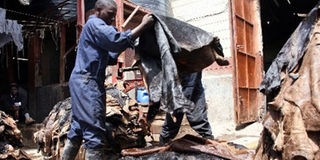
A factory worker at Zingo Tannery inspects newly delivered hides. Photo/LIZ MUTHONI
It’s approaching midday.
Deep inside Nairobi’s Industrial Area, a group of workers offloads stacks of foul-smelling leather hides under the watchful eye of a burly supervisor.
While many consider the hide a waste product, the keenness of the supervisor overseeing the exercise suggests that here, it is a valuable and valued commodity.
A short distance away inside an ageing factory building, three giant machines sit conspicuously idle.
Labourers go about their daily business on a handful of others machines scattered across the medium-sized factory floor. It is the picture of a business under siege.
“We are facing tough times because the supply of hide fell drastically following the prolonged dry spell and getting quality raw materials has become a nightmare,” Mr Robert Njoka, the proprietor of Zingo Investments that runs the leather tannery, says.
Kenya has suffered close to four failed rain seasons back-to-back, sparking widespread drought that has led to the death of thousands of animals die across the country.
Businesses such as Zingo did not benefit much because of the poor quality of hide from the carcasses.
“We are currently realising about half of our normal orders of 400, 000 tonnes of hide but the supply is getting better with improved weather conditions,” Mr Njoka adds.
But their woes don’t end with adverse effects of foul weather alone.
A fresh wave of suspected smuggling of leather hides to external markets is also causing nightmares to an industry that is just beginning to recover from the severe blow it suffered following liberalisation in the 1990s that saw most tanneries close shop in the face of cut-throat competition from efficient and mass producing Asian rivals such as Vietnam and China.
“This market serves up an average of four million tonnes of leather hides but only about half reach the tanners, suggesting smugglers are back in the game. The tax agencies must now wake up and improve surveillance,” Mr Njoka said.
In 2004, the government moved to double the export duty on raw hides and skins to 40 per cent to try and curb such acts of smuggling and encourage local players to embrace value-addition programmes that would guarantee them better earnings.
“The tax move helped and several firms that had gone out of business found their footing but this now seems to be changing for the worse once again,” the trader says.
A flood of cheaper finished leather products imported from countries such as China is also subjecting tanneries such as Zingo to endless anguish.
At the factory yard of Zingo tannery, more than half of Mr Njoka’s own work force are wearing imported shoes.
“Economies of scale favour the cheaper imported products and many would naturally take them up. It makes economic sense to do so and if the government is committed to boosting the livelihood of its people then we should have incentives so that we can produce products that are affordable to our people,” Mr Njoka says.
Erratic power supply another consequence of the drought, has further complicated matters, driving up production costs by nearly 20 per cent and rendering goods produced in Kenya uncompetitive in regional markets.
Renewable resource
Dr Joseph Musaa, an analyst in the veterinary services sector, says lack of awareness about the value of quality hides and skins has also affected the potential of the industry.
“Most people across the value chain do not appreciate that everything matters, from the choice of breeds to the animal husbandry process, the slaughter and the hide handling process,” he says.
“Most people are preoccupied with getting to the meat, forgetting that the hide also has value.”
Industry players say challenges arising out of the choice of breeds are already posing a threat to Kenya’s hides and skins exports to destinations such as Europe.
In Europe, buyers currently prefer products measuring 30 square feet, even though most shipments from Kenya average about 25 square feet.
“The size of animals is getting smaller and an elaborate programme is required to correct this trend. Customers are specific in their demands and will only make orders based on their preferred specifications,” Mr Njoka says.
The United Nations Industrial Development Organisation (Unido) says the quality of the hides remains a challenge to the leather industry in Kenya and Africa as a whole.
“Researchers should give much more attention to assessing the quantity, quality and value of hides and skins even though these are joint products with meat and milk. In many cases the value of the hide or skin may constitute a significant proportion of the total value of the animal. Such research data will support extension agents in encouraging people to take care of the hide or skin as a valuable joint product,” it says.
Mr Kenneth Aduda, the principal chief scientist at the Kenya Industrial Research Development Institute (Kirdi), says the main challenges facing the leather industry in Kenya include poor collection of hides and weak quality and processing systems.
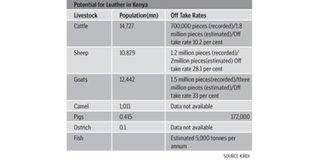
“There is an abundant and renewable resource base in Kenya’s large population of cows, sheep and goats and more recently fish,” he said in a recent presentation to a stakeholder’s meeting on the leather industry value chain.
Statistics showed that African countries have about 20 per cent of the world’s cattle, sheep and goats, but produce only 14.9 per cent of world output of hides and skins.
They have 10 per cent of the world’s cattle but produce only 4.5 per cent of bovine hides.
In addition, their exports of hides and skins have fallen in recent years from 4 per cent to 2 per cent , and their tanning capacity from 9.2 per cent to 6.8 per cent at a time when other developing countries have substantially increased their share of world footwear production.
Unlock a world of exclusive content today!Unlock a world of exclusive content today!