Time flies with great content! Renew in to keep enjoying all our premium content.
Prime
Kenya fuel subsidies at risk as Saudi raises May prices
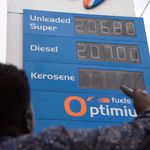
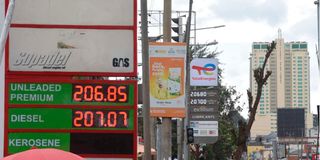
Fuel prices displayed at two petrol stations in Eldoret City, Uasin Gishu County, on April 15, 2026, after the Energy and Petroleum Regulatory Authority (Epra) announced a price increase.
A fund that cushions Kenyans against costly fuel is set to come under pressure in the coming months, as suppliers warned the cost of diesel and petrol will go even higher for consignments covering the May-August period.
The energy regulator on Wednesdayraised retail fuel prices by as much as 24.2 percent to Sh206.84 per litre of diesel amid a spike in crude prices and squeezed petroleum supplies caused by the Middle East conflict.
The prices could have increased to Sh233 a litre in Nairobi or by nearly Sh70 in the absence of a Sh6.5 billion subsidy and reduction of value-added tax (VAT) from 16 percent to 13 percent.
However, on Wednesday night, the regulator revised the fuel prices to Sh196.63 for diesel and Sh197.60 for petrol after further reduction of VAT to eight percent.
But one supplier under the government-to-government (G-to-G) arrangement reckons that the US-Israeli war on Iran has forced it to change the terms of the deal and will deliver its consignment from May at a higher price.
This is a signal that pump prices will surge as the Petroleum Development Levy Fund, which the State uses to subsidise fuel prices, depletes.
State officials reckon that the fund has less than Sh9 billion and is unlikely to last for more two months.
Global analysts have warned that oil and gas prices will not go down any time soon, even if the Middle East war ends, citing pressure on fuel supplies and tight global markets.
Strains on public finances across countries are set to intensify further as the war damages economic activity and boosts demand for interventions to cushion the effects of high energy prices on households and companies.
Aramco Trading Fujairah (ATF) has written to Kenya, stating that its sourcing of petroleum products from “other locations” has come at higher costs, which it would push to Kenya.
The Saudi firm did not, however, indicate which countries it has sourced the petroleum for since the closure of the Strait of Hormuz, a narrow waterway through which up to one fifth of global fuel supplies passes.
This means the diesel and petrol will land in Mombasa at higher prices, setting the stage for sky-high pump costs.
The average landed cost of kerosene more than doubled to Sh170.86 per litre last month from Sh82.63 in February while that of diesel jumped to Sh133.89 per litre from Sh82.30 for the same quantity.
The State was forced to deploy a subsidy of Sh108.10 per litre of kerosene and Sh23.92 per litre of diesel. But, following the VAT reduction to eight percent, Epra said Wednesday night that the subsidy for kerosene dropped to Sh96.56 per litre.
The steep subsidy helped prevent prices from hitting Sh260.88 and Sh230.76 in the new prices announced on Tuesday night. Kerosene prices were retained at Sh152.78.
Kenya imports nearly all of its fuel products from the Middle East via G-to-G deals with Gulf suppliers, including Saudi Aramco Trading Fujairah, Abu Dhabi’s ADNOC Global Trading Ltd, and Emirates National Oil Company Singapore Ltd.
Under the subsidy, oil dealers retain the pump price announced by the Energy and Petroleum Regulatory Authority (Epra).
The government then pays them the additional cost, with the money drawn from the Petroleum Development Levy Fund.
“It would be difficult to sustain a similar subsidy (Sh6.5 billion) for months if the Middle East criss is prolonged,” said a source at Epra.
Some clauses in the deal provide for Saudi Arabia and UAE to push up the cost of petroleum sold to Kenya in the event of Material Adverse Change (MAC).
MAC events are significant developments which affect the execution of contracts, including war, route closures, and extreme rise in cost of sourcing products.
The Middle East conflict has allowed the two Gulf states to initiate price increases to cushion themselves from the higher costs of sourcing for fuel from other countries, and the resultant higher freight and premium costs.
It is emerging that conflicts are among factors that allow the Gulf states to abandon price caps under the contracts and increase fuel costs.
“The situation (Iran war) has forced us to secure cargo from alternative locations in order to meet our contractual obligations. Sourcing from these locations will extend delivery timelines and, when combined with the current elevated price environment, will directly and materially affect the price at which we source our cargo,” said Aramco.
“We are of the view that the above constitute a MAC Event as defined under the Master Framework Agreement. We would like to formally request that the prices of the following upcoming shipments be amended as follows…”
Petroleum development levy is charged at the rate of Sh5.40 per litre of petrol and diesel. The rate was hiked from a previous Sh0.40 per litre from July 2021 as the State sought to build bigger buffers for the subsidy scheme.
President William Ruto on Wednesday said that the government will use all viable measures to mitigate against price spikes in the coming months, even as Kenyans question this promise in the wake of the latest prices.
“We are going to monitor the situation to make sure that we cushion ourselves as a country. We will cushion our economy and our transport sector,” Dr Ruto said.
In the current prices that will lapse on May 14, the biggest subsidy went to diesel, at least Sh5.74 billion, while Sh702 million and Sh423.9 million are set for petrol and kerosene.