Time flies with great content! Renew in to keep enjoying all our premium content.
Prime
Industries cut consumption of cheap electricity at night, weekends
Industrial power use under Kenya’s night-time discount tariff has fallen to a four-year low, signaling slowing economic activity and factory exits from the scheme.
Consumption of cheap electricity at night and weekends by industries dipped to a four year low in the period ended June 2025 with 180.1 Gigawatt-hours (GWh) used, signaling reduced economic activity by the businesses and exit of big firms from the special tariff.
Energy and Petroleum Regulatory Authority (Epra) data shows that this was a decline of 19.9 percent from the 225 GWh used a year earlier by industries and electric vehicles (EVs) under the special tariff, commonly referred to as the Time of Use (ToU).
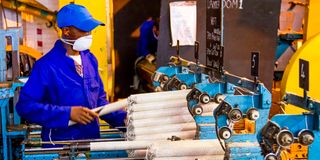
Declining consumption signals that industries and businesses reduced operations amid a tough economy characterised by near stagnant sales, closures and the scaling down of activities.
The special tariff was introduced eight years ago for commercial industrial consumers during off-peak hours. In April 2023, this tariff was expanded to include small commercial industries (using more than 100 kilowatt-hours a month) and electric vehicles (EVs).
Beneficiaries must meet monthly consumption thresholds that are tracked over a six-month period in order to qualify for the ToU.
“Energy consumption under the ToU category reached a cumulative 180.3 Gigawatt-hours (GWh) with beneficiaries saving a total of Sh1.438 billion,” Epra says in the report.
Under the ToU, beneficiaries get 50 percent discounts on electricity prices for using it during the off-peak periods (2200hrs to 0600hrs during weekdays, 0000hrs to 0800hrs and 1400hours to 0000 on Saturday and on public holidays respectively). The 50 percent discount is also available the whole day on Sundays.
A number of heavy electricity users (industries that receive power at 11,000 volts) exited the ToU tariff with beneficiaries under this consumption band dropping to 155 in the year ended June 2025 compared to 177 a year ago.
The exit of the beneficiaries under this category significantly hurt consumption given that this category is one of the heaviest users of electricity.
Firms have grappled with a weak demand for their goods and high operational costs since last year with a number of manufacturers cutting production costs and staff numbers in order to remain afloat, according to a survey by the Central Bank of Kenya (CBK).
The latest survey by the CBK showed that 41.2 percent of manufacturers recorded a decline in sales in the three months to June this year, prompting 47.1 percent of them to cut on production volumes in the period.
Epra’s data shows that the fall in consumption of electricity under the ToU came in a year when the number of overall beneficiaries rose to 2,339 in the year to June 2025 compared to 2,257 a year earlier.
Consumption of electricity under the ToU has been declining over the years from 270GWh in the year to June 2022 to 255 GWh the following year, casting doubts on whether the tariff is achieving its intended goal.
Electricity prices had for years been a major headache for manufacturing with steep power bills hurting the competitiveness of Kenyan-made products, prompting the State to intervene and introduce the special tariff, largely targeting the industry.
The administration of former President Uhuru Kenyatta introduced ToU in 2017 in a two-pronged push to drive productive use of electricity during the low-demand periods and also boost the 24-hour economy.
Industries, under their lobby Kenya Association of Manufacturers (KAM) have in the past pleaded with the government to ease the demands, saying that the condition to exceed their average monthly consumption in the last six months is prohibitive.
In 2022, KAM pleaded with the government to set a different night tariff all-together instead of the ToU, saying that this would improve Kenya’s competitiveness. The ministry of Energy was cagey on KAM's push for removal of the ToU, saying that it would hit Kenya Power’s revenues.
"A committee led by Epra was formulated and tasked with looking into it among other issues like cost of energy ... we are yet to report back to the government on the proposal," Tobias Alando the CEO of KAM said yesterday.