Time flies with great content! Renew in to keep enjoying all our premium content.
Prime
Christmas blackout threat as Ketraco accounts stay frozen
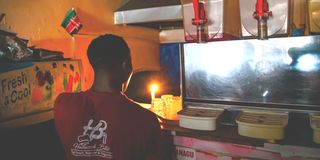
A waiter at Hadassah Bites near Globe Roundabout in Nairobi, Kenya, receives a customer order on September 6, 2024, after a power outage that hit most parts of the country.
Kenya risks nationwide power blackouts after bank accounts belonging to the Kenya Electricity Transmission Company (Ketraco) were frozen in the wake of a Sh10 billion row, leaving the utility with no cash for repairs and maintenance.
In an urgent application filed at the High Court, Ketraco warned that the freezing of its 17 bank accounts has severely disrupted its operations, including the maintenance of electricity transmission lines, raising the possibility of widespread power outages across the country.
The company said the court order effectively halts ongoing projects and threatens stable power transmission nationwide, with severe consequences for public safety, the economy, essential services and energy security.
A Spanish firm obtained court orders to place the bank accounts on ice over the Sh10 billion debt following a botched tender in 2016. Efforts by Ketraco to have the order lifted on Friday were unsuccessful after High Court judge Peter Mulwa declined to temporarily suspend the freeze pending the determination of an appeal filed by the state-owned firm.
Instead, the court directed both parties to appear before him tomorrow (Monday) for the hearing of the application.
Ketraco—which manages high-voltage transmission lines—says the county is exposed to blackouts during the festive season, cautioning that it could cripple industrial production and disrupt essential services such as healthcare.
“Any electricity blackout will equally cripple the Kenyan industrial sectors and essential services like medical care. Such a scenario could easily portend socio-economic unrest,” Ketraco said in court papers.
High demand-driven overloads have been blamed for tripping up the electricity grid in the past, leading to nationwide blackouts.
The government has sought to address that by expanding and maintaining infrastructure to accommodate demand increases without straining the network.
The High Court issued the orders after granting an application by Instalaciones Inabensa S.A., directing 17 banks—including NCBA, Standard Chartered Kenya, Co-operative Bank of Kenya, Citibank NA Kenya and KCB Bank Kenya are to freeze all funds belonging to Ketraco.
The agency told the court that the accounts freeze has triggered operational paralysis, placing the company at risk of breaching contractual obligations, including loan repayments and the payment of salaries to more than 540 employees.
“Similarly, the applicant (Ketraco) is now unable to meet its urgent contractual obligations, service loans, procure key inputs and operate the national transmission grid,” said the firm in an application at the High Court.
Ketraco urged the court to intervene urgently, warning that failure would lead to irreversible loss of public funds.
“Unless this honourable court stays execution forthwith, public funds shall be irreversibly dissipated,” the company stated.
The firm argued that Instalaciones Inabensa SA, which has since been liquidated, is no longer operational and may not be able to refund the frozen money under a court order should Ketraco succeed in its appeal.
Court documents reveal that on July 28, 2023, Instalaciones Inabensa S.A. transferred its rights to another Spanish firm, CA Infraestructuras T & I SLU, which has been pursuing payment in the decade-long dispute.
The Spanish firm Instalaciones Inabensa sued Ketraco following the termination of two contracts for the construction of a power line and a substation in 2016. Ketraco awarded the Spanish firm contracts for engineering, procurement, and construction (EPC) in 2013, but terminated the deal on April 25, 2016. This prompted the matter to be referred to arbitration, where the tribunal found Ketraco to be in breach of contract.
In July 2019, the tribunal awarded Inabensa €37,365,691 (Sh5.6 billion) plus interest and costs.
Not satisfied, Ketraco unsuccessfully challenged the award at the High Court, the Court of Appeal, and the Supreme Court. CA Infraestructuras T & I SLU later filed a liquidation petition to enforce the award amid opposition from Ketraco.
Ketraco had also argued that the Spanish firm is a foreign company with no known assets in Kenya.
Fears are rife that Instalaciones Inabensa could return for the award should Ketraco pay the new firm, CA Infraestructuras, the billions.
The electricity transmission firm reckons that the freezing of 17 accounts in a single stroke offends established doctrine governing execution against public utilities, and calls for judicial restraint where enforcement measures risk undermining statutory mandates and essential public infrastructure.
Ketraco further argues that the matter raises a threshold question of entitlement, namely, whether execution against public funds should proceed before the courts are satisfied as to the identity of the lawful payee, in circumstances where the original contractor is bankrupt and subject to foreign insolvency proceedings.
According to the firm’s legal team, execution must follow entitlement, not precede it, particularly where public funds are concerned, and the risk of misdirection is real.
While acknowledging that the dispute has been protracted, Ketraco maintained that the proceedings are confined to the manner and scope of execution, and sought clarification on how far garnishee jurisdiction may go when it intersects with public finance discipline and statutory governance.
The High Court had earlier rejected Ketraco’s application, saying it was a ploy to delay or frustrate the liquidation process and shield the electricity transmission company from the consequences of its long-outstanding decree.
“It is urgent that this court intervene to stay the execution, for unless it does so forthwith, the public funds shall be irreversibly dissipated,” the company said in the application.