Time flies with great content! Renew in to keep enjoying all our premium content.
Prime
Agency to review KenGen’s Sh2.5bn carbon credits deal
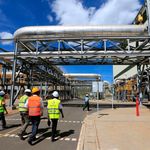
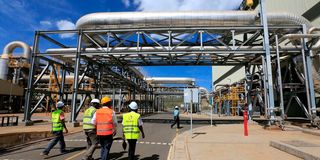
Kenya Electricity Generating Company (KenGen) workers walk at the Olkaria II Geothermal power plant near the Rift Valley town of Naivasha, Kenya on February 15, 2018. KenGen is aligning with Paris Agreement carbon markets by advancing innovative green and low-carbon energy technologies.
The Public Procurement Administrative Review Board (PPARB) has been ordered to hear afresh a case where a firm has challenged its disqualification from Kenya Electricity Generating Company’s (KenGen) Sh2.5 billion sale of carbon credits.
The Court of Appeal issued the orders last week adding that PPARB should set up a new panel to hear the petition where Sintmond Group disputed KenGen’s decision to disqualify it from the tender.
Sintmond Group has challenged KenGen’s decision to disqualify it from a tender for the sale of 6.38 million carbon credits. KenGen awarded the deal to a joint venture of Munja Trading Limited and Marwil Energy Holding.
A fresh hearing of Sintmond’s petition before the PPARB looks set to further delay KenGen’s quest to unlock the sale of the 6.38 million carbon credits as part of revenue diversification.
A carbon credit refers to a certificate that allows an organization to buy and sell the rights to emit greenhouse gases such that entities that reduce their emissions can sell their carbon credits to those that have exceeded their prescribed limits.
"Fourth, the dispute is remitted to the Public Procurement Administrative Review Board for fresh determination before a differently constituted panel in accordance with the legal guidance contained in this judgment,” the three-judge bench of the appellate court said in a ruling dated July 10, 2026.
The Court of Appeal also set aside the High Court ruling issued on May 20, 2026 which had backed PPARB’s decision to uphold the disqualification of Sintmond.
KenGen disqualified Sintmond from the tender at the due diligence stage on grounds that the firm had failed to show proof of prior experience or capacity to manage the sale of carbon credits of such a magnitude like the Sh2.5 billion deal.
Court documents show that the dispute arose concerning the meaning and application of MR-16 –a requirement intended to establish bidder experience in handling Certified Emission Reduction (CERs) or Voluntary Emission Reduction (VER) transactions.
CERs are tradable carbon credits issued by the United Nations under the Clean Development Mechanism (CDM) of the Kyoto Protocol.
Each CER represents one metric tonne of carbon dioxide equivalent reduced, avoided, or sequestered by verified climate projects in developing countries.
VERs refer to verified carbon offset credits generated by climate action projects outside of mandatory regulatory frameworks.
This will be the fourth time that the PPARB is handling the case between Sintmond and KenGen. The tribunal has in the past nullified the tender.
KenGen producer is banking on the sale of its CERs to diversify and boost its revenues, helping to keep the power producer on the profitability path.
The power producer recently disclosed that it has six projects registered under the CDM and had a total of 6,384,398 CER’s available for sale as at June last year.
The CERs are spread across the Olkaria II geothermal expansion project, redevelopment of the Tana hydro power station, optimisation of the Kiambere hydro plant, the Olkaria IV project, the Olkaria I Units 4&5 geothermal project and the 5.1Megawatt Ngong Wind project.
Sale of CERs is part of KenGen’s plan to grow its non-electricity generating revenues to account for at least 20 percent of the firm’s overall revenues. KenGen made Sh56.09 billion in revenues for the year ended June 2025.
“The goal is to grow our non-electricity generating revenues to account for 20 percent of total revenues, strengthening resilience and positioning KenGen as a holistic energy solutions provider,” KenGen says in the report.