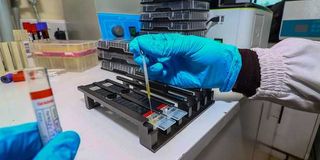
Kenya's fertility industry is now one of the country's fastest-growing specialised healthcare markets, with over 15 established in vitro fertilisation (IVF) centres now operating nationwide, up from just a handful two decades ago.
IVF is a form of assisted reproductive technology where a woman's egg and a man's sperm are combined in a laboratory and the resultant embryo is then transferred into the uterus to establish a pregnancy.
However, rising IVF treatment costs mean that many interested patients are locked out of such procedures.
A standard IVF cycle costs around Sh600,000, covering hormone stimulation through to the pregnancy test but excluding diagnostic investigations. Depending on the patient's condition and the treatment protocol, total treatment costs range from Sh500,000 to Sh1 million.
Patients also spend between Sh30,000 and Sh50,000 on pre-treatment lab tests, while a frozen embryo transfer using previously stored embryos costs around Sh150,000.
Most insurers that offer IVF benefits reimburse between Sh400,000 and Sh600,000, often requiring patients to make co-payments.
Meanwhile, only a handful of employer-sponsored medical schemes cover the full cost, so many patients pay for treatment.
“There are people who want to access the service and require it but cannot afford it,” said Wanjiru Ndegwa-Njuguna, consultant obstetrician and gynaecologist specialist in reproductive medicine at Footsteps fertility centre. “The economic situation has declined over the last two years, and I think that's a big factor.”
She said interest continues to rise even as more patients postpone or abandon treatment because of cost.
At the Nairobi IVF centre, the number of IVF cycles performed each month has climbed to between 80 and 100, a figure that once represented the entire output of Kenya's IVF industry.
Joy Noreh of Nairobi Fertility Centre attributes this growth to changing attitudes towards infertility.
“People now know that it is not a curse. They know that it is a disease," she said.
A study by researchers at the Footsteps Fertility Foundation found that 26.1 percent of patients at gynaecology clinics were subfertile, with around half of the cases being attributed to tubal factors and 15 percent to male factors.
Researchers said the true figure is probably higher, as stigma still causes many couples to consult traditional healers or religious leaders before visiting fertility clinics.
Separately, the Kenya Association of Urological Surgeons estimates that 10 to 15 percent of Kenyan couples experience infertility.
Doctors also report that more men are accompanying their partners for fertility assessments, reflecting a shift in perception that infertility is primarily a woman's issue.
"Men understand that they can have fertility issues too and accompany their wives to the clinic," said Dr Ndegwa.
She said male-factor infertility now accounts for nearly half of the cases seen at her clinic.
She further noted that patients are coming in much earlier than they did a decade ago. IVF was previously often considered only after many years of unsuccessful attempts to conceive. Today, more couples seek specialist care after just one or two years of trying.
“When we started, it was a little bit depressing,” said Dr Ndegwa. “We'd only see patients aged 40 and over, where the chances of success are much lower.”
Now, however, she says that more couples in their late 20s and early 30s are seeking treatment much sooner, because they don't want to wait.
The local growth mirrors a global trend. The global IVF market is expected to be worth around $31 billion by 2026, growing by approximately seven percent each year until 2034.
Meanwhile, the Middle East and Africa region, which includes Kenya as one of its more established fertility markets, is expected to grow even faster, at almost 17 percent a year.
Dr Ndegwa identified two reasons why IVF remains expensive in Kenya.
First, the sector relies almost entirely on imported IVF medicines, laboratory media, equipment and consumables, meaning clinics are exposed to exchange-rate fluctuations, freight costs, and import taxes, which are passed on to patients. Kenya also has no local embryology training programme, meaning that specialists must train overseas, with the costs being recovered by clinics through treatment fees.
“IVF is individualised. My treatment plan is not the same as somebody else's. It's not like buying bread, where everyone pays the same price," said Dr Ndegwa.
He added that Kenya's long-standing lack of a comprehensive law on assisted reproduction has also shaped investment in the sector.
For years, the absence of clear surrogacy laws attracted fertility agencies and investors, particularly after countries such as India tightened the rules on commercial surrogacy for foreign nationals.
“I don't think Kenya is the easiest place to invest, and I don't think the need for IVF is greater than in other countries,” she said.
However, this is about to change after the National Assembly passed the Assisted Reproductive Technology Bill in November last year, after more than a decade of waiting.
If enacted, it will establish Kenya's first licensing and regulatory framework for fertility clinics, prohibit commercial surrogacy and restrict surrogacy arrangements to Kenyan citizens, thereby closing the loophole that had attracted foreign fertility tourism.