Time flies with great content! Renew in to keep enjoying all our premium content.
Prime
The entrepreneur turning soapstone into corporate gold
Egware Museum founder Mogusu Momanyi (right), sculptor Chrispus Oendo (centre) and experience executive Abel Mogambi with soapstone sculptures at Sarit Centre, Nairobi, April 15, 2026.
There are many ways to describe Mogusu Momanyi’s soapstone enterprise, which is based at the Sarit Centre in Nairobi’s Westlands district. With a shop selling carved items on the ground floor and a soapstone exhibition in the basement, it’s easy to view it as a young man’s dream come to life. The shop has been open for three years, while the exhibition opened in December 2025.
Thanks to Mogusu’s marketing expertise, corporate trophies made of soapstone have quickly gained popularity. Organisations such as the UN Global Compact, KPMG, Microsoft, eCitizen, Safaricom, and St. Andrew’s School in Turi have commissioned trophies from this young entrepreneur.

These corporate trophies, priced between Sh15,000 and Sh50,000 each, have kept the enterprise afloat.
“We are the pioneers of soapstone corporate trophies,” Mogusu asserts. “These trophies fund our enterprise and provide the liquidity we need to operate here at Sarit Centre.”
In addition to corporate trophies, bespoke carvings have also attracted frequent clients. “They appeal to those who appreciate handcrafted items,” he notes.
Standing out from competition
Mogusu, who is 30 years old, has been passionate about soapstone since his student days at Kisii School. His club sold carvings at expositions and competitions.
“I truly believed in it,” he recalls, mentioning how he convinced his Junior Achievers club to focus on soapstone, achieving a national ranking of second place in a 2013 competition while in Form Three.
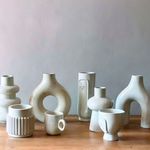
Sculptures carved from soapstone on display at Egware Museum Sarit Centre, Nairobi on April 15, 2026.
Photo credit: Lucy Wanjiru | Nation Media Group
However, while studying commerce and marketing at the University of Nairobi, he took a detour.
“In my fourth year, I was hired by a marketing agency, where we built multinational brands,” he remembers. That was his only employment; after graduating, he started his own marketing agency, which ultimately struggled.
When the agency hit a snag, he returned to soapstone.
Mogusu’s passion for the stone is rooted in his upbringing. He grew up witnessing the mining, carving, and selling of soapstone in his village.
“I was raised in the stony hills of Tabaka in Kisii County, in a village called Nyabigege,” he shares, recalling how he watched soapstone carvers scrambling to sell their wares to passing buyers. What struck him most was how undervalued soapstone products were.
He opened his first soapstone shop in Nairobi's Karen neighbourhood, investing all his savings. However, it quickly became evident that running the shop would be a challenge. Initially, he was to pay Sh60,000 in rent per month, but the landlord, recognising his hard work, halved the amount. “Because you’re working hard, and people can see it, I’ll cut your rent,” the landlord said.
The turning point
One morning, while out running, Mogusu spotted a banner advertising an art fair at Village Market. He contacted the organisers, only to learn that the booking fee was Sh10,000, of which he could only raise Sh3,000.
“Somehow, they granted me an extension, even though everyone else paid upfront. That first day, I realised there was an opportunity,” he recalls, noting the high interest in his products from both customers and competitors. “What I could sell at Village Market in three days would cover my rent in Karen,” he adds.
He also participated in a trade fair at Sarit, where he met the mall's owners and eventually secured a shop. To raise the necessary funds, he turned to friends for support.
“I reached out to friends who had jobs at big companies, asking them to donate. Just imagine asking your peers to fundraise for you! Fortunately, some friends in senior roles were able to help, and we set up the shop,” Mogusu explains.
'Missionary service'
Participating in art fairs has allowed him to reconnect with former classmates and lecturers, who often wondered why he chose this path.
“It was tough knowing I could be a graduate trainee or a corporate executive while standing in front of a store where my peers were shopping,” he reflects, recalling that he turned down offers from top companies after university. “I declined the corporate world,” he states, noting that he sees his work as a form of missionary service.
“A missionary doesn’t care about income; they believe they will convert people to their vision,” Mogusu explains.
“Missionaries explore, not knowing if they’ll succeed, but dedicating themselves to a cause regardless of potential failure.”
Sculptures carved from soapstone on display at Egware Museum Sarit Centre, Nairobi on April 15, 2026.
Photo credit: Lucy Wanjiru | Nation Media Group
He adds, “I like to think I’m playing an infinite game. You choose an industry that’s struggling and revitalise it by focusing on customer experience and possibilities. You create visions and ideas, and that’s what birthed this enterprise.”
At the Egware Soapstone Exhibition, visitors pay to experience the journey of soapstone, from rock to polished art. Abel Mogambi, the exhibition experience executive, guides visitors, pausing occasionally to let key points resonate.
“One factor that enables the stone to exist in the ground is that Tabaka is on a hill,” he explains. “The second factor is the amount of tree cover in the area.”
He notes that not much scientific research has been done to explore additional factors. “In Africa, only two countries have soapstone: Kenya and Zimbabwe. Globally, there’s also India and Brazil.”
Showcasing achievements
The exhibition features a chart showcasing the business's achievements since 2023: 31,200 sculptures sold, generating Sh10.5 million in revenue; 28 men and 42 women employed; and 70 soapstone sculptors engaged.
The experience culminates with visitors receiving a piece of soapstone and the tools to carve their own sculptures, along with aprons, gloves, masks, goggles, and access to running water.
“The greatest lesson I’ve learned here is that creating a soapstone sculpture is hard work. It’s challenging at first, but once you finish, the joy is immense,” Mogusu says. “People come here excited by the photos and videos they see online, but when they sit down to create, they realise how difficult it truly is.”
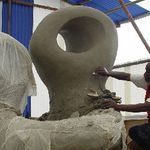
Inside the exhibition, BDLife meets Chris, the resident carver, who also teaches visitors how to carve. Mogusu explains that Chris was brought from Kisii to enhance the craft's value. In Kisii, carvers work tirelessly to produce artworks that are often sold cheaply to traders for export.
“I’d rather you spend a day carving and earn at least Sh5,000. That would transform your life,” says Mogusu.
Winning over corporates
So, how did this enterprise win over corporate clients?
"These corporations come to us because of our commitment to sustainability,” Mogusu explains. “They’re interested in the UN’s Sustainable Development Goals: ending poverty, providing employment, increasing income, and preserving heritage. They’re looking for something more.”
He adds, “While they could easily go to their usual Chinese or Indian suppliers, they choose us because they want a story behind the pieces they purchase.”
The process of creating a corporate trophy is consultative. For each commission, Mogusu meets with the client to understand the event's theme and the emotional response they want the recipient to experience.
Designs with an AI touch
AI tools now assist with initial design concepts. “You provide AI with your brief, and it generates ideas that you can tweak,” he notes, adding that the final piece is entirely hand-carved by master sculptors.
Sculptures carved from soapstone on display at Egware Museum Sarit Centre, Nairobi on April 15, 2026.
Photo credit: Lucy Wanjiru | Nation Media Group
Mogusu dreams of starting a sculpting school in Kisii and recently travelled to Italy with other businesspeople, coinciding with President William Ruto’s visit to the country. He continues to aspire to great things for soapstone.
Concerned that soapstone sculpting is disappearing as a high-skill art form—especially since many accomplished practitioners are in their 50s—he asks, “Why should an ancient craft die out while we stand by? Why not create a platform for others to appreciate it, especially those willing to learn?”
The shop is open every day except Saturdays, and Mogusu, an Adventist, describes his enterprise as faith-based.