Time flies with great content! Renew in to keep enjoying all our premium content.
Prime
The dragon fruit bet now a big success on a quarter-acre dry land
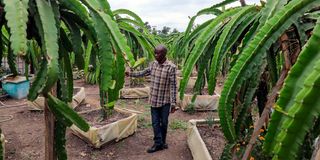
Kran Farm owner and dragon fruit farmer Kennedy Macharia speaks to the media at his farm in the Joska/Kamulu area on the outskirts of Nairobi on June 22, 2026. Macharia is among Kenyan farmers embracing the cultivation of the high-value crop.
When a prolonged drought wiped out his crops, Kennedy Macharia faced a choice familiar to many farmers in Kenya's drylands: keep gambling on unreliable rains or find a crop that could survive without them. He chose the latter.
Today, the former construction worker harvests up to 400 kilogrammes of dragon fruit every month from a quarter-acre in Joska, Machakos County, proving that even in one of the region's driest areas, the right crop can turn adversity into profit.
“In 2003, land in Joska was cheap because the area was undeveloped. I was working as a casual labourer in the construction industry,” he recalls. He bought an acre for Sh600,000 and today, the parcel of land hosts a thriving dragon fruit farm.
Thanks to years of investment in agriculture and the area’s rapid growth, the land, located about 1.5 kilometres off Kangundo Road, has appreciated significantly in value. According to Mr Macharia, an acre in the area is now worth about Sh10 million.
“In fact, finding an acre today is almost impossible. Most real estate developers buy large parcels, subdivide them into 50-by-100-foot plots and resell them for as much as Sh1.3 million each,” he says.
The founder of Kran Farm, who hails from Kangema in Murang’a County, describes Joska as an arid and semi-arid land area whose economic potential can only be fully realised through real estate development or irrigated agriculture due to chronic water shortages.
“If one does not invest in real estate, then farming is the other option, although it comes with challenges because the area is dry and rainfall is highly erratic,” he explains.
Driven by his passion for agriculture, Mr Macharia ventured into farming after fully paying for the land and relocating his family there in 2014. He started small, growing maize, beans and soya beans for both household consumption and sale. He also cultivated various vegetables and kept chickens, goats and rabbits.
However, he relied entirely on rain-fed agriculture, which often proved challenging. Speaking to BDLife, Mr Macharia says some seasons were so dry that crops withered before maturity, forcing him to feed the damaged produce to his goats.
Those challenges eventually led him to one of the most profitable decisions on the farm. During the prolonged drought of 2022, which spilled over into 2023, Mr Macharia began questioning the viability of conventional crops in an area where rainfall had become increasingly unreliable. The situation was so severe, and only hardy plants such as sisal and aloe vera could survive the stress.
“I realised that crops known to survive in dry areas were the only solution. I had to rethink what I was growing,” he says.
The farmer embarked on extensive research, seeking crops capable of thriving under harsh climatic conditions while generating attractive returns. His search led him to dragon fruit, a cactus-like crop that has increasingly gained popularity among health-conscious consumers and high-end fruit buyers.
To understand the enterprise better, Mr Macharia visited a dragon fruit farm in Juja. What he saw convinced him he had found the crop he had been looking for.
“The plants were thriving despite the dry conditions, and I was surprised to learn that a single fruit could fetch close to Sh1,000 depending on its size and quality,” he says.
Unlike maize and beans, which depend heavily on rainfall and seasonal markets, dragon fruit promised year-round production and higher earnings from a relatively small area.
In 2023, he purchased 40 seedlings at Sh850 each and established his first plot. All the seedlings survived, giving him a rare 100 percent success rate. After about one year, the plants began fruiting, although the first harvest yielded less than 100 kilogrammes.
Encouraged by the results, he started expanding gradually. Today, Mr Macharia has between 700 and 800 dragon fruit plants spread across a quarter-acre parcel. The crop is planted in phases to ensure continuous production throughout the year.
Dragon fruit cultivation at Kran Farm in the Joska/Kamulu area on the outskirts of Nairobi. Farmer Kennedy Macharia is among growers embracing the high-value crop. Photo taken on June 22, 2026.
Photo credit: Dennis Onsongo | Nation Media Group
“Getting to this level has required sacrifice, patience and a lot of effort,” he says. The farm currently produces between 250 and 300 kilogrammes of dragon fruit every month, with output sometimes rising to 400 kilogrammes during peak periods.
His goal, he says, is to produce larger fruits weighing about 500 grammes each, meaning two fruits make a kilogramme. To achieve this, he relies heavily on organic manure from his goats and chickens.
The venture has transformed what was once a one-man operation into a source of employment. During busy periods, he hires two casual workers to assist with farm activities.
Besides production, Mr Macharia has built a market that extends far beyond Joska. His largest customer base comes through digital platforms including Facebook, Instagram, TikTok and YouTube, where his daughter plays a central role in promoting the farm and engaging potential buyers.
“My Gen Z daughter is heavily involved in digital marketing,” he says.
She also helps research new production techniques and market trends online, making her an important pillar of the business. Orders flow in from different parts of Nairobi, and Macharia regularly delivers fruits directly to customers in the central business district while also serving local markets.
To ensure sustainability and profitability, he closely monitors production costs, inputs and maintenance requirements: “You have to understand the mathematics of agribusiness. If you don’t keep records and monitor your costs, you can easily lose money."
Record keeping has become one of the biggest lessons he has learnt during his agribusiness journey. Another lesson is the importance of research before investing in any enterprise.
His success with dragon fruit, he says, was only possible because he took time to understand the crop, visit existing farmers and study market demand before planting.
To reduce production costs, he now propagates his own seedlings from mature plants. “I carefully select healthy suckers measuring about one foot from plants that are more than one year old.”
Even with the transformation he has done in Joska, water management remains his biggest challenge. To minimise water use, he has adopted raised-bed technology combined with mulching using dry organic matter. The practice helps conserve moisture and suppress weeds. He is also investing in water harvesting systems, including tanks and a dam with a storage capacity of about 50,000 litres.
“Water shortage was the biggest problem when I started and it is still the biggest challenge today,” he says.
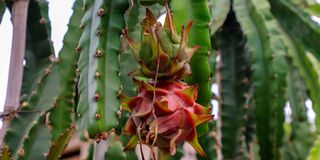
A ripe dragon fruit harvested at Kran Farm in the Joska/Kamulu area on the outskirts of Nairobi. Farm owner Kennedy Macharia is among Kenyan growers embracing the cultivation of the high-value crop. Photo taken on June 22, 2026.
Photo credit: Dennis Onsongo | Nation Media Group
Fortunately, dragon fruit has relatively few disease problems. To repel pests naturally, he has planted Mexican marigold between the rows of dragon fruit plants.
The transformation of his farm reflects the rapid growth of Joska itself. The area that was once characterised by dry bushes, sisal plants, hyenas and snakes has evolved into a thriving peri-urban settlement where land values continue to soar.
Mr Macharia believes dragon fruit offers an opportunity for farmers in arid and semi-arid areas to generate income from small parcels of land while making productive use of spaces that would otherwise remain idle.
“Do not leave your land with empty spaces. Dragon fruit beautifies the farm and at the same time brings value and income,” he says.