He started cooking in Nairobi homes, now he’s built a thriving meal prep business

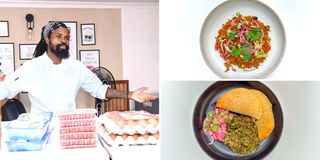
Godrick Mali, founder of Mali’s Meals, during an interview (left), and dishes he prepared in Lavington, Nairobi, on April 2, 2026.

Photo credit: Wilfred Nyangaresi | Nation Media Group

Godrick Mali Luta did not set out to be an entrepreneur. He began by cooking in people’s homes, a skill sharpened in childhood when his mother insisted her sons prepare their own meals.

“I had moments in my childhood that could point to how I ended up here,” he says, recalling how growing up in a house full of boys, his mother would have them cook for themselves. “And then, whenever we travelled from Western Kenya to Nairobi, we would prepare maandazi and chapati to eat on the road to cut costs.”
Still, he insists, that is not where his love for cooking began. Instead, it came later, almost by chance.

“I mentioned once while in high school that I would like to be a chef someday and my family members started throwing anything food-related my way,” he says. “So when the opportunity came, I found myself working at the bakery of a family acquaintance. There was no real payment because I didn’t go in with much knowledge, but she would always appreciate my work.”

He started out with wedding and birthday cakes, learning both the technical precision and discipline required for the craft. But while the experience sharpened his skills, it also exposed his shortcomings.

“I have a love-hate relationship with baking,” he says. “Particularly when it comes to sculpting figurines for decoration, I could never get it quite right.”

Kale and roasted chickpea Caesar salad at Mali’s Meals in Lavington, Nairobi, on April 2, 2026.

Photo credit: Wilfred Nyangaresi | Nation Media Group

When the bakery later expanded into other types of food, it allowed him to tap into his curiosity and experiment beyond pastries. It was in this shift that he discovered a stronger inclination towards cooking.

“My employer would also encourage me saying that I have a good palate,” he adds. “Whenever she made something and I recreated it, my version would always taste better.”

His interest sufficiently piqued, the 31-year-old eventually left the bakery and sought out opportunities in restaurant kitchens. It was while he was still in one of these professional kitchens that his first client called him.

“It was a friend of my former employer, the baker,” he recalls." She said she needed help prepping meals for the coming week and had been told that I was a great cook.”

He agreed to the request.

“I went to her home and prepped for five meals, some freezer-friendly and others kept in the fridge,” he says. “And that is where it all began.”

The response, he says, was positive and immediate. Word spread from that first client to the next, each referral leading to the next: “You know how it is in Nairobi, when people are in the same spaces and someone asks, ‘How do you solve this problem?’, someone will respond and say, ‘I have this guy,’ and share a contact.”

Miso-Ginger Aubergine and Halloumi Salad at Mali’s Meals in Lavington, Nairobi, on April 2, 2026.

Photo credit: Wilfred Nyangaresi | Nation Media Group

But even as demand for his services began to snowball, Godrick was still in employment.

“The restaurant used to be closed on Mondays, and then there were days when I was off and others when my shift would only last half a day,” he says. “I would use these pockets of time to cater to my clients.”

Eventually, he left the restaurant and focused on his growing client base. Driven by convenience, as well as the quality and longevity of his meals, demand grew to a point where he would cook in up to three houses a day, seven days a week.

His system was simple: He charged a service fee of between Sh3,000 and Sh3,500, while his clients covered the cost of the ingredients.

“I wanted the freedom to be creative so I would come up with a menu, share it with the client and then adjust it based on their preferences,” he says. “Then I would give them a shopping list and either purchase the items myself, or work with whatever they had in their home. Then I would go to the house, cook, package the meals and leave.”

Godrick Mali, founder of Mali’s Meals, during an interview in Lavington, Nairobi, on April 2, 2026.

Photo credit: Wilfred Nyangaresi | Nation Media Group

The workload was relentless prompting those around him to encourage him to scale up. The turning point came when some of his clients banded together and, instead of cooking from house to house, suggested he cooks all their meals in one location and distribute them accordingly. This idea became the foundation of Mali’s Meals.

“I started cooking in batches in January 2025, then officially launched Mali’s Meals in April that same year.”

With clients who willingly offered their kitchens for his work, his business required little to no start-up capital, something he is grateful for.

“I didn’t have to make an initial investment to start, and that’s an actual blessing,” he says. “Over time, I did spend about Sh 300,000 in things like packaging and delivery crates, things that I thought would make the business grow and do better in the long run. I have recovered at least two thirds of that money so far, but for me, Mali’s Meals is a community. I’m just a cook.”

His first employee, a fellow cook who had initially come in to help, onboarded from his first day operating a scale. But as demand grew, so did the team. By the time Mali’s Meals was officially launching in April, Godrick had three cooks working alongside him.

Charred Broccoli & Kale Caesar Salad at Mali’s Meals in Lavington, Nairobi, on April 2, 2026.

Photo credit: Wilfred Nyangaresi | Nation Media Group

“Today, it has grown into something different. We have five cooks, a steward, a coordinator who oversees packaging and logistics and a social media person,” he says.

“I cook less since starting this business, and that has its benefits because it empowers the younger cooks, but I’ve come to realise that a cooking business is not only about cooking and I’m really trying to buy back the freedom to just enjoy cooking, because that is the main thing after all. Besides, there are plenty of talents out here who can do some of things quite well and it doesn’t hurt to give them the platform.”

Rather than operate on a day-to-day basis, the business now runs on a tight weekly schedule. They rest on Mondays but as soon as Tuesday rolls around, they begin planning the week’s menu.

“We try and do a different menu every week,” he says. “Before I used to create it myself, but now it’s a collaboration between me and my team. I prefer it this way because it helps them become more creative.”

The menus are shared on Wednesdays with orders coming in from that afternoon. By Friday afternoon, the team has a clear picture of how many households they are cooking for and the volumes of meals required, allowing them to begin sourcing for ingredients which are delivered by Saturday morning.

Preparations start on Saturday afternoon with cleaning and chopping vegetables such as kale, traditional vegetables, potatoes, radishes, lettuce, pumpkins, zucchini, bell peppers, tomatoes, onions, garlic, mushrooms, ginger, carrots and boiling staples such as beans. Sunday, the main production day, sees the team starting to cook as early as 6am. Once ready, the food is cooled, portioned, sealed and labelled before being dispatched later in the afternoon.

“We aim to have the deliveries done between 5pm and 5.30pm, just in time for dinner,” he says.

Yet despite the increasing numbers, the business has retained a deliberately simple system of ordering food. Menus are shared through a Google form that’s shared to their WhatsApp community and on their social media platforms, allowing clients to select meals and place orders with ease.

“I might need to evolve with time, but I didn’t want this to feel robotic,” he says. “I wanted it to feel like a having a personal chef in your home kitchen with whom you could communicate and discuss the week’s menu.”

On average, Mali’s Meals serves between 40 and 45 households every week, which translates to more than 200 individual meals. Main meals, which are mostly vegetarian, are priced at Sh995 with the option of adding meat to the dish at an additional Sh300. Lighter options such as salads go for Sh580. 

And while the revenue is good, Godrick says the expenditure matches what comes in.

“At the very least, the business is able to pay for itself,” he says. “This includes covering for operational costs, expansions such as paying rent for two more days than I used to before, and employee salaries even with the increase in staff over time.” 

Geographically, the business primarily serves Nairobi and its immediate surroundings, with deliveries concentrated in areas such as Lavington, Karen, Lang’ata and Gigiri.

Occasionally, orders come from further areas like Thika, but maintaining freshness has led the business to limit its delivery radius.

“To ensure the meals reach our clients in optimal condition, we try to keep delivery within a 30-minute window,” he says. 

Asked whether there has been a defining order that changed the trajectory of the business, Godrick’s answer doesn’t come right away. But rather than a single moment, he points to a shift in clientele.

“I think the one thing that really changed things for us was working with families,” he says, “When cooking for people with children you have to think differently about the menu. The assumption is that only young, single men have this problem, but it’s not,” he says. “We serve anyone with a busy schedule.”

Entrepreneur challenges

But like many growing enterprises, the journey has not been without its challenges. From finding reliable vegetable suppliers, building a dependable team and managing logistics, particularly delivery, Godrick says each stage has required adjustments. 

“I am a cook myself which means I eat, sleep, and breathe cooking. I feel like I was born to do this,” he says. “It’s challenging to get people who have the same level of commitment to it as I do but at the same time, it has challenged me to adjust myself to people who need to learn before they can get there.”

Scaling up, he admits, also has its own pressures. 
"No one wants to receive hundreds of orders and then fail to deliver, so we are trying to realise what our capacity is, so that we be sure to maintain that,” he says. “We are also looking into implementing new structures to help us manage the numbers better such as increasing the days we do delivery. But I think the farthest we will go is two days per week so that it doesn’t also defeat the basis of meal prep.” 

Beyond operations, however, one of his biggest lessons so far has been in earning trust.

“I want people to trust me to cook for them,” he says. “But when you’re dealing with people from different backgrounds and preferences, it’s not always easy.”

To maintain that trust, he regularly seeks feedback from his clients and works closely with his team to improve consistency. 
Another lesson has been in learning to delegate.

“I’ve had to accept that I can’t do everything on my own,” he says. “I realised that I need to let go and trust others to do the job. This way, I can ensure that those who are coming after me are stepping up and winning as well.”

That shift is tied to a broader vision for the business. 
“I want to make Mali’s Meals a platform that can create job opportunities for Kenyan cooks,” Godrick says. “I also want to create a training hub for people who cook at home, including house managers, so they can improve their skills.”

This cause is especially dear to him as he himself basically learnt his craft on the job.
“I personally believe that one learns cooking in the field and by meeting different chefs,” he says. “I did a degree in Economics with a minor in Sociology in university. My only experience with culinary school was when I participated in a cooking show, The Great Kenyan Bakeoff, and met a wonderful lady who sponsored me for a short course at Boma Hotel.”

But where others might consider starting their own restaurant someday, Godrick remains adamant.

“A restaurant would mean having the same menu every week and having to go in and cook every single day and I don’t care for that,” he says. “Instead, I dream of getting a piece of land where I grow my own crops, harvest them and do pop-ups once in a while which are all about the food and feature nice, simple cooking.”

His ambitions further include making his meals more accessible both by expanding his radius of delivery and by developing signature food products that can be found in shopping outlets.

And while he admits to having a constant fear that the business could fail, his focus, which also doubles up as his advice to others, remains simple: showing up.
“Just start and keep going,” he says. “Even on the days you feel like stopping, show up.”

Follow ourWhatsApp channel for the latest business and markets updates.

PAYE Tax Calculator

Note: The results are not exact but very close to the actual.