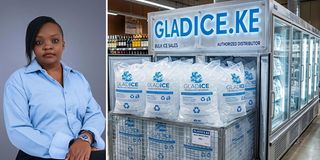
Many people drop a few ice cubes into their favourite drink without giving much thought to how they are manufactured. Yet behind the ice cubes used in cooling whiskies or juice are entrepreneurs earning millions of shillings. They have found a ready market in homes, pubs and restaurants, hospitals, fish markets, and even in wellness centres and supermarkets.
Gladys Anyango is among the Kenyans in this business.
The founder of Glad-Ice Enterprise says she stumbled on an opportunity; what many people take for granted.
She was in air ticketing and business administration and built her career managing supply chains and vendor relationships in Nairobi. Those skills would later prove valuable in identifying a market gap that many may have overlooked.
In 2015, she travelled to Juba, South Sudan, for work as a customer experience support officer. However, delayed salary payments forced her to look for alternative income streams to sustain her while in Juba.
Juba's climate presented a unique opportunity. "The temperatures could reach 40 degrees Celsius, and many people were constantly looking for chilled drinking water and ways to cool down temporarily," she recalls.
Recognising the growing demand, she ventured into specialised ice production in 2016 and bought the ice-making machine for $6,000 (Sh770,000). The business quickly gained traction, helping address cooling shortages in Juba, where ice was a necessity rather than a luxury.
Operating in a harsh climate environment was not easy, but the business attracted a good number of clients and demonstrated the commercial viability of professional ice production. However, civil unrest and insecurity eventually disrupted operations, forcing her to return to Kenya in 2019.
Back home, the timing was hardly the best one would want to return to. Her return coincided with the Covid-19 pandemic and a shrinking job market. Companies were slowing recruitment, while others were laying off workers altogether.
She had come back home with her machinery from Juba and still possessed the operational knowledge she had gained while running the business there. Combining those assets with her logistics experience, she decided to open an ice-making business from her home.
"I started marketing the business on my Facebook page, just like many people were doing at the time," she says.
Restaurant owners, bar operators and fishmongers began making enquiries even before she had fully installed the equipment. The interest confirmed there was a significant and underserved demand for quality ice in Nairobi.
Today, Gladys operates from Ndwaru along Naivasha Road, where she has built a 100 to 150 square feet room in her compound. Here, using her ice-making machine, she produces up to 150 kilogrammes of ice per day. The space also accommodates the water filter system together with a storage tank, a commercial chest freezer and a sealing table to weigh the ice and package it.
How ice cubes are made
The production process relies on an industrial, commercial ice-making machine line integrated with strict water purification. Before the water touches the ice machine, it undergoes a multi-stage filtration process. This ensures high-purity, clean, and crystal-clear ice cubes that are free of contaminants.
The purified water is then pumped into the machine's evaporator grid, freezing it into a precise shape and size. Once fully formed, a brief harvest cycle uses warm gas to release the cubes into an internal collection bin.
The finished ice is immediately scooped, measured into either five-kilogramme or 10-kilogramme bags, and sealed before being quickly moved into a freezer to keep the temperature consistently between -10°C and -5°C to prevent the cubes from melting or freezing together into a solid block.
“Technically, frozen water doesn't expire biologically if kept constantly frozen,” she says, “for a commercial ice cube operation, the ice can last several months without spoiling or losing quality.”
However, most times, the ice is sold quickly to meet daily market demands. “The primary risk to shelf life isn't time, but temperature fluctuations. If the storage unit suffers a power cut or is opened too frequently, the surface of the cubes melts slightly and refreezes, clumping the cubes into a massive, unsellable block.”
Where she sells
Her primary customers, she says, are clubs, bars and restaurants. Others include fisheries, hospitality businesses and industrial users.
During weekends and public holidays, demand rises significantly, with sales often reaching between 250 and 300 kilogrammes.
Just like many enterprises, managing costs remains one of the most important aspects of a business. Electricity, water and licenses remain the biggest threats to profitability. “We cannot use hard water, and electricity is another major factor,” she explains.
“Ice-making machines consume a lot of power, and rising electricity costs can quickly eat into your margins if you are not operating efficiently," she says.
Electricity alone can amount to 30 percent of the expenses, that is Sh25,000 to Sh30,000, depending on the volumes of ice cubes produced in a month.
Water quality presents another challenge. To meet the clarity and hygiene standards expected by premium restaurants and bars, additional filtration systems are often necessary, an additional cost which she had overlooked previously.
Additionally, moving from informal sales to becoming a recognised supplier involves obtaining various permits and certifications. Selling branded bagged ice through supermarkets and retail outlets requires compliance with quality standards, regular inspections and licensing requirements.
There are also packaging costs to consider. The bags alone can cost more than Sh20,000 per month. When combined with water, electricity and labour expenses, monthly operating costs rise to approximately Sh74,000.
Despite the expenses, the business remains profitable. Gladys estimates that after deductions, monthly profits can exceed Sh100,000, with profit margins reaching nearly 59 percent of total monthly collections.
She currently employs three people who assist with deliveries, including casual riders, to assist her with customer supply.
Entrepreneur’s typical day
Her typical day runs from morning to evening or, at times, nights, depending on the demand for the ice. “We work in shifts, two employees during the day and one at night. In 24 hours, we can manage to collect and package 200 kilogrammes of ice and place them in the freezer, depending on the number of deliveries for the day.”
While Facebook was her first and most successful customer acquisition channel, she has since expanded to TikTok advertising, which she says is proving equally promising.
Juba or Nairobi?
When comparing the two markets, which one is better?
"In Juba, security was the barrier. In Nairobi, it's traffic and temperature," Gladys says, "delivering ice through heavy traffic without refrigerated transport requires careful planning and reliable insulation. Restaurants expect deliveries before peak service hours, and delays can easily result in lost business."
Lessons learnt
Over the years, Gladys shares her lessons learned in the business. One of the most important is validating demand before making major investments.
"Market first, manufacture second," she says.
Advertising on social media before fully setting up operations allowed her to confirm demand before committing additional resources. It is an approach she believes many entrepreneurs overlook when launching new ventures.
"Diversification has also become a key pillar of her strategy," she says. "The hospitality sector can be seasonal and vulnerable to economic slowdowns. Ice producers should explore other customer segments such as fishmongers, construction sites and healthcare facilities."
"My reputation is only as good as the last bag delivered," she says, adding, “cheap machines often consume more energy and break down more frequently. Scheduled maintenance is always cheaper than emergency repairs during periods of peak demand.”
The ice-cube buyers
With the growing demand, especially in the alcohol industry, ice sellers are looking at even better returns. Bill Graham, the general manager at Texas Barbeque Bar and Grill in Kikuyu, who also has his own ice-making machine, says ice cubes are no longer just an accessory to a drink. They have become an essential part of the hospitality business.
Having worked in the industry for about 13 years, he has witnessed firsthand the demand. "I sell a high volume of whiskies, and most drinkers prefer their whisky on the rocks," he says.
That demand, he notes, has created an entire demand around ice production and supply.
While his own ice production is primarily for use within the club, he occasionally supplies friends and event organisers. “I supply per kilogramme depending on the event, from about Sh300. On a busy weekend, I can do around 300 kilogrammes," he says.
His machine produces approximately five kilogrammes of ice per hour, but there are times when even that is not enough.
"Sometimes when there are big events on weekends, the demand becomes so high that I am forced to buy extra ice cubes because whisky consumption is very high," he says.
For aspiring entrepreneurs looking to start ice-making, he believes success depends on understanding the market before investing heavily.
"First of all, they need connections and networking. They should know their market," he says.
"Start small, focus on quality and grow gradually. At the end of the day, the more you supply good quality, the more customers you get," he says.
Additionally, he also recommends having backup plans in place, particularly for power interruptions such as generators.