Time flies with great content! Renew in to keep enjoying all our premium content.
Prime
Ever-green mitumba jeans trade that is a darling for Kenyan traders
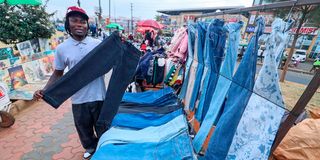
Wycliffe Omondi, popularly known as Quan, arranges a display of second-hand (mitumba) jeans at his roadside stall in Roysambu, Nairobi, on July 21, 2026.
Photo credit: Wilfred Nyangaresi | Nation Media Group
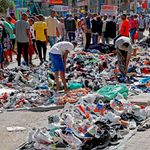
Every week, containers loaded with second-hand clothing land in Kenya, sustaining one of the country's most enduring informal industries. In them are tightly packed bales of denim that find their way to wholesalers in Gikomba, Nairobi, retailers in markets across the country and, ultimately, wardrobes of consumers looking for quality, branded jeans at a fraction of the price of new ones.
Morris Kamau first ventured into wholesale second-hand shoes before noticing demand for denim. Over the past 18 years, his business has grown to supply customers across Kenya and the wider East Africa.
“We import from the UK, Canada and China. The quality and price of the bale is determined by the country we source it from,” says Kamau.
A bale containing around 70 pieces can sell for Sh10,000, while one containing 90 items can fetch around Sh20,000. A premium 50-piece bale may cost Sh40,000. He adds that there are also carefully selected consignments of high-quality jeans that can sell for as much as Sh100,000 per bale.
According to Kamau, consignments from China tend to be cheaper, while bales from the UK and Canada command higher prices as buyers associate them with better quality and popular brands.
"Sometimes I import jeans on order for customers who want them from specific countries, but most of the time I just have a general shipment," he says.
Retailers can visit his warehouse to buy sealed bales, although his long-term clients are allowed to handpick grade one pieces from opened consignments.
“The business is lucrative, and we have seen more and more entrepreneurs coming into this field. There are many more wholesalers today than when I started,” Kamau says.
However, like many businesses, this trade comes with its risks.
“You can promise a client that a bale contains 50 pairs of jeans, but when it is opened, not all of them may be in good condition. Quality is one of the biggest challenges in this business, so it is crucial to have a reliable supplier,” he says.
Kamau adds that finding reliable suppliers is important for maintaining customer trust and sustaining the business.
He also notes that competition has intensified as more traders enter the market.
“Someone can buy from three different wholesalers, pick the best jeans, and create a very clean bale that sells at a higher price,” he says.
To remain competitive, wholesalers have adapted by offering more flexible options, including opening bales for loyal customers seeking specific grades and brands.
Despite the growing competition, Kamau believes that demand for these second-hand jeans remains strong, particularly among consumers seeking quality denim at affordable prices. This demand has also been influenced by a growing network of traders supplying markets across Kenya and East Africa.
The opportunities created by this supply chain can be seen in entrepreneurs such as Jayson Oyang, who first ventured into the business as a university student with just Sh2,500 to his name.
While studying for a degree in Architectural Engineering at the University of Nairobi, Jayson noticed that baggy jeans were becoming increasingly popular among students.
“I’ve always had a sense of fashion, especially when it comes to jeans. Most of my peers loved baggy trousers, and that’s where I got the idea to start a second-hand clothing business,” he says.
Jason Oyang assists a customer while sorting and displaying second-hand (mitumba) jeans at his roadside stall in Roysambu, Nairobi, on July 21, 2026.
Photo credit: Wilfred Nyangaresi | Nation Media Group
He bought his first stock from Gikomba, hoping to make enough profit to go back for more.
“I started with flannels, but they didn’t sell well,” he says. “Then I moved to cargo trousers. They did well until they went out of fashion. That’s when I decided to focus on jeans.”
His customers were fellow students, so his business depended on understanding what young people wanted to wear.
"When you first start a business, you don’t always know exactly what your customers want. Sometimes you buy something thinking people will love it, only to realise that it doesn't sell. You learn from those mistakes and, over time, you begin to understand your customers,” he says.
He goes to Gikomba almost every morning to source stock from trusted wholesalers with whom he has built relationships over the years.
"I don’t really have specific market days. I have people I buy from, and I go there almost daily because I know the quality of their stock.”
The growth of his business is reflected in the amount of capital he can now commit to stock.
“The most I’ve spent on stock in a single day is Sh65,000,” he says.
At his stall, there are around 200 pairs of jeans in various cuts, colours and styles that retail between Sh600 and Sh1,200.
“I stock straight jeans, mum jeans, hard jeans, cargo jeans, combat trousers and shorts. You have to keep changing with what customers are looking for."
Jayson says that his clientele is mainly women in their 20s and early 30s, although he adds that male shoppers in the same age group have become an increasingly.