The soft hum of a filter pump and the gentle movement of ornamental fish might seem far removed from the bustle of business. Still, for an increasing number of Kenyan entrepreneurs, aquariums are proving to be much more than just decorative items. They are becoming a thriving niche business, serving homes, offices, hotels, and corporate spaces.
Entrepreneurs such as Melvin Ondeyo (founder of MEL Aquariums) and Kenneth Mvati (founder of Fuzu Aquariums), have seen a steady rise in demand for custom fish tanks and aquatic installations over the years.
This has been driven largely by social media exposure, changing tastes, and growing awareness of the therapeutic benefits of aquariums.
Mr Ondeyo ventured into the business in 2019 after noticing unexpected interest in his home aquarium.
"We had our own aquarium at home, and after posting pictures of it online, I started receiving lots of enquiries. That's when I realised there was a business opportunity there," he says.
Unlike many businesses that target a specific income bracket, aquarium dealers say their products can be tailored to suit almost any budget.
"Initially, we were targeting everyone because aquariums come in different sizes and price ranges. Anyone can keep them, and anyone can afford them. Beyond business, aquariums are therapeutic," says Mr Mvati, who started his business in 2014 after graduating from university.
The business primarily generates revenue through selling aquariums, although maintenance services, fish sales, accessories, and installations also provide additional income.
For MEL Aquariums, cleaning and servicing have become an increasingly important source of income.
"Aquariums need servicing and cleaning after about four weeks, so maintenance services contribute significantly to our revenues," says Mr Ondeyo.
For Fuzu Aquariums, however, the tank itself remains the biggest earner.
"Our main source of revenue is aquariums. Anyone who buys from us gets free delivery and installation," says Mr Mvati.
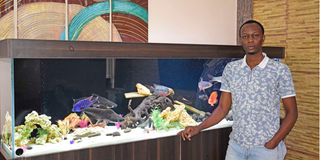
Fuzu aquariums Kenya founder Kenneth Mvati pictured on July 13, 2026 at his client’s house in Nairobi Parklands.
Photo credit: Billy Ogada | Nation Media Group
Aquarium ownership is becoming increasingly affordable.
According to Mr Mvati, ready-made aquariums start from around Sh10,000, depending on size and the accessories included. Mr Ondeyo says a basic two-foot aquarium setup costs around Sh12,500 and comes with six fish, filtration equipment, lighting, and decorative materials.
"A standard package includes fish, a filter pump, lighting, gravel, plants and background décor," he says.
Premium and custom installations can cost significantly more, depending on size and complexity. Most projects are tailor-made around available space and customer preferences.
"Everything is customised. We prefer to hear what the client wants and then deliver according to their vision," says Mr Mvati.
One of the more memorable projects undertaken by Fuzu Aquariums was a 1,000-litre aquarium installation, which was one of the largest projects the company had ever handled.
"It was challenging, but we managed to pull it off successfully," he says.
While hotels and office buildings are increasingly investing in aquariums to enhance the ambience of their reception areas, households remain the industry's largest market.
Mr Mvati says around 80 percent of Fuzu Aquariums' customers are households, with corporations accounting for the remaining 20 percent.
Mr Ondeyo also estimates that the majority of his clients are households, although offices and hotels are increasingly placing orders. The growing popularity of ornamental fish is also changing customer preferences.
"People have become more knowledgeable about fish-keeping and want more than just goldfish," says Mr Ondeyo.
One species gaining popularity is the Arowana, which he says has become a favourite among customers looking for premium options. The internet and social media have emerged as major drivers of demand.
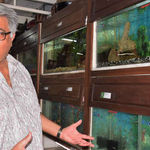
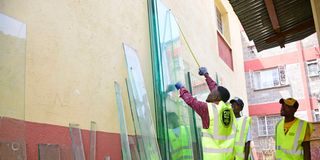
A worker at Fuzu aquariums Kenya takes measurements of glass panels on July 13, 2026 at Fuzu aquariums Kenya in Nairobi.
Photo credit: Billy Ogada | Nation Media Group
“As people travel more and have access to information about what is happening elsewhere in the world, they want to own aquariums too,” says Mr Mvati.
Social media has also transformed marketing and sales.
“Most orders now come online,” he says. "The rest come through referrals and word of mouth from existing customers."
Mr Ondeyo says social media has enabled his business to attract clients beyond Kenya's borders.
"We have managed to reach customers locally and even in neighbouring countries through social media marketing," he says. As well as aquariums, some businesses are branching out into related products and services.
Fuzu Aquariums, for instance, also designs fountains and water features for offices, corporate compounds, and landscaping projects. "That market is still niche, but it is growing," says Mr Mvati.
Despite the growing interest, operators say the business comes with unique challenges.
For aquarium manufacturers, glass remains one of the biggest expenses.
"The constant increase in glass prices is one of our biggest challenges because we make all our tanks from scratch," says Mr Ondeyo. Mr Mvati highlights the need for adequate workspace and technical expertise. "Glass comes in sheets, so you need enough space to store it and resize it according to customer orders," he says.
Handling glass safely and accurately also requires experience. Demand can also fluctuate significantly throughout the year. "Sometimes the business is seasonal, with periods when orders slow down," says Mr Mvati.
The seasonal nature of demand means that maintenance contracts often become an important source of recurring revenue. Fortunately for customers, owning an aquarium is not as expensive as many assume.
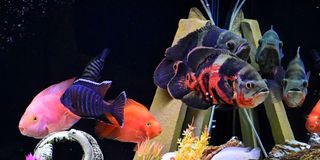
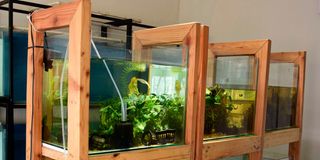
Aquariums with live plants pictured on July 13, 2026 at Fuzu aquariums Kenya in Nairobi.
Photo credit: Billy Ogada | Nation Media Group
Mr Mvati estimates that maintenance can cost as little as Sh500 a month, with fish food accounting for the bulk of regular expenses. "Maintenance costs can be about Sh3,000 in six months," he says.
Mr Ondeyo also describes fish as being relatively low-maintenance pets. "Fish are generally cheaper and more durable than dogs," he says.
Despite increasing competition, the sector continues to offer opportunities for aspiring entrepreneurs. Mr Mvati estimates that a newcomer would require at least Sh100,000 to set up a modest operation.
"There are many opportunities because the business is highly customisable. Success depends on understanding what clients want and delivering it," he says.
Mr Ondeyo says that quality and consistency are ultimately what determine success in the sector.
"Reputation in this business is built through planning, perseverance and delivering quality products," he says.