Kenya Airways’ net loss for the six months to June 2026 jumped 31.9 percent to Sh16 billion after its costs grew exponentially to a record level due to the Middle East conflict.
The national flag carrier’s costs during the period surged by 12 percent to a record Sh97.7 billion, up from last year’s Sh86.7 billion, pushing up its losses from the Sh12.2 billion reported in the first half of 2025.
This was largely due to a surge in fuel costs, which rose to Sh29 billion, accounting for roughly 32 percent of its operating costs, up 66 percent from Sh17.47 billion, which was 22 percent of operating costs.
“Our costs increased significantly because of the Middle East crisis, which increased our fuel costs,” said Mary Mwenga, KQ’s chief financial officer.
According to the International Air Transport Association (IATA), jet fuel prices in Africa rose to the second-highest due to the Middle East crisis, peaking at about $220 (Sh28,470) per barrel in April, before cooling down to $150 (Sh19,411), which still remains above historical averages.
Had it not been for the jump in fuel prices, the carrier’s losses would have remained stable at Sh12.2 billion, Ms Mwega said, noting that the carrier’s turnover defied the global slump in aviation to post a nine percent jump.
The revenues rose to Sh81.2 billion from Sh74.5 billion, supported by growing passenger numbers and demand on key routes, with several international travellers being rerouted through African routes amidst the Middle East shutdown.
Last year, the carrier’s losses were primarily caused by a capacity shortage due to the prolonged grounding of at least two of its widebody aircraft and several others.
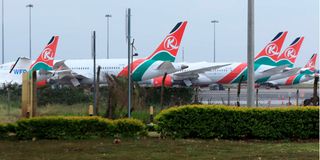
The capacity challenge has persisted this year, with two of its 248-seater Boeing 787 Dreamliners and 149-seater Boeing 737s being down for maintenance, in addition to some of its Embraers, which it uses for regional routes.
According to George Kamal, KQ’s acting CEO, the carrier is facing capacity challenges because many of its aircraft were delivered around the same time, making them due for long-term maintenance at the same time.
“There has also been a shortage of spare parts because original equipment manufacturers (OEMs) are struggling to meet demand for parts,” said Mr Kamal.
The capacity shortfall denied KQ an opportunity to capitalise on demand on key routes, especially long-haul networks like London and New York, which recorded load factors of over 90 percent.
Load factor is the percentage of seats in a plane taken up by paying passengers. Overall, KQ’s load factor for the period improved by 3.9 percentage points to 76.3 percent, highlighting rising demand.
However, KQ’s capacity did not grow to meet the surging demand. Its available seat kilometres (ASKs), which measure passenger carrying capacity, declined by 9 percent to 6 million from 6.7 million. Its block hours – the total flight time its planes flew- also declined by 8 percent to 65,978 hours, from last year’s 72,040 hours.
“What Kenya Airways faces today is not a demand problem but a capacity problem. Kenya Airways has been through an exceptionally difficult period,” said KQ’s board chairman Kiprono Kittony.
The carrier is now banking on increased cargo volume and income from Maintenance, Repair, and Overhaul Operations to shore up revenues in its efforts to return to profit. During the period, its cargo revenues rose by 18 percent to Sh8.8 billion, accounting for 11 percent of its revenues.