Time flies with great content! Renew in to keep enjoying all our premium content.
Prime
Inside the battle between Kakuzi directors and CMA
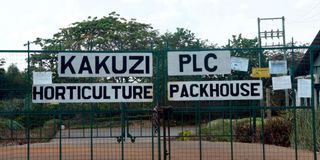
The entrance to the Kakuzi factory in Makuyu, Muranga County. The firm posted a net profit of Sh387.6 million, marking a turnaround from a Sh131.7 million net loss in 2024.
A long-running dispute between agribusiness firm Kakuzi Plc and the Capital Markets Authority (CMA) has escalated to the Court of Appeal, pitting the company’s board of directors against the market regulator in a case that could have far-reaching implications for listed firms.
The matter was heard this week as parties await directions from the higher court. Kakuzi moved to the appellate court after the High Court declined to stop CMA's inquiry into Kakuzi’s affairs. The company is now seeking orders to preserve the status quo pending determination of its appeal.
The parties had in April explored an amicable settlement, raising hopes of ending a legal battle that has dragged on for years.
At the heart of the conflict is CMA’s investigation into alleged conflicts of interest and financial impropriety involving management and operational service agreements between Kakuzi and several related companies within the Camellia Plc.
Kakuzi directors insist that they have provided all information requested by the regulator and question why the inquiry continues despite extensive disclosures. CMA, on the other hand, maintains that it is lawfully exercising its statutory mandate to investigate matters arising from a complaint lodged against the company.
The outcome of the case is being closely watched in corporate circles because the arrangements under scrutiny are common among multinational groups operating through listed companies. Any adverse findings could have implications for governance practices across firms listed on the Nairobi Securities Exchange.
The investigation traces its roots to a summons issued by CMA on June 14, 2021, seeking information relating to Kakuzi’s governance assessment and audit for the 2019 financial year.
The regulator said the inquiry was triggered by a complaint and sought information regarding governance structures, related-party transactions and management arrangements.
Particular attention was directed at Management and Operational Services Agreements signed on December 11, 2017 between Kakuzi and Robertson Bois Dickson Anderson Limited, as well as agreements involving Eastern Produce Regional Services Limited.
The companies, together with Kakuzi, are subsidiaries of Camellia Plc, a British investment group with interests in agriculture and food production.
The regulator also sought to examine Kakuzi’s dealings with related entities, including Eastern Produce Kenya Limited, EPK Empowerment Company (Kenya) Limited, Lintak Enterprises (K) Limited, Linton Park (Kenya) Limited and Siret Tea Limited.
As the inquiry progressed, CMA summoned Kakuzi directors for interviews scheduled between September 12 and 16, 2022.
Through their lawyers, the directors objected, arguing that they had not been informed of the specific allegations against them. They maintained that the summons failed to disclose the nature of the alleged conflict of interest or particulars of the alleged financial impropriety.
Invoking Article 47 of the Constitution and provisions of the Fair Administrative Action Act, the directors demanded disclosure of the allegations before the interviews could proceed.
CMA responded on September 7, 2022, insisting that the summons sufficiently disclosed the matters under investigation. Further exchanges followed, with the directors seeking collective rather than individual interviews and requesting fresh interview dates.
Eventually, the entire board appeared before CMA investigators on November 9, 2022.
Corporate governance report sparks disagreement
A major point of contention emerged after CMA completed its assessment of Kakuzi’s corporate governance self-assessment report for the year ended December 31, 2021.
The regulator awarded the company an overall weighted governance score of 72 percent and stated that Kakuzi had demonstrated commitment to good governance and sustainability. CMA commended the company for strengthening governance structures while recommending areas for improvement.
To Kakuzi, that assessment effectively addressed the concerns underlying the inquiry.
The directors argued that the same issues being investigated had already been examined by the regulator.
They contended that continuing with the inquiry after issuing a favourable governance assessment amounted to revisiting matters already determined.
Their lawyers wrote to CMA in November 2022 asserting that the investigation could not lawfully continue because the issues had effectively been addressed through the governance review.
The directors have consistently maintained that they have answered all questions raised by the regulator. They have repeatedly challenged CMA to identify the alleged irregular payments, specify any financial loss suffered, and explain why information already supplied is considered insufficient.
CMA rejected that position.
In a letter dated December 2, 2022, the regulator stated that the governance assessment and the inquiry were separate processes serving different purposes.
According to CMA, although the two processes touched on similar subject matter, they addressed distinct issues. The regulator further maintained that section 11(3)(h) of the Capital Markets Act grants it authority to investigate the affairs of entities approved to issue securities to the public.
CMA insisted that its investigations were ongoing and that the summons issued to Kakuzi’s directors were lawful and necessary to facilitate those investigations.
Tribunal and High Court reject challenge
The dispute remained unresolved for an extended period, partly because the Capital Markets Tribunal had not been constituted. Once operational, the tribunal heard the matter and on September 19, 2024 dismissed the directors’ appeal.
The tribunal found that CMA’s investigations were still ongoing and that no final decision had been made against the directors.
“We agree with the respondent’s submissions that the investigations being done were inquisitorial in nature, and it is only after notice that adverse action is likely to be taken that the appellants’ position to be furnished with reasons and particulars would hold. The appellants moved this tribunal prematurely,” the tribunal ruled.
Undeterred, the directors moved to the High Court.
However, on September 30, 2025, the court upheld the tribunal’s decision, finding that the directors had failed to demonstrate any violation of their constitutional rights that would justify judicial intervention.
The court held that CMA was merely conducting an inquiry and that the company and its directors would be informed of any developments arising from the process. If wrongdoing was eventually established, the regulator would communicate its decision formally.
“The appellants’ actions also seem to be premature. As such, the contention is for rejection,” the court ruled.
Appeal focuses on fair hearing rights
The dispute has now reached the Court of Appeal, where eight directors are challenging both the tribunal and High Court decisions.
Their principal complaint is that CMA has refused to disclose the particulars of the alleged financial impropriety and the nature of complaints made by third parties.
The directors argue that the Constitution guarantees them a fair hearing, which includes access to the allegations, evidence and materials relied upon by the regulator.
They fault the courts for concluding that no constitutional violations had occurred and maintain that they were entitled to know precisely what accusations they were being required to answer.
According to Kakuzi, the regulator has never adequately explained what was improper about payments made under the service agreements or why responses already submitted were deemed insufficient.
The company also defends the service arrangements under investigation.
Chief executive officer Christopher Flowers told the courts that Eastern Produce Regional Services provides substantial management, finance, information technology and marketing services to Kakuzi at reasonable cost. The arrangement, he said, allows specialised services to be shared across Camellia group companies, generating operational efficiencies.
Mr Flowers also confirmed that he serves as a director of several companies in Kenya, Malawi and Tanzania. However, he denied any conflict of interest, stating that the companies do not compete each other and that he holds no shareholding interests in them.
As the appeal proceeds, the central question remains unresolved: whether CMA is entitled to continue its investigations without providing the detailed particulars sought by Kakuzi’s directors, or whether constitutional fair-hearing guarantees require fuller disclosure before the inquiry can advance further.
The answer could define the balance between regulatory oversight and procedural fairness for listed companies for years to come