Time flies with great content! Renew in to keep enjoying all our premium content.
Prime
How KCB took over Sh42bn driver’s licence deal from Access Bank
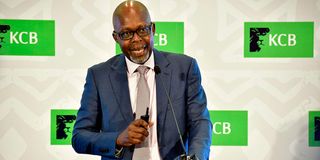
Kenya Commercial Bank (KCB) Group Director Finance Lawrence Kimathi makes his remarks during the bank’s announcement of the FY 2025 Financial Results at the Emara Ole Sereni on March 11, 2026.
Photo credit: Francis Nderitu | Nation Media Group
Access Bank Plc’s uncertainty over the viability of a public-private partnership digital driver’s licence deal held by National Bank of Kenya (NBK) helped KCB Group snap up the contract, which will now help it earn a portion of Sh42 billion over the next two decades.
KCB said Access Bank, which acquired NBK from KCB last year, expressed doubts about the profitability of the project following concerns over uncollected smart driving licences.
Access Bank demanded that it be paid to take up the “liability”, but KCB declined, forcing the public-private partnership agreement to be transferred to KCB even as Access acquired other parts of NBK.
A consortium of KCB and Pesa Print recently disclosed a capital investment of Sh42 billion for the lucrative project, with the injection set to be recouped over 21 years through revenues from instant traffic fines and driver’s licence renewal fees.
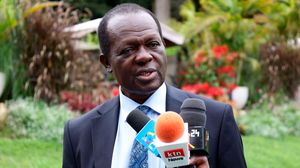
“The auditors of NBK said that there was a stockpile of driving licences and asked that we start making provisions. When Access Bank came and looked at the stock, they said that we should take a provision for it, but we said no,” KCB's chief finance officer Lawrence Kimathi told the Business Daily in an interview.
“We argued that the licences were being used and that uptake was only slow because the enrolment centres were fewer than originally planned. You had 20 odd enrolment centres. When I took my children to collect their driver’s licences, the queue in the Industrial Area went all the way out.”
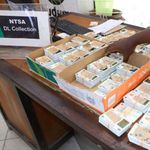
Auditor-General Nancy Gathungu put the National Transport and Safety Authority (NTSA) on the spot last year over the slow uptake of smart driving licences, with 572,674 cards worth Sh176 million remaining unprinted for years, risking losses to taxpayers.
The audit revealed that as of June 2024, NTSA had printed only 1,637,930 smart driving licences despite NBK delivering more than four million units of the cards under the contract.
NTSA signed a Sh2 billion contract with NBK in 2017 to supply, install and maintain five million second-generation smart driving licences, with an initial target of printing all cards within three years.
NBK, which delivered all the cards, saw some of the units returned and sitting idle, risking expiry.
KCB became involved in the deal after acquiring NBK in 2019, but faced the prospect of missing out on the project during the lender’s sale.
The driver’s licence project began in 2017 between Pesa Print and NBK and aims to transition Kenya to second-generation driving licences embedded with biometric and digital security features over a 21-year concession period.
New speed cameras
More than 1,000 new smart cameras are expected to go live on Kenyan roads as part of the project, aimed at curbing speeding and enabling the issuance of instant fines.
The network comprises 700 fixed cameras mounted at strategic locations along major highways and high-risk corridors, and 300 mobile units targeting speeding hotspots and accident-prone zones.
The KCB consortium is expected to generate five million smart driving licences within the implementation period.
The Kenya Kwanza administration has favoured public-private partnerships to deliver key infrastructure projects in the face of revenue pressures from high recurrent spending and rising debt service costs.
Pesa Print had initially been the sole operator after winning a competitive tender in 2015 to supply smart licences under the previous Uhuru Kenyatta administration.
The contract was, however, converted to the PPP model in 2021 to ease fiscal pressures at a time when the government owed Pesa Print close to Sh2 billion in pending bills.
G-to-G oil deal
The retention of the multi-billion-shilling driver’s licence deal will see KCB maintain its close collaboration with the State, including participation in the importation of petroleum products on credit under a government-to-government deal with three State-owned Gulf firms.
Under the arrangement, oil marketing companies (OMCs) deposit Kenya shillings in equivalent payments to KCB, while the bank sources dollars to settle payments to shippers after six months.
KCB ceded a 30 percent share of the oil deal as part of risk mitigation, allowing other lenders to buy into the lucrative arrangement aimed at easing foreign exchange pressures.
I&M Group was one of four banks to buy into the G-to-G fuel importation deal.
In March 2023, KCB handed the State Sh24 billion to help it import cheap foods to be distributed through 120,000 shops in an effort to lower the cost of living as inflation surged at the time.
The scheme was meant to force other manufacturers to lower prices for basic goods, with the government stepping in as the controller of the cost of essential commodities.
The lender said it remains open to working with all partners, including the government.
“If a good opportunity comes up and makes sense, bringing value, we do it. We have worked with this government since they came in, and now look at our profitability!” Mr Kimathi added.
“We have demonstrated from the past that we can work with the government and we do our evaluations. On G-to-G, we said we want to take the risk, and other banks took off. They came back begging to be part of the deal. That structure (of taking risks) has not changed.”
KCB's net profit for the year ended December 31, 2025, rose by 11.2 percent to Sh66.8 billion, anchoring a two-fold increase in the final dividend to shareholders to Sh3 from Sh1.50 previously.