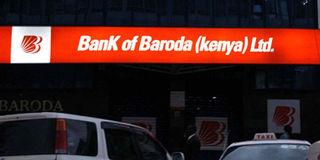
Bank of Baroda has returned to the High Court seeking a review of a decision that left it facing a Sh2.99 billion default judgment in favour of Infinity Industrial Park.
The lender says it failed to file its defence in the case after its former lawyers failed to inform it that the court had granted leave to file a defence in the long-running dispute.
Through credit officer Hillary Sang, the bank says the failure by its advocates to communicate the court’s orders was “very injurious and amounts to sufficient cause for the decision to be reviewed”.
“I verily believe that the absence of summons to enter appearance is not only in error but amounts to sufficient cause to review the court’s decision,” Mr Sang said.
The bank is seeking a review of the High Court’s July 31, 2026 decision dismissing its application to set aside a default judgment entered on September 8, 2025.
Bank of Baroda argues that the summons to enter appearance uploaded on the court’s Case Tracking System (CTS) on June 14, 2024, was unsigned and remains outstanding. It also says its former lawyers never informed it that the court had granted leave to file a defence.
“The failure by the advocates on record to update the lender regarding the court’s orders to file a defence did not place the bank in a position of knowledge to follow up with their then advocates to file the defence,” Mr Sang said.
The High Court, however, found that the bank had participated in the proceedings and was represented by lawyers when it was allowed to file its defence.
“As I have already found, the Defendant entered an appearance, participated in the interlocutory proceedings, and was expressly granted leave to file a defence. The defendant was represented by counsel throughout. The failure to comply with the Court’s timeline is not attributable to the absence of formal summons; it is simply a case of non-compliance with a court order,” the judge ruled.
The court said the bank had failed to provide a satisfactory explanation for its delay and dismissed its application, describing its conduct as indolence.
“The Constitution, specifically Article 159(2)(b), mandates that courts must deliver justice without unnecessary delays. The Civil Procedure Act emphasizes that civil disputes be determined fairly, quickly, proportionately, and affordably, as outlined in Sections 1A and 1B. A party that neglects its rights cannot later rely on the Constitution to avoid the repercussions of its own inaction,” the court ruled.
Bank of Baroda now says the judgment exposes it to immediate and potentially crippling losses.
“That I am advised by the Applicant’s advocates on record, and which advise I verily believe to be true, that the applicant stands to suffer immediate irreparable loss and damage to the tune of Sh2.996 billion which will cause severe operational disruption and reputation damage,” Mr Sang said.
The dispute stems from a Sh1.976 billion loan advanced by the bank to Infinity in 2019 to finance the development of its industrial park, including infrastructure and warehouses at Njiru along the Eastern Bypass.
The loan was secured against several properties, including the industrial park land.
Infinity sued the bank in June 2024, accusing it of actions that disrupted its operations, damaged its reputation, and undermined efforts to attract fresh investment. It is seeking about Sh2.996 billion in damages.
The bank maintains that Infinity defaulted on the loan and that it was entitled to exercise its rights as a secured lender.
On September 8, 2025, the High Court entered default judgment in Infinity’s favour after the bank failed to file its defence within the prescribed period.
The bank later argued that its intended defence raised triable issues, including the replacement of a charge over the industrial park property, the amount secured and a statutory notice relating to a Sh2 billion claim.
The court rejected the argument, holding that the existence of triable issues did not, by itself, justify setting aside the judgment.