Time flies with great content! Renew in to keep enjoying all our premium content.
Kenya unites to power inclusive AI for persons with disabilities
Sponsored by HUAWEI
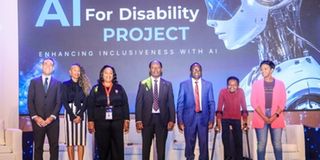
From left: Adam Lane, Director for Policy and Partnerships, Huawei Kenya; Irene Mbari-Kirika, Founder and Executive Director, inABLE; Mary Kerema, Secretary, ICT, E-Government and Digital Economy, Ministry of Information, Communications and The Digital Economy (MICDE); Hon William Kabogo, Cabinet Secretary, MICDE; Mr Stephen Isaboke, Principal Secretary (PS), State Department for Broadcasting and Telecommunications; Bernard Chiira, CEO and Founder, Assistive Technologies for Disability Trust; and Dr Shikoh Gitau, CEO, Qhala, during the launch of the Kenya AI for Disability Project. The launch took place during the closing of the 15th Connected Africa Summit in Nairobi last week.
Photo credit: Huawei
By Pauline Ongaji
On April 24, at the Kasarani grounds of the Kenya Institute of Special Education (KISE), tech leaders and disability advocates came together for conversations around enhancing the availability of tech-enabled assistive devices for persons with disabilities. The focus was on assessing progress since the initiation of these conversations in 2024.
Two years down the line, there is hope at the end of the tunnel. During the Closing Ceremony of the 15th Connected Africa Summit 2026 held at the Edge Convention Centre in Nairobi on April 27-30, Kenya’s Ministry of Information, Communications and the Digital Economy (MICDE), in partnership with KISE, UNESCO, Qhala, inABLE, Assistive Technologies for Disability Trust (AT4D), and Huawei, officially launched the Kenya AI for Disability Project.
This was a culmination of a conversation that began with a shared vision and purpose: To rethink how technology can expand access to education, employment, and economic participation for Persons with Disabilities via homegrown solutions and products.
The AI for Disability Project is informed by the various partner skills and strengths, and reflects the intent of the Persons with Disabilities Act 2025 (Act No. 4 of 2025), which calls for accessibility to assistive technologies.
The launch of the initiative marks a significant milestone in Africa’s digital transformation journey, positioning inclusion not as a policy aspiration but as a design principle embedded within technology, infrastructure, and innovation ecosystems.
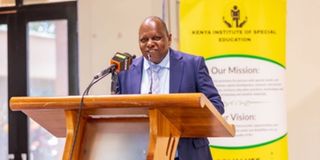
During the project tour, the Director of KISE, Dr Norman Kiogora, spoke about opening doors not just to showcase progress, but to signal a shift. Technology, he insisted, must respond to real needs. “Inclusion must be deliberate, and innovation must be grounded in lived experience if it is to matter,” he said.
Dr Norman Kiogora, KISE Director.
Photo credit: Huawei
That message found an echo in the Director for Policy and Partnerships, Huawei Kenya, Adam Lane, who challenged the room to rethink how technology is built. “Accessibility cannot sit on the sidelines of innovation. It must be placed at the centre, shaping how solutions are imagined from the very beginning,” he said.
Despite progressive frameworks, only a fraction of persons with disabilities in Kenya are employed, and representation in public service remains far below expectations. Stakeholders argue that the gap is systematic.
To narrow the gap, the conversation pointed to artificial intelligence as one of the most promising tools available today.
“AI, Lane noted, is only as inclusive as the intentions behind it. Without centering persons with disabilities, even the most advanced systems risk reinforcing exclusion.”
At the launch of the Kenya AI for Disability Project, Cabinet Secretary for Information Communications and the Digital Economy, William Kabogo, said: “As Africa advances its digital agenda, we must remain deliberate in our approach. Africa must be at the table in shaping solutions powered by emerging technologies.”
He continued: “This initiative is part of our commitment to ensuring that every Kenyan has an opportunity to participate in the digital economy, be it through innovation, employment, or entrepreneurship.”
Secretary for ICT, E-Government and Digital Economy at the ministry, Mary Kerema, described the project as a structural shift in how digital systems are designed.
“The AI for Disability Project marks a decisive shift from inclusion as an aspiration to inclusion by design. It brings together a powerful coalition of disability experts, innovation leaders, and global technology partners to address real, lived challenges faced by persons with disabilities,” she said.
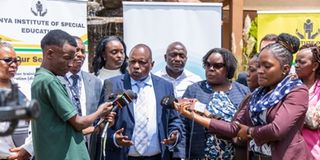
KISE Director Dr Norman Kiogora and the AI for Disability Project partners address the media during a tour of the project.
Photo credit: Huawei
Her remarks hinted at a broader shift within government thinking. “Kenya is moving beyond simply reacting to challenges and is beginning to anticipate them. The goal is to design public systems and service delivery channels that are inclusive from the start, rather than adjusting them later.”
She noted that MoICDE is not only facilitating the initiative but is actively co-engineering solutions with partners.
“As government, we are deliberately re-engineering our systems to be inclusive, embedding accessibility into our digital infrastructure, platforms, and services from the outset, rather than retrofitting it later,” she added.
Ms Kerema further highlighted that the initiative is anchored within Kenya’s national AI strategy and builds on key national infrastructure, including the Konza Technopolis Data Centre and a growing network of digital hubs across the country, designed to widen access and participation.
For innovators like Dr Shikoh Gitau, CEO, Qhala, the emphasis on local design is crucial. “Too often, assistive technologies are developed in contexts that do not reflect African realities. Language, culture, affordability, and infrastructure all matter.”
She argued that if solutions are to work, they must be built with the people who will use them.
This is where partnerships like the one formed between Qhala, UNESCO, inABLE, AT4D, Huawei, KISE, and the Ministry become particularly important, with each bringing a piece of the puzzle, from research and innovation to deployment and policy alignment.
Founder and Executive Director of inABLE, Irene Mbari-Kirika, welcomed the partnership, describing it as a critical step toward addressing long-standing barriers faced by persons with disabilities in education, employment, and digital participation through Assistive Innovation.
“For too long, persons with disabilities have been excluded from the digital economy not because of a lack of ability, but because systems were not designed with them in mind. This initiative changes that reality by bringing co-creation, innovation, and accessibility together at scale,” she said.
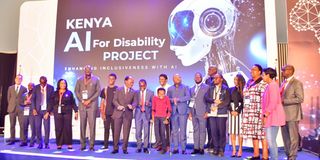
William Kabogo, Cabinet Secretary, Ministry of Information, Communications and The Digital Economy; Mr Stephen Isaboke, EBS, Principal Secretary (PS), State Department for Broadcasting and Telecommunications; Ministers of ICT from African countries and the Kenya AI for Disability Project team during the launch at the 15th Connected Africa Summit in Nairobi last week.
Photo credit: Huawei
In the meantime, KISE is investing in its ability to design and produce assistive technologies locally, supported by the government. “The aim is to reduce costs while ensuring that solutions remain relevant to the communities they serve. It is a move that signals confidence not just in technology, but in local capacity,” explained Dr Kiogora.
The foundation for this work was laid earlier in 2024, through a collaborative hackathon targeting university students to develop AI-powered solutions. Many of these are presently in various phases of development.
Among the students is John Maina, now in his fifth year of studying Petroleum Engineering at the University of Nairobi. He said: “Our project, Brain Visualizer, is a prototype currently being used at KISE to support learners with visual impairments. It leverages accessible audio-based tools built on open-source technologies to enhance digital literacy and expand opportunities for employment and self-employment.”
He continues: “The feedback we have received so far has been very encouraging, with strong appreciation for the solution. We are now working on localising the platform beyond English to include Kiswahili and other languages, ensuring broader reach and usability.”
Another student, James Riri, a Bachelor’s of Technology graduate in Information Technology from the Technical University of Kenya, joined the AI for Disability Hackathon in 2024. Reflecting on his journey, he said: “What stood out for me during the three-month innovation sprint was the importance of designing with users, not just for them. Engaging directly with persons with disabilities fundamentally changed how I approached product development.”
He adds, “Our product, WeLove, is a digital assistive tool designed to support individuals with incontinence. Using artificial intelligence and machine learning, it predicts optimal restroom times based on factors such as daily routines and nutrition, helping users better manage their condition with dignity and independence.”
Riri’s hackathon project has since evolved into a start-up. “We founded Umbilabs to continue developing inclusive technologies that address the everyday challenges faced by persons with disabilities, with WeLoveas one of our flagship solutions.”
Riri, who has since graduated from university and is currently an Assistive Technology Innovator and Founder, Umbilabs.
For Huawei, this journey aligns with its broader Tech4All initiative. “The real strength of AI lies in its ability to adapt to individual needs, moving away from one-size-fits-all approaches toward more personalised tools that empower users in meaningful ways,” noted Lane.