Time flies with great content! Renew in to keep enjoying all our premium content.
Huawei backs Limuru forest restoration drive as tree growing efforts expand
Sponsored by HUAWEI
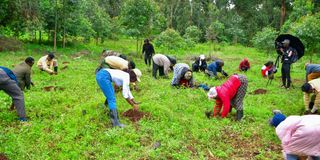
Representatives from the Ministry of Foreign and Diaspora Affairs and Huawei join the Uplands forest community in Limuru for the tree planting exercise.
Photo credit: Huawei
By Pauline Ongaji
The Ministry of Foreign and Diaspora Affairs, the Ministry of Environment, Climate Change and Forestry, and Huawei Technologies Kenya have partnered to drive the conservation and restoration of Uplands forest in Limuru, Kiambu County.
The initiative, anchored at Uplands Forest Station, was marked by a large-scale tree growing exercise that saw the planting of 5,000 indigenous seedlings, signaling the start of a sustained restoration effort aimed at reviving one of the region’s critical ecosystems.
Kenya continues to lose over 84,000 hectares of forest cover annually, with an additional 15,000 hectares degraded, according to the 2024 Kenya Forest Service report. These losses threaten biodiversity, disrupt water systems, and undermine livelihoods, particularly in regions like Limuru, where forests play a vital role in sustaining both ecosystems and communities.
Lari Sub-County, where the exercise took place, hosts six of Kiambu County’s eight forests, making it a key ecological corridor that supports water catchments extending far beyond the area. However, years of logging, charcoal burning, and land-use pressures have left sections of these forests degraded and vulnerable.
It is against this backdrop that the Uplands restoration effort is positioning itself not merely as a tree planting exercise, but as a long-term shift from environmental depletion to regeneration.
“This is more than planting trees. It is about translating global environmental commitments into practical action on the ground,” said Ambassador Michael Kiboino, Secretary of Management at the Ministry of Foreign and Diaspora Affairs, who represented Principal Secretary Korir Sing’oei.
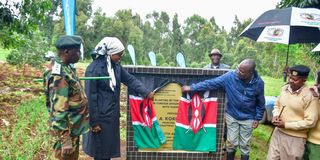
Ambassador Michael Kiboino (right), Management Secretary at the Ministry of Foreign and Diaspora Affairs, with Khadija Mohammed (right), Public Affairs and Media Director, during the Uplands forest restoration exercise.
He noted that the 5,000 trees planted during the exercise contribute to the Ministry’s broader efforts, which have now reached approximately 170,000 trees planted across various forest stations nationwide, part of Kenya’s ambitious target of growing 15 billion trees by 2032.
Amb. Kiboino noted that this achievement was a testament that diplomacy extends beyond board rooms and foreign missions, now defined practical action that responds to the global challenges we all share.
“Environmental challenges are global in nature, and through initiatives such as this, we are advancing environmental diplomacy through local action that contributes meaningfully to global environmental goals. We are not just planting trees, but cultivating a lasting legacy of partnership, restoration and conservation of Mother Nature for posterity,” he added.
Speaking during the exercise, Huawei Technologies Kenya Public Affairs and Communications Director Khadija Mohammed said the company’s participation is aligned with its global sustainability agenda.
“Our participation is guided by the belief that technology and partnerships can drive meaningful environmental impact. This exercise is part of Huawei’s global initiative known as Tech4All, through which we support sustainability and conservation efforts across different sectors and regions.”
Here in Kenya, Huawei has participated in marine conservation projects in Kisite-Mpunguti Marine Park, and the company is now partnering with the government on forest restoration through tree growing initiatives.
That distinction between planting and growing, emerged as a central theme throughout the exercise. “It reflects a broader shift in conservation strategy, one that prioritises long-term survival, monitoring, and community stewardship over short-term planting targets,” said Uplands Forest Station Manager Paul Nderitu.
On the ground, that responsibility is largely carried by local communities. The Uplands Community Forest Association (CFA), which brings together more than 2,600 members from surrounding constituencies, has been instrumental in driving restoration efforts.
According to CFA Chairman Tom Kimani, the transformation in the area has been gradual but significant.
“There was a time when charcoal burning was widespread and forest destruction was common. Today, we are seeing change because communities are directly involved in protecting these forests,” he said.
Kimani explained that this progress has been built through sustained engagement, awareness campaigns, and practical incentives that link conservation with livelihoods.
“One such approach is the Tree Establishment and Livelihood Improvement Scheme, which allows community members to cultivate crops while nurturing tree seedlings,” he added.
Under this model, farmers intercrop food crops such as maize and onions alongside young trees, ensuring both environmental restoration and household income. Over time, as the trees mature, they become self-sustaining, and farmers transition to new areas, creating a continuous cycle of restoration.
Local administrators say this approach has strengthened community ownership, a key factor in ensuring long-term success.
Deputy County Commissioner Samuel Kariuki emphasised that Lari’s extensive forest cover presents both opportunity and responsibility.
“We have a lot of land under forests, where six out of eight forest stations in Kiambu are here in Lari. We may not always have enough resources, but with partners, we can go further,” he said.
He pointed to ongoing collaboration with the Ministry of Foreign and Diaspora Affairs since 2024, noting that earlier planting efforts have recorded encouraging survival rates.
“The trees are doing well,” he added, emphasising the importance of follow-up and monitoring.
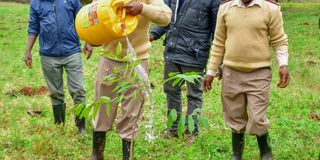
Samuel Kariuki, Deputy County Commissioner, Lari, during the tree planting initiative in Uplands, Limuru.
Photo credit: Huawei
Forest officials echoed this sentiment. Uplands Forest Station Manager Nderitu confirmed that the area had previously experienced significant tree loss, leaving sections exposed and ecologically fragile.
“This area did not have sufficient tree cover before, but restoration is helping to bring it back to life,” he said.
He further emphasised that the choice of indigenous tree species is critical to the success of the restoration effort. “Unlike exotic varieties, indigenous trees are better adapted to local conditions, supporting biodiversity, improving soil structure, and enhancing water retention,” he added.
According to Nderitu, water conservation remains a central pillar of the initiative. “The forest supports a river that serves communities as far as Mai Mahiu. Once considered permanent, the river had begun to shrink due to deforestation and human activity, and conserving this forest is directly linked to conserving the river,” Nderitu explained.
Today, he added, early signs of recovery are visible. “As tree cover increases, the land is gradually regaining its ability to retain and channel water, offering renewed hope for downstream communities.”
For residents, these changes translate into many benefits, which include improved access to water, enhanced soil fertility, and new income streams through agroforestry.
At the policy level, the initiative aligns with Kenya’s national target of growing 15 billion trees by 2032. However, stakeholders are increasingly clear that achieving this goal will require more than mass planting campaigns.
Stakeholders emphasised the need for greater private sector involvement in forest restoration efforts, noting that achieving long-term sustainability requires collaboration beyond government and communities.
“It is within this context that Huawei has stepped in,” Khadija explained, adding that the company’s role goes beyond technology development, to ensuring its solutions contribute to sustainable development and a better future.
“Supporting initiatives like this is part of our commitment to safeguarding the environment for future generations, because if we do not take care of the earth today, we risk leaving future generations without a viable home,” she concluded.