Time flies with great content! Renew in to keep enjoying all our premium content.
Digital talent race heats up as Huawei contest marks a decade of impact
Sponsored by HUAWEI
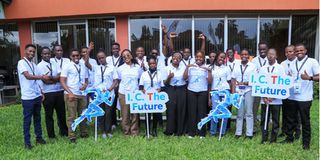
Participants from universities and TVET institutions who emerged as National and Regional Finalists in the 2025/2026 Huawei ICT Competition during the award ceremony held on the sidelines of the 2026 Connected Africa Summit at the ICT Talent Development side event.
Photo credit: Huawei
By Pauline Ongaji
ICT skills are increasingly indispensable. In fact, their demand in the labour market keeps growing as more industries across the world embrace modern technologies like cloud computing, artificial intelligence (AI), data analytics, and others.
Today, employers want graduates who can do more than understand theory. They want problem-solvers who can design, build, and secure real digital systems.
It is within this perspective that Huawei’s flagship talent development initiative – the Huawei ICT Competition – has steadily evolved over the past decade from a niche academic contest into one of Kenya’s most influential platforms for nurturing digital capability.
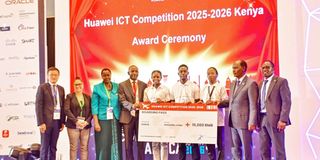
Cabinet Secretary for Information, Communications and Digital Economy William Kabogo (second from right), is joined by Broadcasting PS Stephen Isaboke (right) and partners from ICT Authority to celebrate with some of the students who excelled in the Huawei ICT Competition.
Photo credit: Huawei
What started as a university-focused challenge has grown into a national pipeline for identifying, training, and exposing young ICT talent to global standards.
Since its global launch in 2015 and entry into Kenya in 2018, the competition has reflected the rapid pace of technological change. Each edition has attracted more participants, introduced more advanced technologies, and raised the bar of performance. Today, it brings together students from universities, colleges, and TVET institutions in a shared space of learning and competition.
“Each year, participation has expanded, competition has intensified, and the calibre of talent has risen, reflecting both Kenya’s ambition to become a regional digital hub and the increasing stakes of the global digital economy,” says Franklin Mutisya, a Huawei ICT Academy instructor at Machakos University.
That growth has become visible in the Huawei ICT Competition Kenya 2025/2026 Edition. In addition to featuring largest number of participants so far, the impact is notable.
“With a target of 12,000 student participants drawn from universities, colleges, and TVET institutions, the competition signals a decisive shift from scale to impact,” Mutisya underscores.
This expansion has been shaped by Kenya’s wider digital transformation agenda. The country continues to position itself as a regional technology hub, yet a persistent challenge remains: The shortage of job ready ICT professionals.
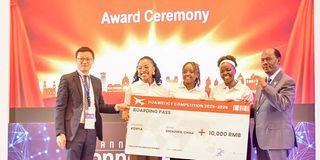
James Sun Quan, Deputy Chief Executive Officer of Huawei Kenya, joins Melanie Minayo, Faith Chepkoech, and Joan Kinoti of Jomo Kenyatta University of Agriculture and Technology as they receive a symbolic travel ticket from William Kabogo, Cabinet Secretary for Information, Communications and Digital Economy, ahead of the Huawei ICT Competition Global Finals to be held in Shenzhen in early June. The three students will represent Kenya as an all-girls team on the global stage.
Photo credit: Huawei
Employers increasingly require skills in cloud computing, cybersecurity, artificial intelligence, and data analytics, areas where traditional training has often lagged behind industry demand.
Recognising this gap, Huawei has strengthened its partnership with the Government through a 2025 MoU with the State Department for Technical and Vocational Education and Training. The collaboration is designed to align education with industry needs and ensure students graduate with practical, market relevant skills.
Under this framework, Huawei plans to establish 150 ICT Academies within TVET institutions, certify 1,000 students annually at Huawei Certified ICT Associate level, and train 150 instructors each year. The initiative is designed to embed practical ICT training within the education system, making the competition a central pillar in a broader talent development strategy.
Highlighting the company’s long term commitment to talent development, Huawei Kenya Deputy Chief Executive Officer James Sun Quan, says:
“Huawei’s continued investment in ICT talent development is helping shape the next generation of innovators, engineers and digital leaders in Kenya. Through sustained partnerships, skills training and global exposure opportunities such as the Huawei ICT Competition, the company has demonstrated a strong commitment to empowering young people and supporting the growth of a competitive, knowledge-driven digital economy,” he says.
Against this backdrop, the 2025/26 edition stands out not only for its scale, but also for its inclusivity, where TVET institutions, once marginal participants, are now central players in the competition.
This shift is evident in the Networking Track, where a team from PC Kinyanjui Technical Training Institute advanced to the regional finals. Their progress highlights how technical institutions are increasingly competing at the highest levels alongside major universities.
“At the beginning, everyone participates individually… then at the regional stage, participants form teams of three,” explains Lucy Gathu, a Computer Science student in the team. Her teammate Eric Nzai describes the technical focus of the track. “The Networking Track mainly deals with telecommunications and internet connectivity… we configure devices such as switches, routers, firewalls, and servers,” he says.
Steve Mutisya adds that the experience bridges theory and practice. “After configuring devices in the simulator and confirming that everything works, you can then apply the same configurations to real, physical devices.”
Lucy Gathu, Steve Mutisya (left), and Erick Nzai of PC Kinyanjui Technical Training Institute made history in their debut appearance under the TVET category of the Huawei ICT Competition, advancing all the way to the recently concluded Regional Finals in South Africa. Their achievement underscores the growing strength of Kenya’s TVET institutions in nurturing world-class digital talent.
Photo credit: Huawei
These experiences affirm the practical, simulation-based learning that the Huawei ICT Competition champions. The Huawei approach also features a boot-camp where top students receive intensive training, mentorship, and exposure to real industry environments.
Cabinet Secretary for Information, Communications and the Digital Economy, William Kabogo, expressed contentment with the competition:
“Kenya’s digital future will be shaped by the talent we nurture today. The outstanding performance of these students in the Huawei ICT Competition demonstrates that when young people are equipped with the right digital skills... they can compete globally and drive innovation locally.”
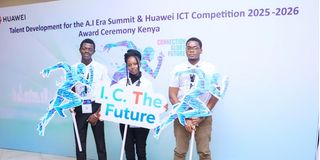
Following the competition, nine students will represent Kenya at the Global Finals in Shenzhen, China. They are Melanie Minayo, Joan Kinoti, Faith Mosonik, Denzel Ninga, Joy Njoroge, Robert Wambua, Catherine Atieno, Brian Kamau, and Salem Lumumba, drawn from different universities and TVET institutions.
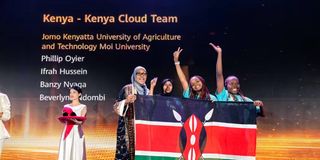
As part of the Huawei ICT Competition 2024/2025, the all-girls Kenyan cloud team received the prestigious Women in Tech Award at the Global Finals in Shenzhen, China. This team consisting of Ifrah Hussein and Beverly Ndombi from Moi University, and Banzy from JKUAT stood out not just for their technical excellence, but for representing the power and promise of women in STEM on a global stage. Their recognition is a celebration of resilience, brilliance, and the bright future of digital inclusion.
Photo credit: Huawei
This year's competition featured students from the University of Nairobi, Jomo Kenyatta University of Agriculture and Technology (JKUAT), Technical University of Kenya, Kenyatta University, Moi University, Machakos University, Mount Kenya University, Africa Nazarene University, Open University of Kenya, Jaramogi Oginga Odinga University of Science and Technology, and PC Kinyanjui Technical Training Institute. The diversity reflects the widening reach of digital opportunity across the country.
The competition now features four tracks: Networking, Cloud, Computing, and Innovation. Each is aligned with industry demand.
As it moves through national, regional, and global stages, the Huawei ICT Competition continues to provide exposure, certification, mentorship, and pathways into employment.