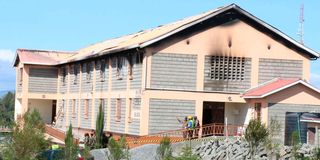
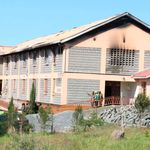
A burnt dormitory (Stanford and Oxford Dormitory) at Utumishi Girls Senior School in Gilgil, Nakuru County on May 28, 2026. 16 students perished in the dormitory fire while seven sustained serious injuries in an incident that took place at 12 midnight.
Photo credit: Boniface Mwangi | Nation Media Group
On what should have been an ordinary night, with assingments done and lights out, students at Utumishi Academy allegedly set their dormitory on fire. Nine suspects, all fellow students are in custody over the arson.
The instinct, as always, is to call this an isolated incident. To blame a few bad apples. To prosecute, suspend, and move on. We are good at that in Kenya. What we are less good at is asking the uncomfortable question underneath: why does this keep happening?
Because it does keep happening. Over the past two decades, Kenya has recorded dozens of school unrest incidents, from fires and strikes to destruction of property and physical confrontations.
Education authorities and school administrators agree: the cases are not just continuing. They are getting worse. There is a version of this story that blames teenagers for being teenagers.
Adolescents have always tested limits. That is part of growing up. But there is a real difference between a teenager who sneaks out to visit a nearby market and one who plans and carries out an arson attack on fellow students. That difference deserves a closer look.
A friend of mine, a parent, nurse, and psychologist, recently shared a reflection (in a WhatsApp group) that stopped many of us mid-scroll.
She wrote: "Bad adults are not an accident. They are a project. A project that started at age five when a child talked back to an adult and the parent laughed and said, 'Huyu mtoto ni tough kama mimi.'"
She traced the path from the tantrum at 10 that no one addressed, to the teenager who disrespected a teacher while the parent came to school not to apologise but to argue, to the 28-year-old who cannot hold a job because nobody ever told them they were wrong. She called it "software installed early." And she has a point.
But the software is being installed in a world that parents, teachers, and communities did not design and cannot fully control.
Think about what Kenyan students are navigating today. A school system that, for all its progress in expanding access, still struggles to meet the emotional needs of young people.
A Competency-Based Curriculum whose rollout has been, to put it kindly, uneven, leaving both teachers and students caught between old expectations and new demands that were never fully explained. Teachers who are overworked, undertrained in counselling, and managing classrooms of 60 or more students with very little support.
Then add social media. Not as a villain, because that framing is too simple, but as an accelerant. TikTok, Instagram, and WhatsApp show young people a very particular image of confidence: loud, fearless, and free of consequences. The teenager who goes viral for arguing with a teacher gets thousands of views. The one who sits quietly and studies gets nothing. That is not a small thing. It shapes what young people believe strength looks like.
Mental health is equally important and almost entirely absent from our school policy conversations.
According to the Kenya National Adolescent Mental Health Survey, over 44 percent of adolescents experienced mental health problems in the past year, with anxiety being the most prevalent.
Boarding schools, which include many of Kenya's top-performing institutions, cut young people off from their families for months at a time. When you combine academic pressure, emotional isolation, and no structured psychological support, you are sitting on a powder keg. Sometimes, literally. Parents carry a large share of responsibility here.
The habit of defending children at all costs, captured in the familiar phrase Usimshoutie, has produced a generation that has never learned that correction is not cruelty.
Discipline is not punishment. It is teaching a child that choices carry weight, that other people matter, and that "no" is a complete sentence. These are lessons the world will eventually teach, but it does so without patience or mercy.
Utumishi suspects must face justice. The girls who were hurt deserve nothing less. But prosecution alone will not change the deeper problem. Here is what will, backed by evidence from countries that have faced this same reckoning.
Every boarding school in Kenya needs a trained counsellor on staff. Not a teacher doubling up between lessons. A qualified professional whose job is the wellbeing of students. Students need a safe and confidential way to flag concerns before they become crises. Not a suggestion box in a corridor. Finally, parents need practical support, not blame.
Britain launched a dedicated programme in 2018 to embed trained mental health practitioners in schools, an initiative that has since been independently evaluated and expanded.
Australia developed a national student wellbeing framework that formalised expectations around school-based wellbeing support. Kenya's TSC and Ministry of Education need to ring-fence funding for this. It is not a luxury. It is infrastructure.
Social and emotional learning needs a serious home inside our CBC framework. Teaching children to manage frustration, raise a grievance calmly, and resolve conflict without reaching for destruction is not a soft skill. It is foundational.
A landmark study covering 213 school programmes in the United States found a 24 percent drop in antisocial behaviour among students who received this kind of learning. Singapore embedded it into its national character education programme. Finland introduced peer mediation in classrooms and recorded fall in school violence. These are working models, not untested ideas.
A real, trusted channel. Countries including New Zealand, Canada, and Sweden have invested in structured, confidential channels for students to raise concerns (such as anonymous student helplines, anonymous reporting platform, and legal requirement for every school to maintain a documented grievance pathway for students), and each has reported measurable improvements in early intervention. Kenya should treat this not as an afterthought but as policy.
Australia's Triple P Positive Parenting Programme, tested in over 100 clinical trials across 25 countries, reduced difficult child behaviour by up to 40 percent and cut parental stress by a quarter. Scotland ran parenting workshops through schools and community centres and recorded measurable improvements in family relationships. When you equip parents with tools rather than shame them with judgment, things change.
None of this is beyond Kenya's reach. What it requires is political will, budget priority, and the honesty to admit that suspensions and expulsions are not a strategy. They are a delay.
Our children are telling us something. The only question is whether we are ready to listen before the next dormitory burns.
Dr Boniface Oyugi is a Honorary researcher at the Centre for Health Survices Studies, University of Kent. Email: [email protected]
Unlock a world of exclusive content today!Unlock a world of exclusive content today!