Time flies with great content! Renew in to keep enjoying all our premium content.
Prime
Why targeting leaders risks global stability
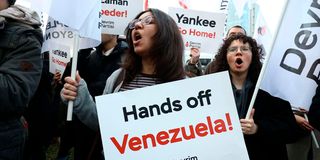
Demonstrators shout slogans during a protest in front of the US Embassy in Ankara, Turkey on January 4, 2026, a day after US President Donald Trump said the US has struck Venezuela and captured its President Nicolas Maduro and his wife Cilia Flores.
The pursuit or threat of arrest against a sitting head of state, such as Nicolás Maduro, is often framed as a moral or legal question, but its deeper implications lie in economics and global stability.
Beyond the political arguments for or against the Venezuelan president, actions that target incumbent leaders through unilateral legal measures introduce dangerous uncertainty into world trade and the international economic system. In an already fragile global economy, this kind of precedent does far more harm than good.
Global trade depends on predictability. Markets function not on moral judgments but on expectations—about contracts, governments, borders, and continuity. When powerful states signal that sitting presidents of sovereign countries can be treated as criminal suspects outside multilateral frameworks, they inject fear into the system.
Investors, shipping firms, insurers, and trading partners begin to reassess risk, not just in one country but across entire regions. If political disputes can suddenly become criminal pursuits, then no government is fully insulated from disruption, especially in the developing world.
The arrest or attempted arrest of a sitting leader also threatens the basic principle of sovereign immunity, a cornerstone of international commerce. Heads of state are not protected because they are flawless, but because global interaction requires stable interlocutors.
Trade agreements, energy contracts, debt negotiations, and development partnerships are all conducted between governments that must be recognised as legitimate counterparts. Undermining that legitimacy through unilateral legal actions weakens the foundations on which long-term economic cooperation is built.
For energy markets in particular, the consequences can be severe. Venezuela sits atop one of the world’s largest proven oil reserves, and while its production has declined, it remains an important factor in regional and global energy calculations. Any move that increases political volatility around such a producer adds pressure to already strained energy markets.
Price fluctuations, supply uncertainty, and speculative behaviour follow, affecting not just oil-importing nations but global inflation trends. Economic instability, once triggered, rarely remains contained.
There is also a chilling effect on South–South trade and cooperation. Many developing nations see actions against leaders like Maduro not as neutral law enforcement but as selective punishment.
This perception encourages countries to insulate themselves from Western-dominated financial systems, accelerating fragmentation in global trade.
When states seek alternatives to avoid vulnerability—through parallel payment systems, new trading blocs, or currency diversification—the result is a less efficient, more divided global economy. Fragmentation may benefit no one, but it is often the predictable response to perceived economic coercion.
World trade is also damaged by the normalisation of sanctions and legal threats as political tools. Sanctions regimes tied to leadership targeting often extend far beyond individuals, restricting banks, shipping companies, insurers, and exporters.
Ordinary businesses become collateral damage, forced to navigate complex compliance risks that raise costs and discourage engagement. For small and medium-sized economies, these barriers can be devastating, cutting off access to capital and markets even when humanitarian or commercial needs remain pressing.
Crucially, such actions weaken multilateral institutions designed to manage global economic disputes. When powerful states bypass international courts and collective mechanisms, they signal that rules apply selectively. T
his erodes trust in institutions like the United Nations, the World Trade Organisation, and international arbitration systems. Once trust erodes, compliance follows, and the entire architecture that supports global commerce begins to crack. Economic stability cannot survive in a system where rules are optional for some and absolute for others.
There is also a long-term strategic cost. Actions taken against one leader today may be used as justification against another tomorrow. Governments begin to price political survival into economic decisions, prioritising short-term security over long-term growth.
Infrastructure projects stall, trade negotiations freeze, and regional integration slows. The world economy, already grappling with debt, climate shocks, and geopolitical rivalry, can ill afford additional self-inflicted instability.
Opposing the arrest of a sitting president like Maduro is not the same as endorsing his governance. It is a defence of economic rationality and global stability.
The writer is a journalist and communication consultant.
Unlock a world of exclusive content today!Unlock a world of exclusive content today!