Why stability in Somalia is crucial

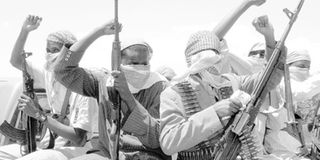
Somali militants in Mogadishu. “The TFG loosely holds onto power thanks to the 4,300-strong African Union mission.” Photo/REUTERS

US Secretary of State Hillary Clinton is in Africa on a seven-nation tour that started in Kenya and ends in Cape Verde.

The trip is partly meant to send a message that Africa still ranks high in the US foreign policy agenda competing against a complex mix of foreign dossiers like Afghanistan, Iran, the Middle East and North Korea.

This follows hot on the heels of US President Barack Obama’s Accra, Ghana, stop which was a thorough snub for Kenya, East Africa largest economy and strategic entry point to the Horn of Africa and the Great Lakes region.

This is a country reeling from last year’s post-election violence whose perpetrators still remain at large.

The Cabinet has failed to agree on the way forward as per the recommendations put forth by a probe commission headed by Justice Philip Waki.

Terror suspects

Barely a month ago, Kenya was ranked East Africa’s most corrupt nation by Transparency International.

Kenyans remain largely angry at the political class and frown at the direction the country is taking with new corruption, nepotism, tribalism worsening the socio-economic situation across the region.

Even so, what will be hot in the agenda of Secretary Hillary Clinton is the deteriorating security situation in the Horn of Africa region.

Australian police recently foiled a suicide attack.

Among the arrested suspects were young Australian citizens of Lebanese and Somali descent with clear links to the al Shabaab militia.

This confirms long-running fears of a growing role of the hardline Islamists, who in barely a year have expanded the area they control in Somalia by marketing themselves as an alternative to the TFG government, attracting fighters from Europe, South Asia and according to recent reports in the New York Times, even in the US city of Minneapolis in Minnesota.

The TFG loosely holds onto power thanks to the 4,300-strong African Union mission and it is only a matter of time before they take over and start running the show in Somalia.

The instability in the Horn of Africa region echoes a long way back.

From the way Italians and Britons divided up the country during colonialism to the way the map was drawn up.

Even during Somali dictator Siad Barre’s reign, he was considered as simply ‘mayor’ of Mogadishu and could not spread his rule in the whole of Somalia.

The Oromo live inside Ethiopia, but they consider themselves Somali.

Eritrea and Ethiopia and Djibouti still have territorial disputes and continue to sponsor rival militia against one another.

These regional forces have continued to export their conflicts into an unstable Somalia.

Closer home, Kenya’s North Eastern province tried to secede in the 60s and join Somalia and the Shifta war that followed saw human rights violations against ethnic Somalis by the army, according to Human Rights Watch.

Since then the development policy of Kenya has been a loud snub for the northern region and the area remains largely neglected with loose groups easily moving across the joint borders between Kenya, Ethiopia, Sudan, Eritrea and Somalia.

Refugees have been fleeing the conflict and hunger in Somalia–some to Yemen across the sea and others into Kenya.

In the UN run refugee camp of Dadaab, almost a quarter of a million people live in desperate conditions, according to the United Nations.

UNHCR chief, Antonio Gutteres, has just asked for help to improve their lot, but one must add that with young refugees living in such desperate conditions, they will become easy prey for terrorist cells, especially al Shabaab, who have been known to infiltrate borders in a bid to lure young men to serve as fighters.

With the police being ranked as number one most corrupt agency, diplomatic sources have expressed fears that there is no security at the borders.

Urgent solution

An unsecure Somalia means insecurity everywhere.

As the Australian Prime Minister put it on learning of the terrorist attack, ‘the enduring threat of terrorism’ still stares our face. We must all act in concert to help Somalia with stable government.”

Perhaps this is the time to ask Somali diaspora to take a more active role in bringing stability to their country.

The stable Puntland and Somaliland should also be bolstered as ‘islands of near-stability’ while the Arab League must aid the AU and IGAD in finding an urgent solution to this cesspool.

The International community meanwhile must replicate the ‘surge from sea to land’ to help start turning things round.

The writer is a fellow at the Institute of African Progress.

PAYE Tax Calculator

Note: The results are not exact but very close to the actual.