Time flies with great content! Renew in to keep enjoying all our premium content.
Prime
When infrastructure falters, budget pays
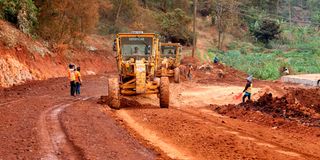
A road under construction. KeNHA has been allowed to appeal a court order requiring it to pay Sh201 million to an Israeli contractor over disputed road works.
As Kenya navigates a Sh4.7 trillion budget framework amid revenue underperformance and rising debt service obligations, public debate has understandably focused on borrowing levels, taxation measures and expenditure ceilings.
These are visible pressure points. However, a less visible but structurally significant issue lies upstream in the infrastructure value chain: project underperformance.
Much of the current public frustration — whether expressed through concerns about rising taxation, service delivery strain or the widening gap between economic expansion and household welfare — reflects deeper structural pressures within the fiscal system.
Understanding these pressures requires looking beyond headline budget figures to the performance integrity of long-term capital investments.
Infrastructure is often discussed in binary terms — either as a necessary investment or as excessive borrowing. The reality is more nuanced. Infrastructure can expand economic capacity when assumptions hold.
But when core assumptions weaken — whether in demand forecasts, cost calibration or risk allocation — projects may generate less economic value than anticipated while still locking in long-term financial commitments.
This gap between projected performance and realised outcomes is not always dramatic. It often appears gradually, through lower-than-expected utilisation, deferred maintenance, renegotiated contracts or fiscal support measures that were not prominent at financial close. Over time, however, the cumulative effect becomes material.
Large-scale infrastructure projects embed economic assumptions that typically extend two to three decades — reflecting 20-year design lives under conventional procurement or 25–30-year concession periods under public -private partnership frameworks.
Traffic growth projections assume certain income elasticities and logistics patterns. Energy projects assume specific industrial expansion trajectories. Toll roads assume willingness-to-pay thresholds aligned with projected income growth. When these assumptions prove optimistic, the physical asset remains — but its economic performance shifts.
When infrastructure projects are scaled in the hundreds of billions of shillings, even modest percentage deviations in projected performance can materially alter fiscal outcomes.
A 10 to 20 percent divergence in traffic volumes, energy demand, or cost escalation assumptions may appear manageable in isolation, but when applied across multi-billion-shilling investments, the resulting revenue gaps or cost pressures can compound over decades.
These adjustments do not disappear; they must ultimately be absorbed within the broader fiscal framework. For example, if a major toll corridor records sustained traffic volumes below conservative projections, the resulting revenue gap may trigger fiscal support measures or contractual adjustments that reverberate beyond the transport sector.
The consequence is not merely a slower return on investment. It is fiscal inflexibility.
Revenue shortfalls in infrastructure-linked projects can migrate into contingent liabilities, tariff adjustments, concession restructuring or direct fiscal support.
Capital cost underestimation can result in variations and refinancing pressures. When aggregated across multiple projects, these adjustments narrow fiscal space and complicate medium-term budget planning.
This dynamic is not unique to Kenya. Globally, infrastructure performance risk is one of the most studied drivers of long-term public finance stress. What matters is not whether ambitious projects are pursued, but whether they are subjected to sufficiently rigorous preparation and independent scrutiny before commitment. The most expensive stage of any infrastructure project is not construction.
It is weak preparation.
When alternatives are not exhaustively evaluated, when traffic or demand models rely heavily on central-case projections, or when downside scenarios are treated as remote rather than plausible, risk accumulates quietly. By the time performance gaps emerge, contractual and political commitments make course correction complex.
In an environment of tightening fiscal space, Kenya’s economic resilience will depend not only on revenue mobilisation and borrowing strategy, but also on the performance integrity of its capital investments.
Infrastructure does not strain public finances simply because it is built. It strains public finances when projected economic value does not fully materialise.
Ensuring that assumptions are rigorously interrogated before financial commitments are made is therefore not a technocratic detail — it is central to long-term fiscal stability.
In capital investment, ambition must be matched by preparation and discipline. The budget ultimately reflects the difference.
Kenya possesses strong technical capacity in public and private sectors. The challenge is institutional consistency. Are demand models routinely stress-tested against conservative scenarios? Are bills of quantities examined not only for price competitiveness but for executability? Are lifecycle maintenance costs fully integrated into financial projections? Are downside cases given equal weight in decision-making processes?
These are not procedural questions. They are macroeconomic ones.
As infrastructure ambitions scale — particularly within regional corridor and energy integration frameworks — the magnitude of potential deviation expands. Small percentage errors, when applied to very large capital commitments, translate into meaningful fiscal consequences over time.
This does not argue for halting infrastructure development. On the contrary, infrastructure remains essential to productivity, trade integration and urban efficiency. The argument is for discipline commensurate with scale.
Strengthening upstream project preparation and independent technical challenge functions may be one of the most cost-effective fiscal reforms available. Institutionalising independent project review panels and mandatory downside sensitivity disclosure before financial close could significantly reduce long-term exposure without slowing development momentum.
In an environment of tightening fiscal space, Kenya’s economic resilience will depend not only on revenue mobilisation and borrowing strategy, but also on the performance integrity of its capital investments.
Infrastructure does not strain public finances simply because it is built. It strains public finances when projected economic value does not fully materialise.
Ensuring that assumptions are rigorously interrogated before financial commitments are made is therefore not a technocratic detail — it is central to long-term fiscal stability.
In capital investment, ambition must be matched by preparation discipline. The budget ultimately reflects the difference.
Eng Mwawasi is Infrastructure & PPP Governance Specialist
Unlock a world of exclusive content today!Unlock a world of exclusive content today!