What leaders can learn from Raila’s boldness in opening up city bypasses

The 17.3-kilometre Nairobi Western bypass.

Photo credit: File | Nation Media Group

Nairobi’s Eastern, Northern and Southern bypasses, as well as their link roads, have a unique, but also annoying, history. It ended well, though, bespeaking the late Raila Odinga’s boldness in driving public good.

The bypasses, which provided much-needed relief to local and transnational traffic that did not enter the city centre, had been projected and planned for in the 1970s.
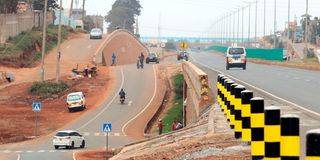
Since the corridors traversed private land, compulsory acquisition was done, and those affected were compensated. But the acquisition was not followed up with construction.

For years, life went on, with the corridors remaining unclaimed and hence available for all manner of land uses, other than the reserved one. Ultimately, politically correct operatives in the Kanu government, famous for high levels of public land-grabs, “discovered” them.

With the connivance of those in public offices, the corridors were quickly re-planned into plots and subsequently allocated. The construction of palatial houses, and, in some cases, offices, followed and were completed in the 1990s.

It remains rather intriguing how people entrusted with leadership have lost vision and compromised, rather than protected, such vital public corridors.

When the National Rainbow Coalition government took over in 2002, the matter of the grabbed public land became moot. By 2003, the public had been adequately sensitised about the extent of public land grabs that had previously happened.

It was then that the Council of the Institution of Surveyors of Kenya (ISK), which was privy to the bypass corridors grabbing, flagged the matter publicly.

It teamed up with Odinga, then minister for Roads, Public Works and Housing, to push for the opening up of the corridors. The ISK provided hard evidence of the public land grabbing by private individuals.

Convinced that there was a good case, and supported by an able team of his then Assistant Minister, Joshua Toro, PS Erastus Mwongera, Odinga confronted this seemingly insurmountable challenge boldly.

He was not deterred by the fact that the corridors had been re-planned and allocated at a high level, and that the beneficiaries were well-connected and influential persons.

Odinga provided focused and resolute leadership at a most needed moment. As the then chairman of the ISK Council, I witnessed the bureaucracy, the technical and political obstacles that he and his team had to relentlessly navigate.

The ministry went on to issue public notices, asking beneficiaries in the corridors to vacate, or else be evicted. Most resisted. Some went to court.

However, between 2004 and 2005, they were evicted, and developments were demolished, with construction of the bypasses commencing.

Ultimately, the bypasses were opened up and gradually constructed. Today’s leaders must learn to be bold in advancing and protecting public lands and resources, despite the risks.

Confronting threats and obstacles in the pursuit of the public good is what defines good leadership. On this, Odinga provided a powerful model.

The writer is a consultant on land governance.

PAYE Tax Calculator

Note: The results are not exact but very close to the actual.