Inside the water utility performance monitoring benchmarking systems

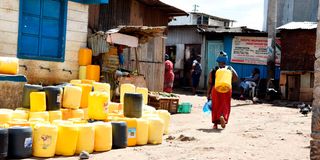
A resident of Southlands Kijiji in Lang'ata with water jerrycans walks past an NMS watering point on August 25, 2021.

Photo credit: File | Nation Media Group

Kenya’s water sector has made significant institutional progress over the last two decades, particularly following the reforms introduced under the Water Act 2002 and later strengthened through the Water Act 2016. Yet despite these reforms, many water service providers struggle with persistent operational, financial, and governance challenges.

As urban populations grow, climate variability intensifies, and public expectations increase, the issue of water utility performance can no longer be treated as a purely technical matter. It has become a central governance and development concern.
One of the most important reforms in the sector has been the introduction of utility performance monitoring and benchmarking systems under the oversight of the Water Services Regulatory Board.

Through annual performance reports and comparative utility rankings, Kenya has gradually developed one of the more structured utility performance assessment systems in the region. Indicators such as non-revenue water, water coverage, continuity of supply, staff productivity, metering ratios, and revenue collection efficiency now play an increasingly important role in shaping sector conversations.

The logic behind performance benchmarking is simple but powerful: utilities improve when performance becomes measurable, visible, and comparable. Benchmarking creates institutional pressure for improvement while simultaneously providing managers, regulators, counties, and citizens with a clearer understanding of service delivery realities.

However, the experience of the Kenyan water sector also demonstrates that performance measurement alone does not automatically produce better outcomes. Some utilities continue to perform poorly despite years of reporting and regulatory oversight. This suggests that the deeper challenges affecting utility performance are often institutional rather than purely technical.

In many counties, water utilities operate within politically sensitive environments characterised by financial constraints, ageing infrastructure, weak maintenance cultures, governance instability, and rapid urban expansion.

In some cases, utility managers face competing pressures between commercial sustainability and political expectations for low tariffs or informal service provision. Consequently, sustainable performance improvement requires more than technical efficiency metrics.

It requires stronger governance systems, professional management, realistic investment planning, and clearer accountability frameworks.

There is also growing recognition that climate change is beginning to reshape the operational realities of water utilities. Droughts, erratic rainfall patterns, and increasing water stress are likely to place even greater pressure on already constrained systems.

Future utility performance frameworks must, therefore, integrate resilience, sustainability, and adaptive capacity more explicitly.

Kenya has already laid an important foundation for utility performance regulation. The next phase of reform should focus on deepening institutional accountability, strengthening governance capacity, and ensuring that performance systems translate into meaningful improvements in service delivery for citizens.

Prof Collins Miruka is the Deputy Vice Chancellor - Administration, Finance, Planning and Development at Tharaka University. He can be reached at [email protected] or @prof_miruka on Twitter

PAYE Tax Calculator

Note: The results are not exact but very close to the actual.