Time flies with great content! Renew in to keep enjoying all our premium content.
Prime
United States quiet World Cup problem
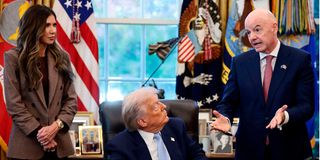
US President Donald Trump sits while FIFA President Gianni Infantino and US Homeland Security Secretary Kristi Noem stand by his side, as he meets with the White House Task Force on the FIFA World Cup 2026 in the Oval Office at the White House in Washington DC, US on November 17, 2025.
There is a special kind of cultural confusion that comes from visiting the United States (US) a month before the World Cup. Not the Super Bowl. Not the NBA Finals. I mean the actual World Cup, the global sporting festival that turns entire nations into temporary psychiatric wards of joy, heartbreak and unprovoked street dancing.
Yet here I am in Atlanta, and the pre-World Cup atmosphere is… muted. Whisper-soft. As quiet as a teenager’s room after you’ve switched off the home Wi-Fi.
Walking around downtown Atlanta, I have seen exactly one bar, just one, with football-themed décor. Parasols on the tables outside, marked with the World Cup emblem and a beer-themed offering titled “First Eleven”, were notable. If you blink too enthusiastically, you’ll miss the only sign that the world’s biggest sporting event is around the corner.
The 2026 World Cup is slated to be played in Canada, Mexico and the US. Out of the 16 cities in which the games will be played, 11 are in the US, which is an interesting twist of hosting fate, given that it is one of the least soccer spectator-driven countries in the world.
A double whammy, as it were, has hit the 2026 World Cup planning. Firstly is the Trump administration’s anti-immigrant policies, whose chickens are coming to a very public summer roost. According to a New York Times article dated May 4, authors Henry Bushnell and Adam Crafton quote from a survey undertaken by the American Hotel and Lodging Association (AHLA).
In the survey, close to 80 percent of respondents reported that bookings are tracking below initial forecasts, citing “visa barriers” and “broader geopolitical concerns” as among the top constraints suppressing international demand for hotel rooms in the 11 cities.
Further, potential visitors were felt to may be impacted by the US travel bans, which affect four countries competing in the World Cup – Senegal, Ivory Coast, Haiti and Iran, while nationals from three further qualifying countries – Algeria, Cape Verde and Tunisia - must deposit up to $15,000 in bond payments to be granted a tourist visa to enter the US.
This is over and above the looming risk of the dreaded Immigration and Customs Enforcement (ICE) agents who’ve spent the last year rounding up non-US citizens and ignominiously throwing them into detention centres before a one-way ticket to an Ecuadoran hellhole of a prison.
The second whammy is the issue around the ticket prices. Because if the American street atmosphere is muted, the pricing is screaming. Loudly. In several languages. Inspired by who-knows-what and only God knows why, FIFA has embraced dynamic pricing, which is a polite way of saying “the price changes depending on how badly we think you want it.”
Dynamic pricing is a common North American feature for airlines, concerts and sports event pricing. One moment, a ticket is $300, the next it’s $1,200, and by lunchtime, it’s priced like it includes a small equity stake in the stadium.
Compare this to the Qatar 2022 World Cup, where prices were stable, with the lowest category available to international tourists at $69 and the World Cup final match attracting a charge of $1,600 back then, compared to the current prices drifting into the $11,000 trajectory!
The immutable paradox in all of this is the World Cup organisers giving Trump-esque statements. According to the same New York Times article quoted above, a FIFA spokesperson responding to the AHLA report “also argued generally that global demand for the 2026 World Cup is unprecedented, with more than five million tickets sold for the tournament and excitement continues to build for the largest sporting event on the planet.”
So, based on my passing observations in the city of Atlanta, and anecdotal data from other non-Americans nearby, America is not excited. There is no energy, no noise, no flags, no billboards.
The excitement level is about the same as a cat watching someone fold the laundry.
In most countries, the World Cup is not an event. It is a season. A mood. A national personality transplant. Productivity drops. Tempers rise. Flags multiply. Even people who don’t watch football suddenly become experts in formations, refereeing decisions, and the psychological fragility of their national team’s goalkeeper.
Maybe it’s coming. Maybe Americans are slow burners. Maybe they’ll wake up on opening day and suddenly discover that football (soccer) is, in fact, the world’s most beloved sport. Or maybe they’ll continue treating it like a polite hobby, something you watch after brunch, before baseball and during halftime of the NBA playoffs.
The current FIFA administration’s inexplicable need to reprice tickets at a time when the biggest World Cup host country’s immigration policy is similar to the entry protocols at the Strait of Hormuz, which it is also blockading, will be a sideshow worth observing. But maybe a miraculous Energiser rabbit will be pulled out of a hat. Who knows?
Carol Musyoka is a former banker and is currently a corporate governance specialist.
Unlock a world of exclusive content today!Unlock a world of exclusive content today!