The pacesetter’s trap for Africa’s founders

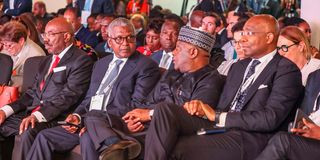
Dangote Group founder Aliko Dangote (second left), among dignitaries following proceedings during a session at the University of Nairobi on May 11, 2026, as part of the Africa Forward Summit 2026.

Photo credit: Wilfred Nyangaresi | Nation Media Group

A school child in Nairobi was last week asked who the two men jogging toward State House Primary School were. She answered without hesitation: Kipchoge and Emmanuel. Her classmate, uncertain about the second name, leaned over and asked the French president what he was called. The children were not being rude. They were being precise. In Kenya, Eliud Kipchoge settled that question a long time ago.

That moment, unrehearsed, unscripted, caught on someone's phone before the cameras repositioned told more truth about Africa's actual economy of attention than anything said inside the Africa Forward Summit.
Thirty African leaders. Macron as deal-lead. Total Energies, Orange, CMA CGM, €23 billion announced, €700million committed to modernise the port of Mombasa. France did not arrive to observe but it arrived with its president and its companies welded into a single strategy, knowing that state power and private capital are not separate instruments.

Africa arrived with its Presidents and its dignity. The founders sat in the audience.

This column is not an argument against foreign investment. Africa needs capital, and capital has no ideology worth respecting more than its own return. This is also not a lament about Macron. A man who jogs eight kilometres through Nairobi in the cold and submits to the honest verdict of schoolchildren has at minimum earned his discomfort in good faith.

What this column names is something older and more structural: the phenomenon I am calling 'protocol capture' — the systematic displacement of Africa's actual value-creators from the seats of agenda-setting, replaced by political figures who convene summits in founders' names while founders occupy the audience rows.

Inside that hall, the moderator noticed something the cameras almost missed. The crowd was not gathering around heads of state. It was gathering around Aliko Dangote. Not a minister. A builder. The real gravitational centres of this continent's imagination are its founders. Kipchoge. Dangote. The crowd knew. The protocol sheets did not.

That same week, in a quieter register, a video moved through our FBX founder community. A young man, still years from adulthood, running what looked like several small enterprises from a single location in the village — trading, moving, solving. No pitch deck. No incubator approval. The village had given him his MBA, and he was using it.

Pauline Warui, who shared the video, opened a real question: is entrepreneurship inherent, or is it made? The conversation that followed was honest and did not resolve neatly, because honest conversations about Africa rarely do.

Here is the paradox I will not flatten: the village boy is evidence of extraordinary human capital forming outside the system, and his being outside the system is a national failure. Both are true simultaneously.

Admiring his determination without building a system that treats him as an asset. He does not need our admiration. He needs architecture.

Kipchoge built something rarer than a world record. He built a global personal brand from Kenyan soil. Nike carries his name on shoes. Safaricom redesigned the M-Pesa logo for him. No government agency authored that outcome.

No bilateral summit created that leverage. He ran his way to a position of cultural gravity that a French president now jogs beside on a cold Nairobi morning. That is a founder's journey wearing an athlete's shoes.

A disclosure I cannot omit: Macron and I are both World Economic Forum Young Global Leaders, he from the class of 2016, I from 2014. We have shared global sessions. Watching him move through my city carried, therefore, a particular texture.

I am not watching a foreign leader tour a foreign country. I am watching a peer, operate with a clarity of national purpose that I wish we matched. France knows what it is building, who it is building it with.

The strongest counter-argument to everything I am building here is also the most honest one: African founders have not yet consolidated enough to occupy the convening seat. The institutions that produce Dangotes are still too few. The capital stacks that back them are still too shallow.

But here is the second-order consequence that neither argument reaches: when Africa's founders are permanently in the audience while politicians manage the agenda, the agenda is permanently wrong. Not maliciously.

Architecturally. Politicians optimise for summits. Founders optimise for markets. The asymmetry does not produce bad speeches. It produces bad economies.

African founders have been setting the pace on this continent for decades. Building resilient enterprises without state backing. Solving problems the state had given up on.

Running ahead of the ribbon. Arriving at the finish to find someone else already holding it. That is not a gap in execution. That is 'the pacesetter's trap' — doing the hardest work while others receive the credit, the capital and the convening authority. Gates are not opened by running faster. Run harder. Convene louder. The next summit should be ours to host.

They are opened by those who hold keys, or broken by those who have finally understood the gate was never meant for them. The continent's children already know who built what. The summit programmes have not caught up.

Michael Anthony Macharia is a serial entrepreneur, founder of Seven Seas Technologies and Ponea Health

PAYE Tax Calculator

Note: The results are not exact but very close to the actual.