Seizing opportunity in climate action

CLIMATEACTION

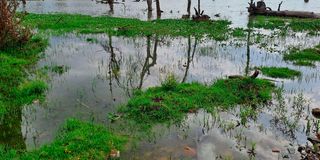
Submerged section of what was once the bank of Lake Naivasha that has been affected by the rising water levels. 

Photo credit: File | Nation Media Group

Climate change is no longer a distant threat, it is here with us! From unusual rains and prolonged droughts to deadly heatwaves and floods, the world is experiencing the impact of rising global temperatures caused by human activity.

According to the Intergovernmental Panel on Climate Change Global Carbon Project report of 2021, 86 percent of global carbon emissions come from burning fossil fuels such as coal, oil and gas.
Another four percent comes from cement production, while 11 percent results from deforestation and other land-use changes. Cutting down forests reduces the earth’s ability to absorb carbon, worsening the problem.

In response, governments have introduced laws and policies to reduce emissions under the Paris Agreement on Climate Change. Kenya enacted the Climate Change Act 2016, updated in 2023, and rolled out the National Climate Change Action Plan (2018–22).

The private sector, civil society organisations (CSOs), and individuals each have important roles to play in meeting the goals of the Paris Agreement.

The private sector can contribute by supporting tree planting initiatives, promoting climate-friendly businesses, and facilitating technological innovations, including the use of artificial intelligence for environmental monitoring.

CSOs can educate the public about climate action, organise community tree planting events, and advocate for sustainable practices.

Individuals can take practical steps such as reducing energy use by switching to energy-efficient bulbs, adopting renewable energy solutions, using sustainable transport like walking, cycling, or electric vehicles, consuming more plant-based foods, and minimising waste through recycling.

Taking the above actions presents certain benefits. Enhancing biodiversity thus supports food, water, climate, health, and economic prosperity. It creates more resilient natural systems, generates income for communities, and empowers women and youth.

There are also financial benefits. The carbon and biodiversity credit market allows communities to earn income by planting trees which absorb carbon.

The absorbed carbon is quantified and sold to developed countries that have historically contributed most to emissions.

In Kenya, Furaha and Baraka Farms (FBF) is already demonstrating how business and sustainability can work hand in hand.

FBF acts as a strategic partner, linking global economic players seeking carbon neutrality with local communities driving the green economy. It connects communities to carbon credit buyers, creating new income opportunities.

As the world faces rising emissions and changing weather, FBF demonstrates that climate action is not only about survival but also about building a better future for all.

The writer is the internal audit manager at Absa Life Assurance Kenya

PAYE Tax Calculator

Note: The results are not exact but very close to the actual.