Recently, Kenya’s Cabinet gave the nod to setting up of a Sovereign Wealth Fund (SWF), which establishes a framework for management and investment of among others, revenues from Kenya’s mineral resources, an attractive proposal in principle and politically appealing.
In theory, the proposal promises intergenerational equity and long-term national wealth creation. In practice, however, this ambition risks becoming wishful thinking unless several bare minimum conditions are first met within Kenya’s mining sector and its fiscal architecture.
A SWF relying on revenues from mining presupposes a large, predictable, and sustainable revenue streams. We are not there yet I dare say. The sector has historically contributed less than one percent to GDP and an even smaller share to total government revenue.
Royalties collected remain low, highly concentrated in just a few operations - the largest of which closed down recently; highly vulnerable to commodity price volatility and very long development timeline for new projects.
Successful natural resource-anchored SWFs for instance in Norway, Botswana and Chile were established off the back of sustained periods of large-scale, profitable mineral production.
In contrast, Kenya still remains more of a frontier exploration jurisdiction than a mining destination. The country is under-explored relative to its geological potential, further, we have limited proven mineral reserves that can be converted into producing mines and most mineral rights applications are heavily speculative.
Consequently, diverting early-stage revenues from the sector to a SWF before it matures risks starving the very exploration activities required to grow the revenue base in the first place.
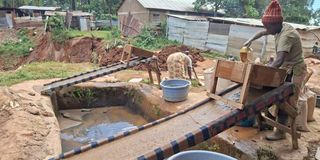
The sector still struggles with weak compliance and revenue leakages, all these attributed to illegal and unregulated mining, under-declared royalty and valuation disputes, limited capacity from government in verification of production reports and weak enforcement of employment, training and local content obligations.
The state must first be able to efficiently collect what is already due for a SWF to work. Without these, the SWF risks being capitalised on paper revenues rather than real cash flow undermining its credibility and sustainability.
Since the enactment of the Mining Act 2016 and mining royalty collection and management regulations, counties and local mining communities are yet to get their rightful share of royalties collected.
For Kenya’s mining sector to contribute to a sovereign wealth fund, it must first build a materially larger and diversified revenue base from multiple producing mines, alongside full enforcement of revenue collection, production reporting, valuation systems, and clear, transparent, and insulated governance for both mining revenues and the SWF.
Equally critical is resolving county and community benefit-sharing frameworks while prioritizing exploration, value addition, and long-term sector growth ahead of short-term revenue expansion.
Communities continue to demand visible and immediate benefits and the social license to operate continue to remain fragile. Channeling royalties into a National SWF at this time without first resolving the benefit sharing for counties and communities’ risks fueling more resistance to mining projects, further constraining realization of new projects and limiting revenue growth.
Further, any shilling directed in a SWF is a shilling not invested in mineral exploration initiatives, geological data acquisition, regulatory capacity building and skill development. At this stage, investment in these initiatives may yield higher long-term returns than prematurely capitalizing a SWF.
Royalties are calculated form raw minerals or minimally processed material, capturing only a fraction of value from minerals.
We currently export most minerals with minimal beneficiation with little to no local processing and refining, barely any downstream industries. Royalty base from the mining sector remains structurally constrained, limiting the ability of revenues from mining to sustain a SWF.
That said, a SWF funded by revenues from mining is not inherently flawed- but at present, it is premature. Without first growing the sector, the fund risks becoming a symbolic institution funded by insufficient and unstable revenues.
The priority should be building the sector first, only then can mining revenues realistically and sustainably serve as an anchor for a fund that delivers long-term national value.
The writer is chairman of the Mining Engineers society of Kenya.
Unlock a world of exclusive content today!Unlock a world of exclusive content today!