Time flies with great content! Renew in to keep enjoying all our premium content.
Prime
Kenya’s MSME growth problem
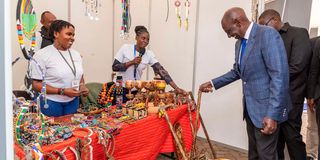
President William Ruto is shown a Maasai walking stick by Saidia Kimiti (right) and Scholastica Ateya, Nyota program beneficiaries from Kiasili Designs during the launch of the Revised Micro, Small & Medium Enterprises (MSME) Policy 2026 and celebrations to mark the World MSME Day at the Kenyatta International Convention Centre (KICC) in Nairobi.
As Kenya marked the World MSME Day, policymakers, development partners, financial institutions and business leaders once again reflected on one of the country's most pressing challenges: how to create more jobs. Yet the question itself may obscure a more important reality.
The issue is not where jobs will come from, because we already know the answer. Across Kenya, millions of jobs are created, sustained and expanded every day by micro, small, and medium enterprises (MSMEs).
According to the 2026 Economic Survey, Kenya created 882,100 new jobs in 2025, with more than 716,800 jobs originating from the informal sector, where the vast majority of MSMEs operate. Informal sector employment rose to 18.1 million people, highlighting the continued role of small enterprises as the primary source of employment growth in the economy.
For many years, discussions about unemployment have focused primarily on labour markets, workforce readiness and education systems. While these conversations remain important, they can sometimes divert attention from a simple economic reality: jobs are ultimately created by enterprises.
If Kenya wishes to create more employment opportunities, it must create the conditions that allow more enterprises to start, survive, grow, and become productive. In this sense, MSMEs are not merely participants in the economy. They are among its most important drivers.
Their contribution extends far beyond the number of businesses they represent. MSMEs provide employment to millions of Kenyans, often serving as the first source of income for young people entering the labor market, women seeking economic opportunity, and communities located far from major urban centers.
They create opportunities where few alternatives exist and play an essential role in linking economic growth to household prosperity.
This is particularly important in a country where the majority of labour market entrants will build livelihoods through entrepreneurship, self-employment, contracting, small businesses and participation in value chains rather than through formal salaried employment.
Much of the public conversation around employment continues to focus on the search for jobs, yet a significant proportion of Kenya's workforce creates its own economic opportunities every day.
Supporting MSMEs is therefore not simply a business agenda but a livelihoods agenda, a youth agenda, and ultimately an economic development agenda.
Despite their importance, many MSMEs continue to face constraints that limit their ability to expand and create jobs. Access to finance remains one of the most significant of these barriers.
The Central Bank of Kenya's 2024 Survey on MSME Access to Bank Credit found that there were approximately 890,000 active MSME loan accounts valued at Sh784.4 billion across the banking sector. Despite the substantial lending volume, many small businesses still struggle to secure affordable capital, particularly during their growth stages when financing needs are highest.
Experience from enterprise development programmes across the country suggests, however, that access to capital alone rarely delivers sustained growth.
Businesses tend to achieve stronger outcomes when financing is accompanied by business development support that helps entrepreneurs strengthen financial management, improve record keeping, adopt new technologies, expand market reach and make more informed decisions.
Market access remains equally important. Many MSMEs do not struggle because they lack determination, effort, or entrepreneurial spirit.
They struggle because they are unable to consistently access customers, integrate into supply chains and secure reliable buyers. For countless enterprises across the country, the challenge is not producing goods and services, but strengthening connections between MSMEs and wider value chains.
Technology is also reshaping the environment in which businesses operate. Digital tools are enabling enterprises to access customers beyond their immediate geography, improve operational efficiency and participate in entirely new markets. At the same time, businesses that fail to adapt, risk becoming less competitive in an increasingly digital economy.
Expanding digital capability among MSMEs should be viewed not only as a technology objective, but also as a competitiveness and productivity objective.
These realities point towards a broader lesson. Enterprise growth rarely depends on a single intervention. Finance matters. Skills matter. Technology matters. Market access matters. Supportive regulation matters. The most effective enterprise ecosystems recognise that these factors reinforce one another.
There is an opportunity to reframe the conversation. Rather than asking how to create more jobs, we should ask how to help more businesses grow. Rather than focusing exclusively on employment programmes, we should strengthen the ecosystems that allow enterprises to thrive.
Rather than viewing MSMEs as peripheral to economic policy, we should recognise them as central to Kenya's growth story.
Entrepreneurs are far more likely to succeed when they can access capital, build capabilities, connect to markets, adopt appropriate technologies, and operate within an enabling business environment.
This also requires a shift in how we think about MSMEs themselves. Too often, small businesses are discussed primarily as beneficiaries of support programmes rather than as economic actors that create value, generate employment, drive innovation, and contribute to national prosperity.
The writer is the Managing Director, KCB Foundation
Unlock a world of exclusive content today!Unlock a world of exclusive content today!