Kenya’s blueprint for funding Africa’s future

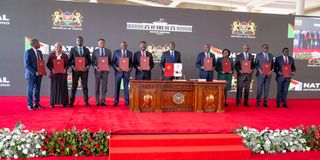
President William Ruto (centre) and members of National Assembly Finance and National Planning Committee display copies of the National Infrastructure Fund Bill after it was assented into law at State House, Nairobi on March 9, 2026. 
 

Photo credit: PCS

For decades, the dominant story of African development has been one of dependency: waiting for the World Bank loan, the International Monetary Fund (IMF) arrangement, the donor conference, the debt relief round. That story is not entirely wrong. But it is dangerously incomplete. And Kenya, with little fanfare, is writing a different one.

Over the past few years, Kenya has enacted a sweep of legislation that amounts to the most ambitious domestic capital mobilisation framework on the African continent.
Its centrepiece, a Sh5 trillion National Infrastructure Fund (NIF), is not another borrowing vehicle. It is something structurally different: a mechanism designed to make Kenya’s own savings, its pension funds, its retail investors, its private equity market, do the work that foreign debt was never built to do sustainably.

The problem it is solving is rarely discussed in development economics circles, though it should be. Africa’s infrastructure financing gap, estimated at $68 to $108 billion a year by the African Development Bank, is not primarily a shortage of money.

There is no shortage of capital in the world. The shortage is of investable projects: opportunities where private capital can enter without facing crippling sovereign risk, opaque regulatory environments, or legal frameworks that shift mid-contract. That uncertainty is not a footnote. It is the reason trillions of dollars in global private capital have largely bypassed the continent. The NIF addresses this directly.

By absorbing sovereign and legal risk at the project level, it removes the uncertainty that forces private investors to demand prohibitive risk premiums or walk away entirely.

It acts as a structural buffer between the Kenyan State and the market, giving development finance institutions, private equity funds, domestic pension managers and local retail investors, a common platform on which to participate without exposure to the regulatory volatility that has stalled projects across the continent for a generation.

The Sh5 trillion pipeline of dams, roads and urban transit becomes financeable not because Kenya has borrowed more, but because the NIF makes the risk profile legible and acceptable to capital that previously had nowhere in Kenya to go.

This matters beyond Kenya’s borders. Rwanda built a competitive economy from near-zero after 1994. Botswana converted diamond revenues into one of Africa’s most stable development trajectories through the Pula Fund. Mauritius became a continental financial hub through regulatory design alone. These nations did not succeed by waiting for the global financial architecture to serve them.

They engineered their own conditions for growth. Kenya is now doing the same, at greater scale, and with instruments far more sophisticated than anything its predecessors had available.

The human dimension of this architecture is equally significant. The planned 65 percent initial public offer of the Kenya Pipeline Company, targeting Sh100 billion on the Nairobi Securities Exchange, will be the largest state offering since Safaricom’s landmark 2008 listing.

When an ordinary Kenyan in Kisumu or Eldoret can hold shares in the pipeline that carries fuel to their town, development stops being something administered from above and becomes something people own.

A proposed Sovereign Wealth Fund, with an intergenerational component anchored in the Constitution, extends the same logic forward in time: today’s resource revenues become tomorrow’s infrastructure, rather than today’s debt service.

None of this works without legal integrity. The legal profession across Africa must stop treating transformative legislation as a courtroom opportunity, and start treating it as architecture to be designed soundly from the outset. Innovation in finance and innovation in law must move together, or neither moves fast enough.

As Mohammed bin Rashid Al Maktoum, the architect of Dubai’s own transformation from desert outpost to global financial hub, once observed: “Time is too precious to waste on postponing our people’s dreams and expectations.” Africa’s legal community would do well to take that as its mandate.

The World Bank estimates that a 10 percent increase in infrastructure investment can raise long-term gross domestic product growth by one to two percentage points in emerging economies. Those numbers translate into jobs, hospitals, schools, and the material improvement of lives.

Kenya’s new framework will not automatically deliver them. Discipline, transparency and governance that is genuinely insulated from political interference will determine whether the architecture performs or corrodes.

Africa does not need to borrow its way to prosperity, it needs to build its way there, using the assets it already owns, the savings it already holds, and the institutions it must now have the courage to build. The opportunity is not merely economic. It is civilisational.

The writer is a partner at G&A Advocates LLP.

PAYE Tax Calculator

Note: The results are not exact but very close to the actual.