Inside Kenya Airways’ high-stakes turnaround

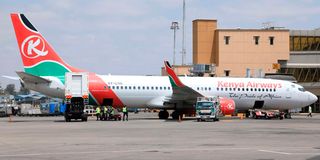
 A KQ plane at a parking bay at JKIA. Wealthy Kenyans are chartering entire Kenya Airways planes for weddings, corporate events, and luxury travel.

Photo credit: File I Nation Media Group

Kenya Airways (KQ) confronts a balance sheet implosion and operational paralysis that demand surgical precision from its new board.

Kiprono Kittony assumed chairmanship on March 5, inheriting an airline reeling from early 2025 losses after a brief profitable spell in 2024. The Pareto Principle—80 percent of challenges from 20 percent of root causes—lays bare the crisis: financial fragility, fleet groundings, cost-revenue mismatches, strategic inertia and labour friction.

Past bailouts have merely deferred insolvency; recovery now requires deleveraging through equity partnerships, ruthless fleet prioritisation, governance rigour and performance-linked human-capital realignment.

The financial arithmetic reveals a liquidity trap. By mid-2025, negative working capital exceeded Sh129 billion, with liabilities far outstripping assets and equity deep in the red.

Cash reserves hovered at just Sh4 billion—barely enough for one engine overhaul.

First-half revenue plunged nearly 20 percent amid capacity cuts, delivering a net loss that erased prior gains. Operating costs fell only modestly, squeezed by surging fleet ownership expenses from lease revaluations and inflation. Finance charges and forex losses on dollar debt compounded the strain.

This high-fixed-cost structure against volatile yields leaves the airline unfinanceable without fresh equity, spotlighting Treasury’s hunt for a Sh258 billion strategic investor.

Operationally, three Boeing 787-8 Dreamliners—one-third of wide-body capacity—sat grounded from global GEnx parts shortages.

Overhaul delays slashed long-haul seat-kilometres and passengers by double digits, idling routes to Europe, Asia (Beijing pushed to late 2026) and the Americas. Mumbai airspace curbs, February JKIA strikes and weak cargo uptake at Nairobi hub piled on.

Cost per seat trails peers like Ethiopian Airlines, hampered by dollar leases and maintenance gaps absent in state-backed rivals.

Strategically, Addis Ababa’s hub and Gulf fifth-freedoms erode market share.

Treasury’s 48 percent stake fuels privatisation talk, but CEO vacancy, board churn and opacity repel suitors.

Labour unrest—11 years without pay raises—sparks Kenya Aviation Workers Union notices and February walkouts over stalled CBAs, discriminatory contracts and eroded wages. Turnover bleeds talent just as recovery needs expertise.

Mr Kittony’s Nairobi Securities Exchange pedigree equips him for this fight. Backed by Dr David Ndii’s bailout scepticism, the board must launch “Project Safari”: a 90-day global request for proposal for airline strategics like Qatar Airways or Emirates, injecting $500 million-plus equity below 49 percent stake. The model is not hypothetical.

South African Airways’(SAA) partnership with the Takatso Consortium offers a clear regional precedent: after years of state-sponsored rescue, SAA adopted a strategic equity investor, imposed stricter fleet discipline, streamlined its network and reset labour terms, allowing the carrier to stabilise its balance sheet and re-anchor itself at OR Tambo.

Dr Ndii’s moral-hazard critique frames KQ’s version as disciplined privatisation—milestones gating funds to fleet fixes and deleveraging, with operational expertise and hub safeguards. Fleet action demands similar aggression. Escalate Boeing and GE talks, leveraging the Airplane Health Management deal to cut downtime sharply.

Secure parts priority via commitments or diplomacy, targeting full 787s airborne by June. Wet-lease 787-9s bridge premium routes; phase ageing Embraers for 737 MAX efficiency. Outsource MRO to Dubai or Johannesburg for supply resilience and savings.

Virgin Australia’s post-administration playbook—slashing fleet types, exiting marginal long-haul, renegotiating leases—demonstrates how this restores capacity and cash flow quickly.

The common thread in successful airline turnarounds, including SAA and Virgin, is a willingness to shrink to a smaller, more defensible core before rebuilding, rather than trying to preserve every legacy route and aircraft type.

Revenue shifts from solo routes to networks must follow a similar logic. Expand Qatar codeshares into Africa–Middle East–US corridors for load uplifts and premium yields via shared loyalty. Cargo pacts with Qatar or DHL tap JKIA’s untapped potential in perishables, adding tens of millions yearly through belly arbitrage.

Cede marginal legs for interline revenue, mirroring Continental Airlines’ 1990s “Go Forward Plan,” where a relentless focus on reliability, operational simplicity, and carefully targeted incentives helped lift a chronically loss-making carrier from a series of bankruptcies to a profitable, industry-leading position within a decade.

LATAM’s own restructuring after Latin American crisis and Chapter 11-style reorganisation offers a parallel: a sharp balance-sheet clean-up, fleet rationalisation and tighter network discipline, underpinned by a clear equity-backed recovery plan, ultimately restored creditor confidence and investor interest.

Governance anchors execution, drawing on the same playbook that helped Continental and SAA stabilise without waiting for new capital. Deploy real-time dashboards to slash approvals to weeks; audit procurement for leakage. Tie C-suite pay to profitability and leverage; issue quarterly disclosures ahead of NSE relisting.

Continental’s transparent scorecards and accountable leadership rebuilt trust without new shareholders, a tactic KQ can pair, with equity infusion. The lesson from these cases is clear: even with a strong strategic partner, such partnerships work only when the board embeds specific, measurable and time-bound metrics into the company’s DNA, and holds management personally accountable for them.

Human capital ties it together. Co-design a three-year CBA: immediate inflation catch-up, escalating merit pay gated by on-time performance, utilisation and loss contraction. Seed with productivity bonuses and post-relisting stock options.

Monthly town halls with Mr Kittony and a tripartite committee share raw financials, positioning staff as recovery partners—echoing Continental’s cultural reset. In SAA, once labour agreements were re-negotiated under the new investor structure, the threat of mass strikes gave way to more pragmatic, outcome-oriented dialogue.

The key lesson for Kenya is that successful turnarounds do not simply “fix” the balance sheet; they realign the workforce’s incentives and expectations so that recovery becomes a shared mission.

SAAirways, Continental Airlines, Virgin Australia and LATAM each show that execution trumps politics when the board commits to clear, enforceable priorities. By mid-2026, strikes fade, jets turn, margins turn positive, and suitors commit.

Negative equity lifts as JKIA reclaims hub status against Addis and Doha. Mr Kittony and Dr Ndii hold the mandate for dominance in Africa’s skies—not survival, but leadership. The 80/20 math spares no mercy: execute decisively, or fade.

The writer is a corporate finance executive in New York and holds a Wharton MBA. Email: [email protected]

PAYE Tax Calculator

Note: The results are not exact but very close to the actual.