How far can the powerful nations go?

People carry placards as they rally to condemn the US strikes on Venezuela and the capture of Venezuelan President Nicolas Maduro, during a protest in Karachi, Pakistan January 4, 2026.

Photo credit: Reuters

On January 3, 2026, United States President Donald Trump announced that America had carried out a military operation in Venezuela, capturing President Nicolás Maduro and flying him out of the country to face charges in a US federal court.

According to US officials, President Maduro, long wanted on narco-terrorism and weapons-possession charges, was taken in a coordinated strike described by the White House as “extraordinary” and necessary to bring a self-declared criminal and threat to justice.
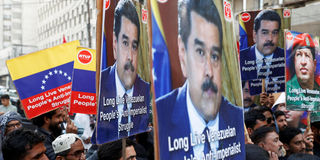
The operation involved air strikes and special forces and was greeted with celebrations among some Venezuelan opposition figures, while provoking condemnation from governments across Latin America and beyond.

The announcement went further: Trump declared that the United States would “run Venezuela” until a “safe, proper and judicious transition” of power could occur, and that American companies would invest in and rebuild the country’s oil infrastructure.

The president even suggested the US would consider further military actions if deemed necessary. This may be the butter on this bread but a global concern emerges.

For many observers this dramatic turn raises profound questions about international law, sovereignty and the rule of law itself. Under the UN Charter, a fundamental norm of the post-World War II international order is the prohibition on use of force against the territorial integrity or political independence of any state, except in cases of self-defense or when authorised by the UN Security Council.

There is no indication that such authorisation was sought or granted in this case, and even claims of self-defense against drug trafficking, which the US may invoke, are highly contested in global legal circles.

It is expected that Washington may frame its action as self-defense, but many would also argue that this precedent weakens the charter’s central safeguards against unilateral military intervention.

The contrast with past US policy decisions adds fuel to the debate. Critics have pointed to the president’s pardon of former Honduran President Juan Orlando Hernández, who was convicted and sentenced to 45 years in prison in the United States for drug trafficking, as evidence of inconsistency in how President Trump applies his brand of justice.

If prosecuting “narco-terrorists” is a top priority, why was Hernández forgiven while another sitting head of state was seized and spirited away for trial? This inconsistency reinforces perceptions that powerful states see international law as a suggestion, often to suit geopolitical and economic interests.

Beyond legal theory, the practical implications are stark for weaker states around the world. For years, smaller nations have watched as powerful states intervene, directly or indirectly, in domestic affairs when strategic or economic interests are at stake.

Whether in the Middle East, Africa or Latin America, the threat of military action or economic coercion can overshadow diplomatic engagement, eroding the very principles of sovereign equality that are supposed to underpin the international system.

The US move in Venezuela recalls past interventions, such as the 1989 invasion of Panama to depose Manuel Noriega. Yet in the modern era it sets a potentially broader precedent of a great power targeting a hostile leader and announcing governance of another state until its own preferred outcome is met.

For weaker countries, such developments send a chilling message of how feeble their sovereignty is. It may be upheld in theory, but in practice it can be overridden by those with military and economic might.

When international law is treated as advisory rather than binding for powerful nations, it undermines confidence in global institutions designed to maintain peace and equitable order.

The result is a fractured system where justice and human rights are honoured unevenly, and the powerful are perceived to operate above the rules they often demand others follow.

The effects are not only legal and diplomatic but also profoundly psychological. Nations that lack strong defenses or alliances may feel vulnerable to external pressure under the guise of anti-crime, anti-terror or economic development campaigns.

This dynamic deepens global inequalities and reinforces a world where might often makes right. It is no wonder several countries are looking to have nuclear weapons as the ultimate deterrence from foreign interference.

After all this dust settles, the US capture of Nicolás Maduro and its aftermath pose a fundamental question for international governance. Whether international law exist as a set of enforceable norms binding on all, or merely as a suggestion for powerful nations to observe when convenient.

The world’s response in the coming days and months will be a critical barometer of how much existing international order can withstand such tests and direct assault of its core principles before it crumbles.

The writer is a Strategic Communication and International Relations Professional.

PAYE Tax Calculator

Note: The results are not exact but very close to the actual.