Galana–Kulalu food dream taking root

The Galana-Kulalu food security project, which has officially ended its trial phase and transitioned into large-scale maize production.

Photo credit: Wachira Mwangi | Nation Media Group

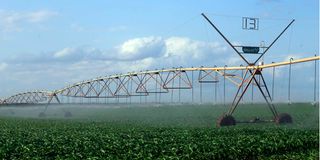
Last week, I stood on the Galana–Kulalu plains, and for a moment, I simply breathed it in, thousands of acres of maize, lush and swaying under the coastal sun. This was not just a view; it was the physical proof that the long-delayed promise is finally alive.

When the Galana–Kulalu Food Security Project was launched in 2013, the ambition was audacious: turn 200,000 acres of semi-arid wilderness into a breadbasket capable of feeding the nation.
The vision was inspiring, but its early years were marked by slow progress. Skepticism took root. To some, it became a cautionary tale of grand dreams that fail to materialise.

But Kenya’s story has never been one of surrender. Ours is a nation defined by resilience, and the belief that delay does not mean defeat.

And today, that belief is bearing fruit on the very soil where so many once saw only dust and doubt.

My visit, alongside Engineer Kefa Seda, Director General of the Public–Private Partnership (PPP) Directorate, and hosted by my colleague, the Principal Secretary for Irrigation, CPA Ephantus Kimotho and the National Irrigation Authority’s Chief Executive Officer, Eng Charles Muasya, offered more than a tour. It was a front-row seat to transformation in motion.

The centre-piece is a 600,000m³ water reservoir that serves as a sedimentation basin, capable of irrigating 20,000 acres with reliability and precision.

This milestone alone has already drawn Sh12.5 billion in private sector investment, earmarked for modern grain storage facilities, expanded irrigation systems implemented by the National Irrigation Authority, and farm roads to speed produce from field to market.

Under this revitalised PPP model, the first 20,000 acres will be brought under irrigation. On average, each acre will yield 70 bags of maize per year, that is 1.4 million bags annually, valued at nearly Sh5.6 billion.

These figures are not abstract statistics: they represent meals on the table, stable prices in the market, and income in the pockets of Kenyan farmers.

The Galana–Kulalu is an economic game-changer. Every additional tonne of maize we grow here means fewer imports.

This translate to saving billions in foreign exchange, strengthening the shilling, and shielding ordinary Kenyans from the instability of global commodity prices.

Fewer emergency imports also free up valuable budget space, money we can channel into hospitals, classrooms, roads, and other nation-building priorities.

Yet even these gains are only the beginning. The larger Galana–Kulalu block holds 1.5 million acres suitable for irrigation.

Fully realised, this potential could transform rural Kenya: raising farm incomes, supporting agro-processing industries, creating thousands of jobs, and boosting export earnings.

This is the very essence of the Bottom-Up Economic Transformation Agenda, growth that is inclusive, sustainable, and driven by the productivity of our people.

So far, progress is already visible. Phase 1B, covering 1,700 acres, is underway, bringing the total under seed maize cultivation to 3,200 acres by December 2025.

Plans are underway to expand to 4,500 acres next year, steadily building towards the 20,000-acre target. Beyond maize, a landmark partnership between the private sector, the National Irrigation Authority, and the Agricultural Development Corporation is exploring the development of 180,000 acres into diversified agricultural ventures, from fodder production to meat value chains.

This will be anchored by a proposed 306 million m³ dam, designed to irrigate 200,000 acres through a 60-kilometre canal system.

The secret to this turnaround not only lies on the land or water, but also in the way the project is delivered. By combining private sector efficiency and capital with government oversight and community participation, we are reducing risks, speeding up delivery, and ensuring that the benefits are both scalable and sustainable.

Supporting infrastructure is another vital piece of the puzzle. The ongoing construction of the Galana bridge and the approaching feeder roads being implemented by KeRRA will guarantee smooth market access.

The planned Galana Dam will ensure a year-round water supply. These elements are not optional, they are the backbone of any serious irrigation effort.

The economic logic is undeniable. Kenya spends a colossal sum of money each year importing food, a dependence that leaves us vulnerable to price spikes, currency swings, and supply chain disruptions. Galana–Kulalu directly tackles these vulnerabilities, replacing dependence with self-reliance.

And the model is not untested. Around the world, nations like Israel, Egypt, and Morocco have transformed arid landscapes into thriving agricultural hubs. They did it with modern irrigation practices, crop diversification, and smart market integration. Kenya can do the same, and is doing it.

But Galana–Kulalu is about more than economics. It is about dignity and sovereignty. It is about ensuring that the ugali on our tables comes from maize grown in our own soil.

It is about farmers who can sell their harvests at fair prices, families who can plan their meals without fear of sudden price hikes, and communities that thrive because opportunity has taken root where it once seemed impossible.

As I gazed across those endless green fields, I did not just see maize. I saw a vision made tangible. I saw proof that when ambition is matched by discipline, when public and private hands work in unison, and when projects are anchored in accountability, there is no limit to what we can achieve.

That is the Kenya we are working toward. And with focus, discipline, and unwavering partnership, that future is not a distant dream. It is within our grasp.

Dr Chris Kiptoo is the Treasury Principal Secretary.

PAYE Tax Calculator

Note: The results are not exact but very close to the actual.