Time flies with great content! Renew in to keep enjoying all our premium content.
Prime
Data, sovereignty and new scramble for Africa
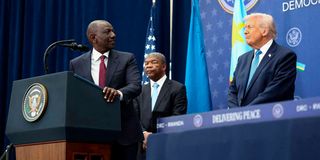
Kenyan President William Ruto speaks next to USÂ President Donald Trump and President of Angola and Chairperson of the African Union Joao Lourenc during a signing ceremony at the USÂ Institute of Peace in Washington DC, US on December 4, 2025.Â
In a move that reverberated through global health, technology, and international law, a Kenyan High Court intervened last week to suspend key provisions of a major health cooperation framework between Kenya and the US.
The order, issued by justice Bahati Mwamuye on December 11, targeted data-transfer clauses within the five-year, $2.5 billion pact, responding to a petition that warned of "permanent and irreversible harm" once Kenyan health data crossed its borders.
The court's decision illuminates a critical tension in modern development partnerships. While grant money is substantial, with the US contributing approximately $1.7 billion and Kenya covering the remainder, real, long-term value lies not in funds, but in data.
The central question is no longer just about aid, but about Kenya’s health data’s immense strategic value to AI systems, pharmaceutical pipelines, and diagnostic platforms it will train. This dispute heralds a new resource contest, echoing a painful history.
Centuries ago, maps of Africa were redrawn in distant European capitals, with euphemisms like "protection" and "civilisation" masking extraction of tangible assets like land and minerals.
Today, a new map is being drawn, not of territory, but of data flows, using the language of "frameworks" and "digital health systems." The Kenya-US Health Cooperation Framework, signed on December 4, is a prime example.
As the first of its kind under a new US global health strategy, it requires participating nations to share pathogen-related data, including biological specimens and genetic sequences, with American authorities.
While rapid information sharing is essential for global public health, the agreement's fine print raises profound questions about governance.
Where will this data be stored? Who will control its reuse? And what happens when it fuels creation of proprietary vaccines, diagnostics, and AI-driven surveillance tools far beyond Kenyan oversight?
These are precisely the concerns that prompted the Consumer Federation of Kenya and Senator Okiya Omtatah to file separate court petitions, arguing the deal was rushed and bypassed necessary parliamentary scrutiny.
To grasp the stakes, one must understand why African health data is a scientific and commercial asset of extraordinary value. Because human life originated in Africa, its populations possess more genetic diversity than those of any other continent on earth.
This genetic richness, shaped by millennia of co-evolution with pathogens like malaria and HIV, holds keys to understanding human immunity, metabolism, and drug response.
Indeed, even small genomic studies in African populations have uncovered millions of previously unknown genetic variants, yielding more novel disease associations than larger studies in European populations.
Yet, individuals of African ancestry remain severely underrepresented in global genetic and clinical datasets. As a result, many AI-powered diagnostic tools and precision medicines, calibrated on other populations, can perform poorly and sometimes dangerously when applied to African patients.
This is not a matter of charity, but rather a market imperative. Recognising this gap, a consortium led by Meharry Medical College, and backed by $80 million from pharmaceutical giants like AstraZeneca and Roche, is racing to build the world's largest African-ancestry genomic database.
The goal is not altruism, but pursuit of biological insights that other datasets simply cannot provide. Intellectual property that emerges, such as patents on drug targets, proprietary algorithms, and precision medicine protocols, will belong to whoever trains their models on this data first.
Viewed through a financial and legal lens, the Kenya-US framework represents a case of incomplete technology transfer. The agreement, for instance, lacks explicit guarantees of co-ownership for intellectual property derived from Kenyan biological materials.
It includes no requirements for AI models trained on Kenyan data to be deployed locally, nor does it secure preferential pricing on any resulting medical products for the Kenyan people. Crucially, benefit-sharing terms are deferred to future "subsidiary agreements," meaning Kenya could export its valuable data for years before securing any equity in innovations it helps create.
This dynamic is what scholars’ term "data colonialism." As Kenyan commentator Nelson Amenya noted, the pattern is troublingly familiar: a foreign power identifies valuable raw material, extracts it with minimal upfront compensation, processes it abroad, and sells the finished product back to the source.
Nearly 50 civil society organisations echoed this sentiment in an open letter to African heads of state, warning that such deals risk "entrenching unequal power dynamics" and undermining the continent's push for health sovereignty.
The court-mandated pause offers Kenya an opportunity to renegotiate from a position of strength. The very genetic diversity that makes African data so valuable is a powerful source of leverage. AI developers seeking to build globally relevant models cannot simply go elsewhere. A renegotiated agreement should, therefore, be built on three core principles.
First, mandatory intellectual property co-ownership. Joint ownership of patents, models, and other discoveries derived from Kenyan data must be the default, not an afterthought negotiated years later. The ethical guidelines of the H3Africa Consortium, which emphasise reciprocity and accountability, provide a clear precedent 10.
Second, clear terms for governance and deployment that confront the continent's infrastructure gap. Simply demanding "local deployment" of AI models is a hollow victory if computational infrastructure required to run them does not exist in Africa.
Without local data centres and high-performance computing, data must still be processed on foreign-owned cloud platforms, perpetuating the very dependency these agreements should seek to dismantle. A fair deal must therefore include provisions that not only govern data but also contribute to building physical infrastructure required to analyse it on African soil.
This leads to the third and most crucial principle: substantive capacity building. Funding must be directed toward creating a complete local ecosystem.
This means going beyond training technicians who upload records and instead investing in advanced training for Kenyan data scientists who can build the models, bioinformaticians who can analyse genomic data, and engineers who can manage computational resources. This is the only path to ensure tools built from Africa's data serve, and are controlled by, Africa's people.
The High Court's intervention is a powerful statement that sovereignty and consent are as vital in the digital age as they were during the era of colonial treaties.
The scramble for Africa's resources never truly ended; it has simply migrated from soil to the very code of life. The urgent question now is whether, this time, Africans will be the ones writing the rules.
Dr Jean-leah Njoroge is an AI and Innovation executive, recognized amongst the leading women influencing AI by VentureBeat and other industry organizations. She writes on data governance and technology transfer at insightsbydrjean.com.
Unlock a world of exclusive content today!Unlock a world of exclusive content today!