Africa has risen, now’s time to scale

Nigeria's president Bola Tinubu and Gabon's President Brice Clotaire Oligui Nguema attend a panel discussion during the Africa CEO forum under the theme “The Scale Imperative: Why Africa Must Embrace Shared Ownership,” at the Kigali Convention Centre in Kigali, Rwanda, May 14, 2026. 

Photo credit: Reuters

Fifteen years ago, ‘Africa Rising’ became the phrase that dominated investor roadshows and development forums. It was compelling and aspirational, but for many Africans, it often felt like a story being told from the outside looking in. The growth numbers were real, but ownership of the narrative was less certain.

What is happening now feels fundamentally different. Across boardrooms, industries, and policy circles, African business leaders are no longer waiting to be invited to the growth conversation. They are driving it. More importantly, they have skin in the game. There is a level of urgency, conviction, and accountability emerging among this generation of leaders that feels less like rhetoric and more like responsibility.
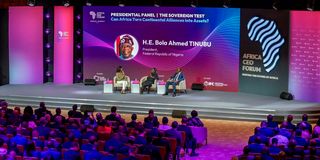

At the annual Africa CEO Forum held in Kigali last week, there was a palpable sense that the continent has moved beyond simply talking about potential. The mood was more grounded. More practical. This is not optimism for headlines. It is optimism backed by execution.

The question is no longer whether Africa will rise. Africa has risen. The real question is what scaling looks like and whether we are prepared to do what scaling demands.

One of the clearest takeaways from the discussions is that fragmentation remains one of Africa’s most expensive holdbacks. Layered approvals, inconsistent regulations, and protectionist instincts continue to undermine the scale the continent urgently requires. Alignment is not the surrender of sovereignty. It is what makes scale possible.

No economy has industrialised meaningfully without roads, ports, energy infrastructure, and digital connectivity. These are not supporting features of growth. They are the foundation on which growth stands. Integration cannot remain a legal framework on paper. Goods, services, capital, and people must be able to move more efficiently across borders if the continent is serious about building a truly interconnected commercial ecosystem. The same logic applies to industrialisation.

Africa holds more than 30 percent of the world’s mineral reserves and produces significant volumes of agricultural commodities, yet much of this value still leaves the continent in raw form. Every unprocessed cocoa bean exported is value exported. Every barrel refined elsewhere represents jobs, skills, and industrial capability built in another economy instead of our own.

Recent global supply chain disruptions made one thing clear: resilience is built through productive capacity. Therefore, industrialisation is no longer an aspirational talking point. It is an economic imperative.

The framework for deeper integration exists through the African Continental Free Trade Area. The challenge now is implementation. Fragmented markets limit investment appetite. Integrated markets fundamentally change the proposition. A continent of more than a billion people with a growing middle class is not a marginal story. It is one of the most significant commercial opportunities in the world.

Ultimately, scaling is not the absence of crisis. It is the decision, often in the middle of a crisis, to build systems, industries, and institutions resilient enough to survive beyond a single partnership, a single commodity, or a single political cycle.

Africa has risen. That chapter is written. What comes next will be defined by whether we have the discipline, courage, and coordination required to scale.

That is the work before African leaders now. Not to wait for the conditions for scale to arrive, but to create them deliberately through coordinated capital, aligned policy, infrastructure investment, industrialisation, and meaningful integration.

Few stories capture that reality more clearly than that of Maryanne Musangi and HACO Industries. When she took over the business founded by her father, the late Chris Kirubi, she inherited a company heavily reliant on a single partnership through the manufacturing of Bic pens. For decades, that one line carried the bulk of the company’s revenue. Until it didn’t.

When the partnership ended, the vulnerability of dependence was exposed almost overnight.

What followed is the real lesson. Ms Musangi did not simply mourn the loss. She questioned the structure that allowed one relationship to carry so much weight in the first place. The crisis became an opportunity to rebuild differently. HACO diversified its production lines, expanded supply chain partnerships beyond East Africa, and entered new markets with a clarity that only comes from surviving near collapse.

That story mirrors Africa’s own challenge.

For too long, much of the continent has operated within narrow dependencies. Exporting raw commodities. Relying heavily on external financing. Anchoring growth on singular partnerships and extractive arrangements. The moment one lifeline disappears, the weakness of that model becomes impossible to ignore.

The same spirit of skin in the game is visible in what Aliko Dangote is attempting across the continent. After building Africa’s largest refinery in Nigeria, Mr Dangote is now looking to replicate that scale in East Africa through a proposed multi billion dollar refinery project that could reshape the region’s energy landscape.

Reports indicate that Kenya is emerging as the preferred location because of the scale of the market, the depth of Mombasa port, and the strategic opportunity to reduce East Africa’s dependence on imported refined fuel.

What makes the Dangote story significant is not simply the size of the investment. It is the philosophy behind it. At a time when many conversations about Africa still centre on extraction, short term capital, and imported solutions, Dangote is placing long term industrial bets on the continent itself. Refineries, fertiliser plants, cement factories, logistics infrastructure. These are not symbolic investments. They are infrastructure designed to shift productive capacity back into African economies.

That is what scaling looks like in practice. Not waiting for perfect conditions. Not outsourcing belief in the continent. But deploying capital, taking risk, and building assets that outlast political cycles and market sentiment.

Another recurring theme across conversations in Kigali, was capital and, more specifically, the paradox surrounding it.

Africa does not necessarily suffer from a lack of capital. African pension funds and institutional investors control significant pools of money. The challenge is coordination. Currency volatility, fragmented regulations, short term investment thinking, and weak cross border trust continue to slow the deployment of long term capital into infrastructure and industrial projects.

The issue is not simply supply. It is alignment.

Infrastructure, industrialisation, and regional integration require patience. The returns may not appear in a single quarter, but they fundamentally reshape economies over decades. African institutional investors increasingly need to see strategic deployment of capital not as charity, but as commercial foresight.

The solution to Africa’s financing gap will not come exclusively from outside the continent. Much of it will come from coordinating and unlocking the capital already within it.However, capital without policy coherence is ambition without structure.

One of the clearest takeaways from the discussions, is that fragmentation remains one of Africa’s most expensive hold backs. Layered approvals, inconsistent regulations, and protectionist instincts continue to undermine the scale the continent urgently requires. Alignment is not the surrender of sovereignty. It is what makes scale possible.

No economy has industrialised meaningfully without roads, ports, energy infrastructure, and digital connectivity. These are not supporting features of growth. They are the foundation on which growth stands. Integration cannot remain a legal framework on paper. Goods, services, capital, and people must be able to move more efficiently across borders if the continent is serious about building a truly interconnected commercial ecosystem.The same logic applies to industrialisation.

Africa holds more than 30 percent of the world’s mineral reserves and produces significant volumes of agricultural commodities, yet much of this value still leaves the continent in raw form. Every unprocessed cocoa bean exported is value exported. Every barrel refined elsewhere represents jobs, skills, and industrial capability built in another economy instead of our own.

Recent global supply chain disruptions made one thing clear: resilience is built through productive capacity. Therefore, industrialisation is no longer an aspirational talking point. It is an economic imperative.

The framework for deeper integration already exists through African Continental Free Trade Area. The challenge now is implementation. Fragmented markets limit investment appetite. Integrated markets fundamentally change the proposition. A continent of more than a billion people with a growing middle class is not a marginal story. It is one of the most significant commercial opportunities in the world.

Ultimately, scaling is not the absence of crisis. It is the decision, often in the middle of crisis, to build systems, industries, and institutions resilient enough to survive beyond a single partnership, a single commodity, or a single political cycle.

That is the work before African leaders now. Not to wait for the conditions for scale to arrive, but to create them deliberately through coordinated capital, aligned policy, infrastructure investment, industrialisation, and meaningful integration.

Africa has risen. That chapter is already written.What comes next will be defined by whether we have the discipline, courage, and coordination required to scale.

PAYE Tax Calculator

Note: The results are not exact but very close to the actual.