Private cars to be barred from JKIA main terminal in upgrade plan

Jomo Kenyatta International Airport

Motorists being subjected to security checks at the entrance of the Jomo Kenyatta International Airport in Nairobi.

Photo credit: File | Nation Media Group


Private cars dropping travellers at the Jomo Kenyatta International Airport (JKIA) will temporarily not be allowed into the main terminal area, as temporary parking spaces are hived off to create room for expansion aimed at immediately increasing capacity.
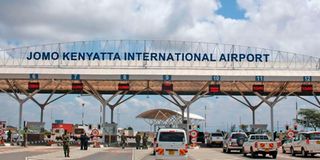
Consultants from Sidara, the private firm hired to draw up a masterplan for the revamp of the country’s main airport, have proposed that only airport taxis and ride-hailing cabs be allowed into the terminal area under the new plan.

This will free up the temporary parking spaces, creating room for expansion of the terminal and increasing the airport’s capacity from the current 7.5 million passengers per year to 12 million.

“This temporary parking [inside the main terminal area] will now only be used by airport taxis and digital taxis, while private cars will be allowed to pick up or drop off outside,” said a Sidara representative during a stakeholder engagement forum for the masterplan.

Under the new plan, private cars will drop off or pick up travellers near the long-term car park, instead of inside the circular terminal area, where they have traditionally been allowed to operate.

The freed-up space will be used to expand the terminals, creating additional check-in and security screening points to reduce the long queues currently experienced due to strained capacity.

Proposed changes 

To avoid congestion, the proposal includes merging Terminals 1B and 1C into one larger facility to handle all international departures by all airlines, including Kenya Airways and its SkyTeam partners.

International arrivals will be moved from Terminal 1E, which is set to close, to Terminal 1A, currently reserved for the national carrier KQ and its partners such as KLM and Emirates.

The closure of Terminal 1E is expected to create room for the expansion of Terminal 1D, currently the most overstretched facility, which will be used solely for domestic departures and arrivals.

According to Sidara’s analysis, Terminal 1D handled about 1.8 million passengers last year — more than three times its designated capacity of 500,000 — making it the most strained terminal. Terminal 1A, used by KQ and its partners, was also overstretched, having handled four million travellers last year, nearly double its designed capacity of 2.5 million. Terminals 1B and 1C, used by other international carriers, were the only ones operating within their intended capacity.

The optimisation measures form the first phase of a broader plan to transform JKIA into a world-class airport, complete with an Airport City and a special economic zone (SEZ) within its precincts.

This initial phase is intended to create immediate additional capacity, buying time for the development of a new terminal and runway that would boost the airport’s total capacity to 22.3 million passengers by 2029.

The move comes as the Kenya Airports Authority (KAA) plans to roll out its own ride-hailing app for airport taxis, to rival Uber and Bolt in efforts to boost efficiency at the terminal.

The platform will initially focus on taxi bookings, with an option to schedule rides in advance, but is designed to expand into a broader airport services hub spanning lounge bookings and online shopping.

“The overall objective is to design, develop, deploy, and support an official JKIA Airport Digital App, initially focused on regulated taxi booking and ground transport management, and architected as a modular, extensible platform capable of supporting multiple airport commercial and operational services,” said in a disclosure as it kicked of a search for a consultant to develop the app.

According to plans, travellers will only book authorised taxis through a mobile app, a web portal, or on-site kiosks, with real-time fare estimates, vehicle tracking, and trip notifications. It will also include a dispatch engine to automatically allocate drivers, similar to how ride-hailing platforms operate, and manage queues across terminals.

Passengers exit with their valuables at the International Arrival Terminal 1A at Jomo Kenyatta International Airport (JKIA) on November 7, 2023. 

Photo credit: File | Nation Media Group

KAA says the app will create geofenced taxi ranks, a technology using GPS-based virtual boundaries to regulate taxi services by allowing airport authorities to manage, track, and restrict vehicle movements, enforce waiting rules, implement surge pricing, and automate app functionality when vehicles enter or exit designated zones.

Taxi drivers will be registered and have a mobile application linked to airport-issued credentials, allowing trip acceptance, navigation, messaging, and performance tracking. It will have in-app messaging with customers, performance monitoring, and history tracking.

“The backend shall include driver onboarding and vetting portal (PSV license, ID, vehicle docs), driver wallet, trip logs, rating system, availability status, and promotion tools,” KAA says. The platform will also integrate with mapping tools and KAA’s electronic point-of-sale system to provide detailed reporting on trips, fares, and revenues.

The authority said the platform will also support verification of drivers’ PSV licences, identification documents, and vehicle records, with reporting dashboards available to KAA and the National Transport and Safety Authority.

Follow our WhatsApp channel for the latest business and markets updates.

PAYE Tax Calculator

Note: The results are not exact but very close to the actual.